-
As 2025 draws to a close, I’ve found myself looking back on a year that was big, bold, challenging, and deeply rewarding — one of those years that leaves its mark.
January began in Bangkok, welcoming the New Year with my daughter as fireworks lit up the sky outside our hotel window. What followed was a whirlwind — magnificent temples with intricate architecture, the giant Reclining Buddha and the Golden Buddha, hands-on time with elephants at a sanctuary, the Louis Vuitton Visionary Journey exhibition, and a bus trip to the UNESCO World Heritage site of Ayutthaya, where ancient ruins quietly remind you of empires long gone.
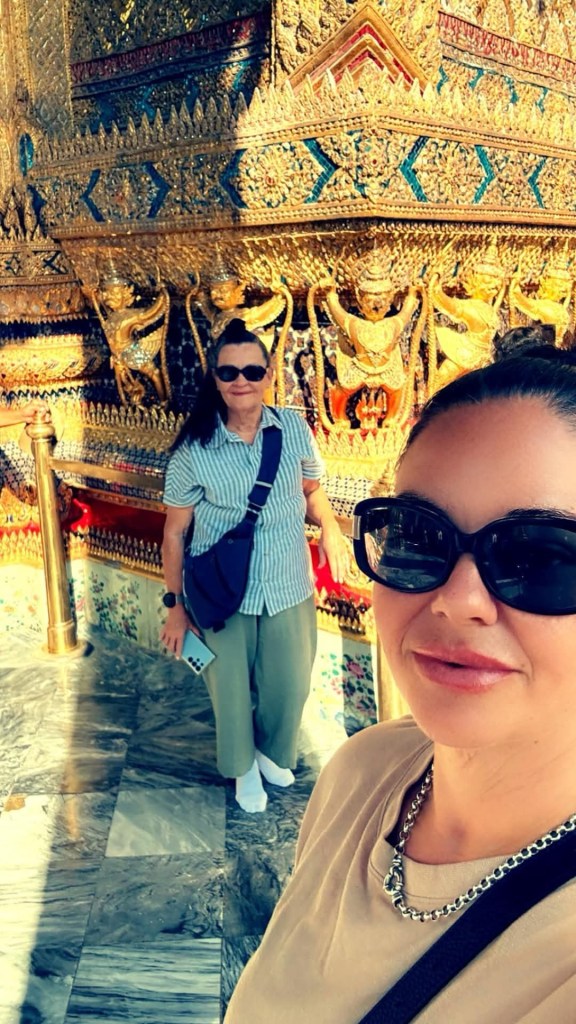
And then there were the shopping malls — vast beyond anything I’d experienced before, where seemingly anything you could imagine was for sale. Bangkok was exciting, colourful and full of life… but I’ll be honest, I didn’t miss the noise, the traffic, or the constant sensory overload that comes with a city of 18 million people.
From there, it was back home and then off to Tasmania for a few weeks with my Tassie family — a place where there is always time to stop, breathe, and reset.
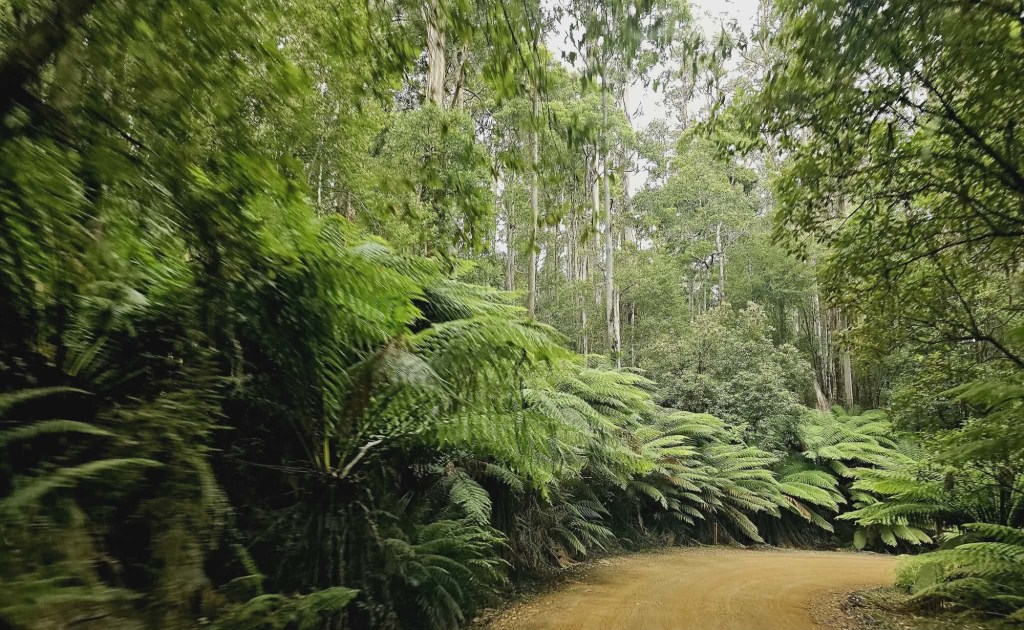
The following months were devoted to training and planning for my Camino. In late March, I set off with my two adult granddaughters, first spending a few days in Barcelona. It was everything I’d hoped for and more. The Sagrada Familialeft me speechless — if you haven’t seen it, “spectacular” doesn’t come close. Park Güell and wandering the Gothic Quarter were also highlights.
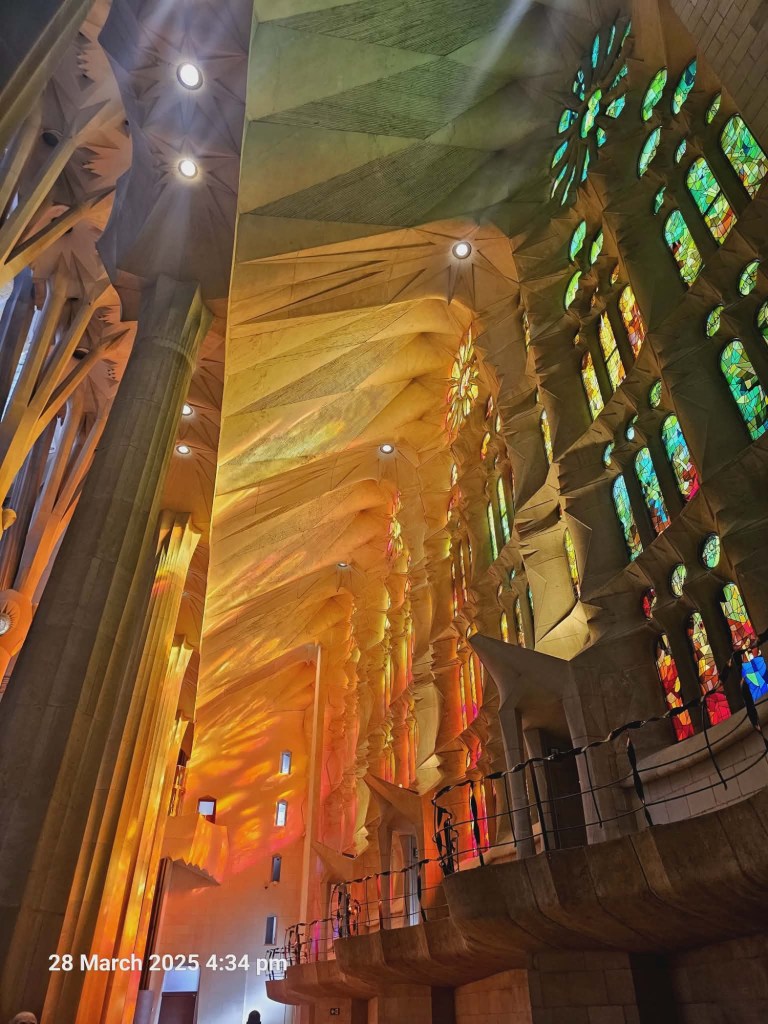
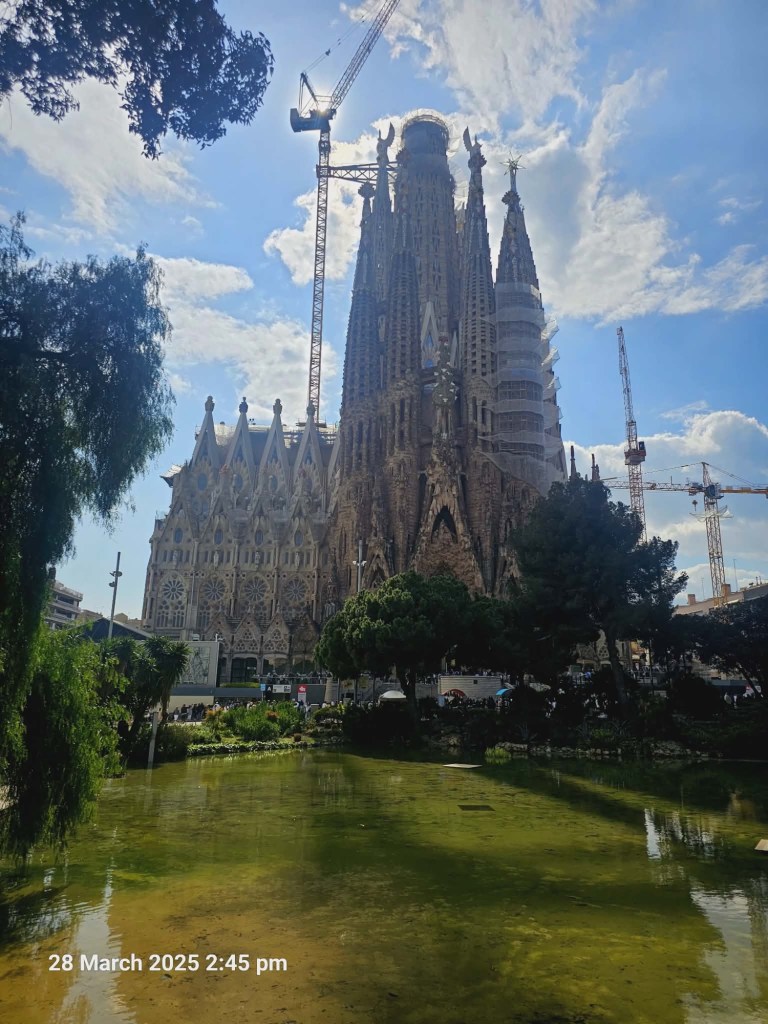
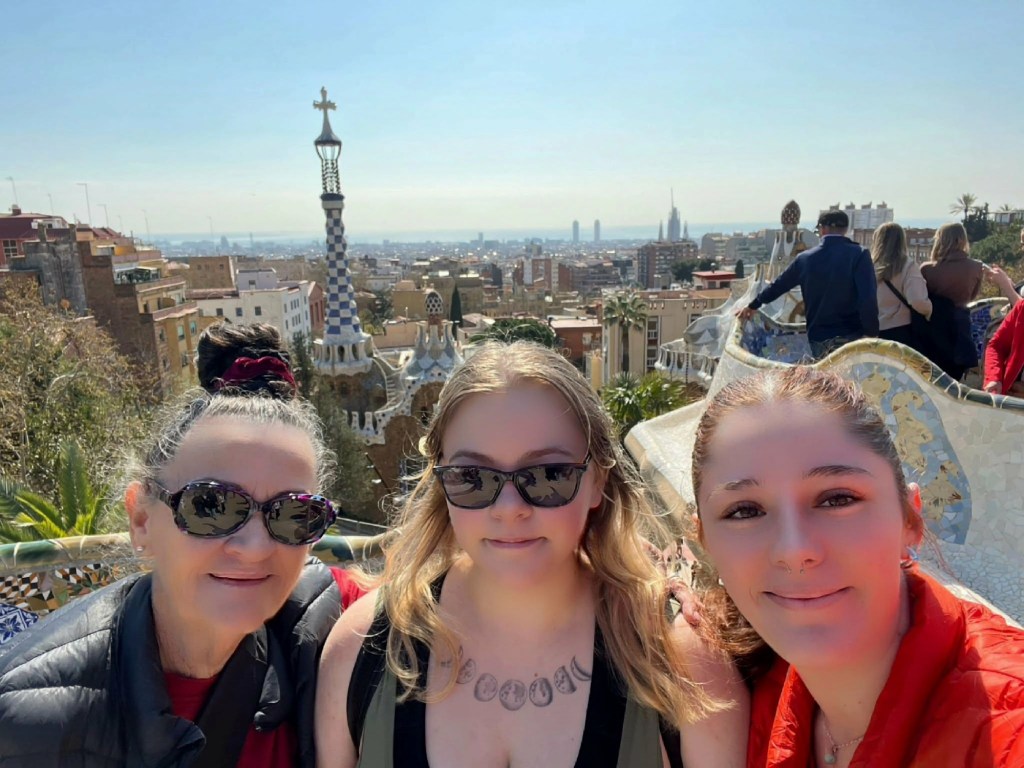
From there we travelled to Saint-Jean-Pied-de-Port, our Camino starting point. The trail over the Pyrenees had reopened the day before after winter closure. The week prior had seen perfect spring weather, and we were hopeful.
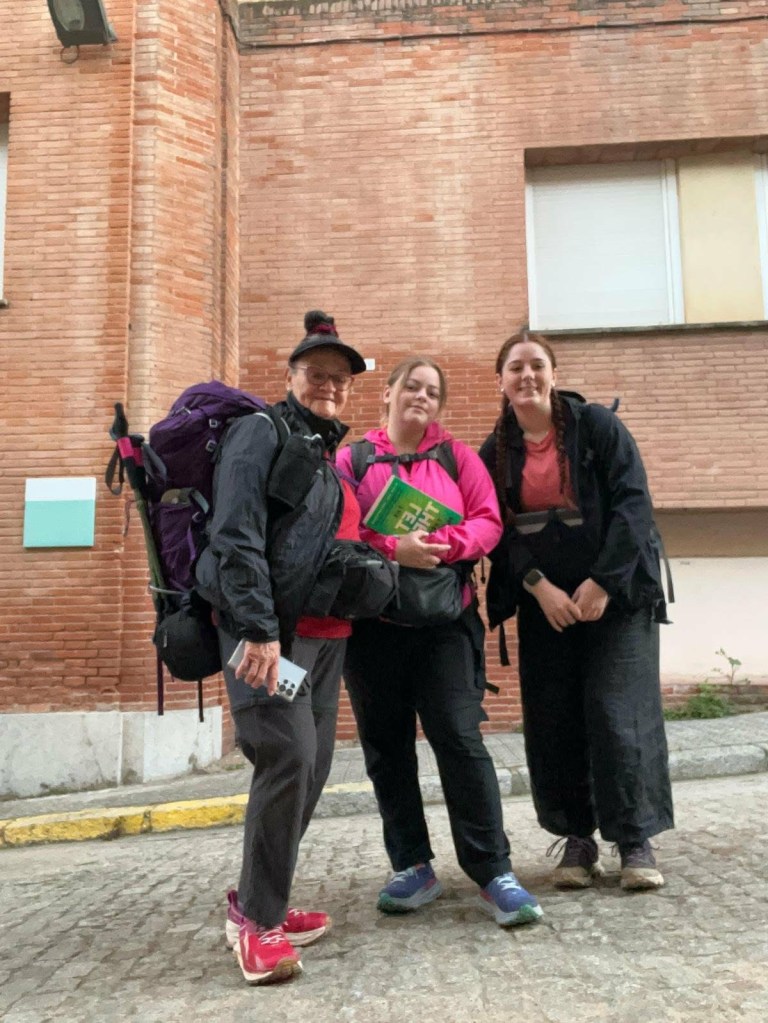
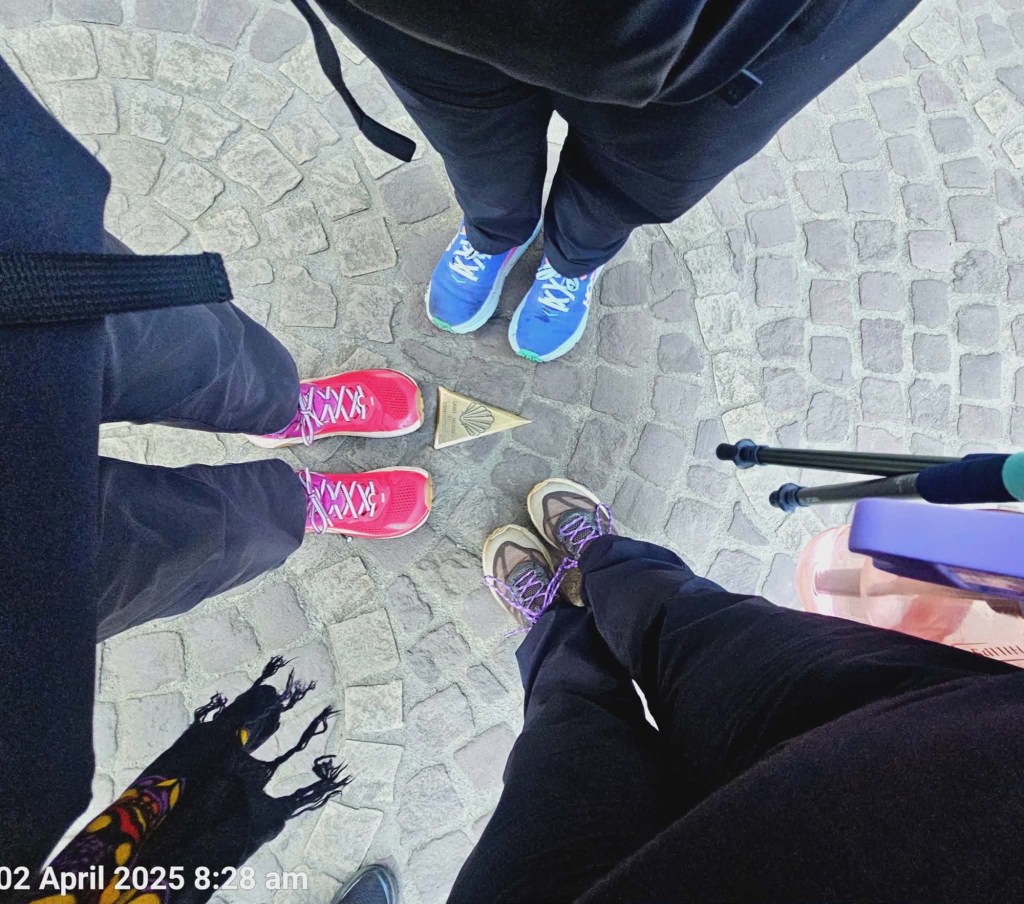
Our optimism didn’t last long.
The first day was glorious — blue skies, gentle breezes — but overnight the wind rose. Forecasts predicted 46km/h winds, which sounded manageable. What followed was a brutal reminder never to underestimate the Pyrenees. Wind gusts later recorded at 112km/h, icy rain and stinging ice pellets battered us, at times forcing us to walk backwards just to stay upright. Ponchos became parachutes, trekking poles had minds of their own, and turning back was no longer an option.
It was terrifying at moments — but we made it. Plenty of life lessons were learnt, though that’s a story for another time.
For the next five weeks, we walked across Spain, following yellow arrows and scallop shells. Walk, eat, walk, eat, sleep — repeat — for 35 days. Madness? Possibly. Life-changing? Absolutely. Years ago I was asked why I would walk a pilgrimage and I had no answer. I still don’t — except that it gets into your blood and quietly calls you back. I know there will be more Caminos in my future.
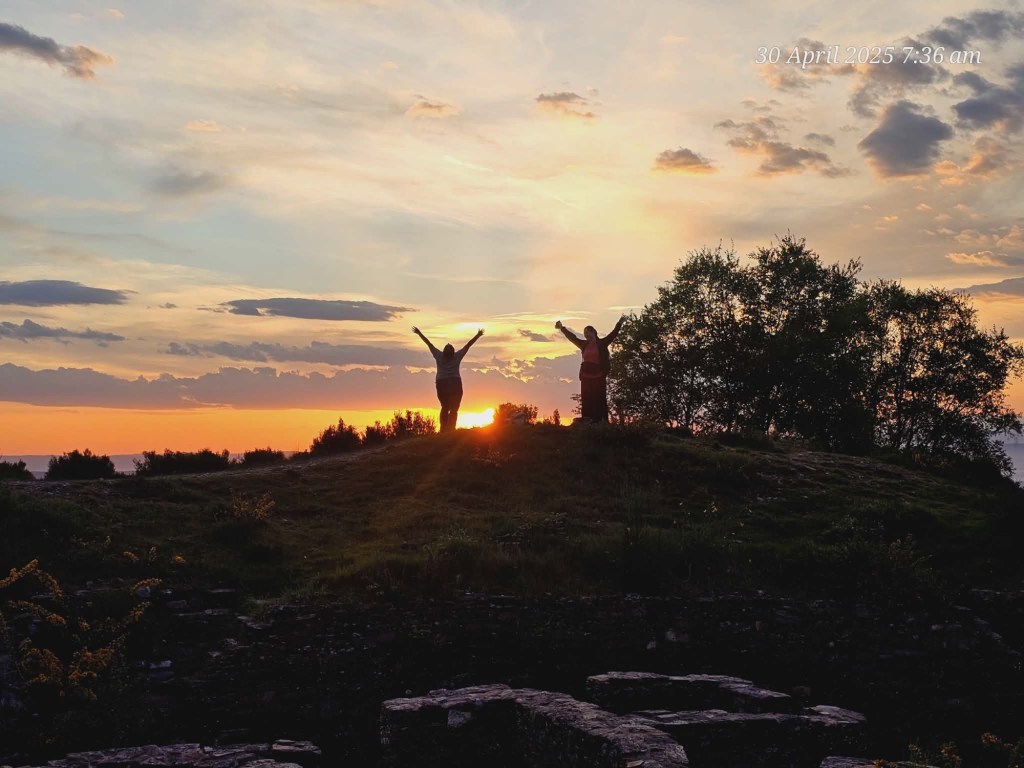
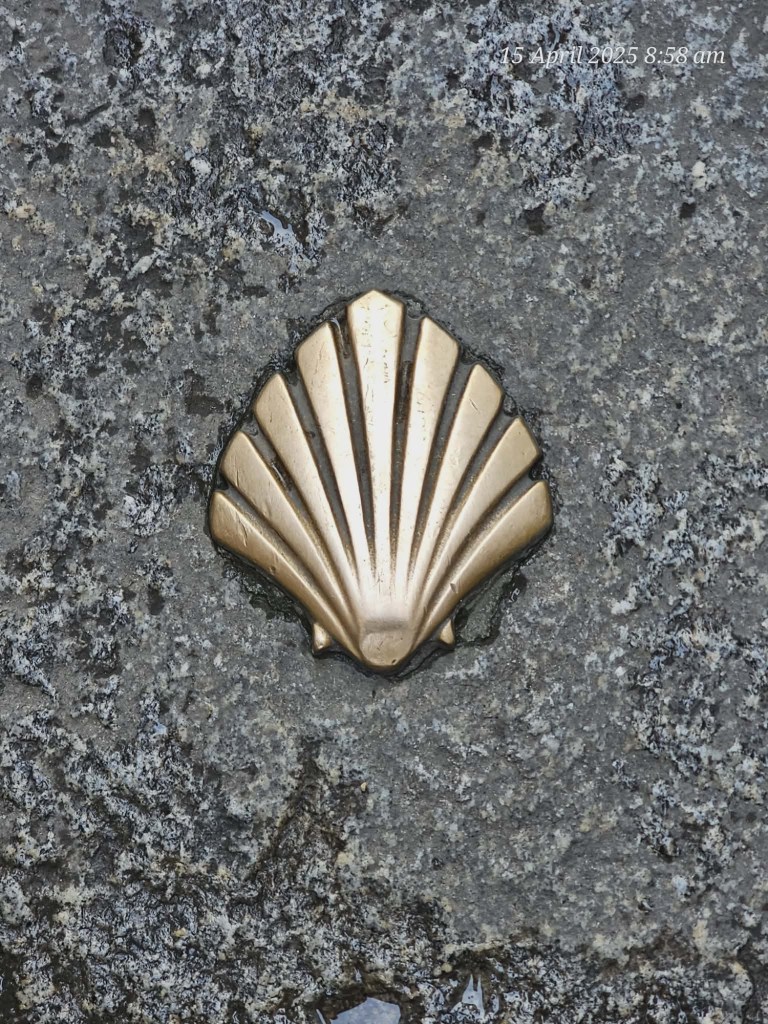
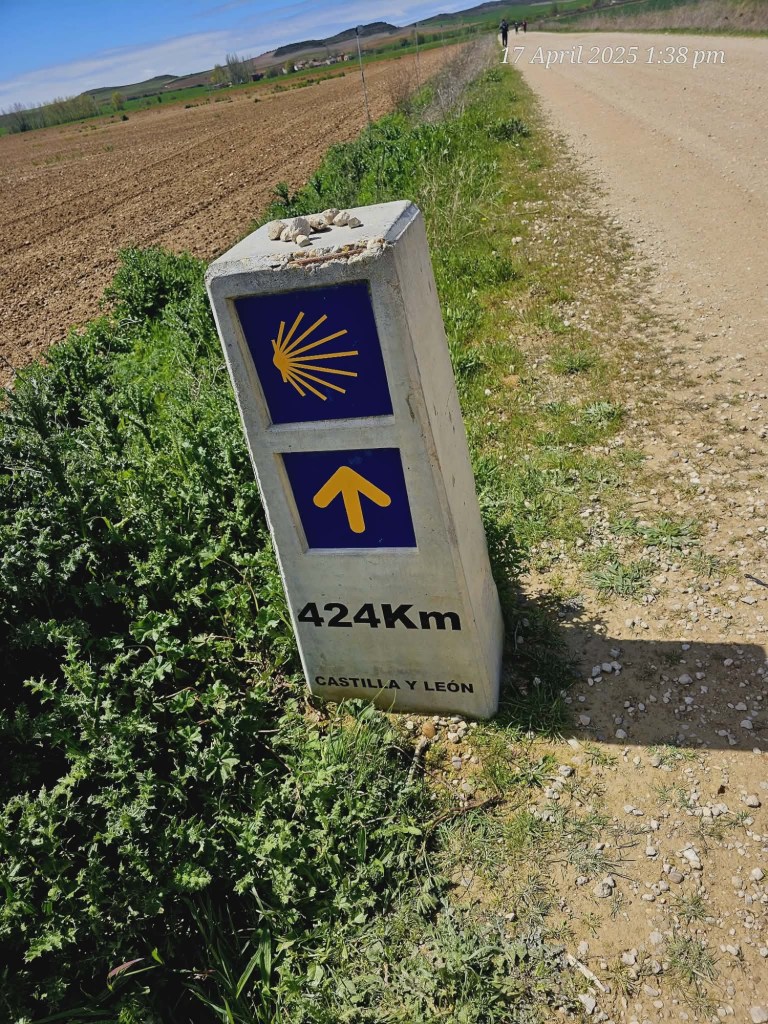
At the end we treated ourselves to a few days in Porto, Portugal behaving like tourists, late nights and sleeping in before the dreaded long haul flight home.
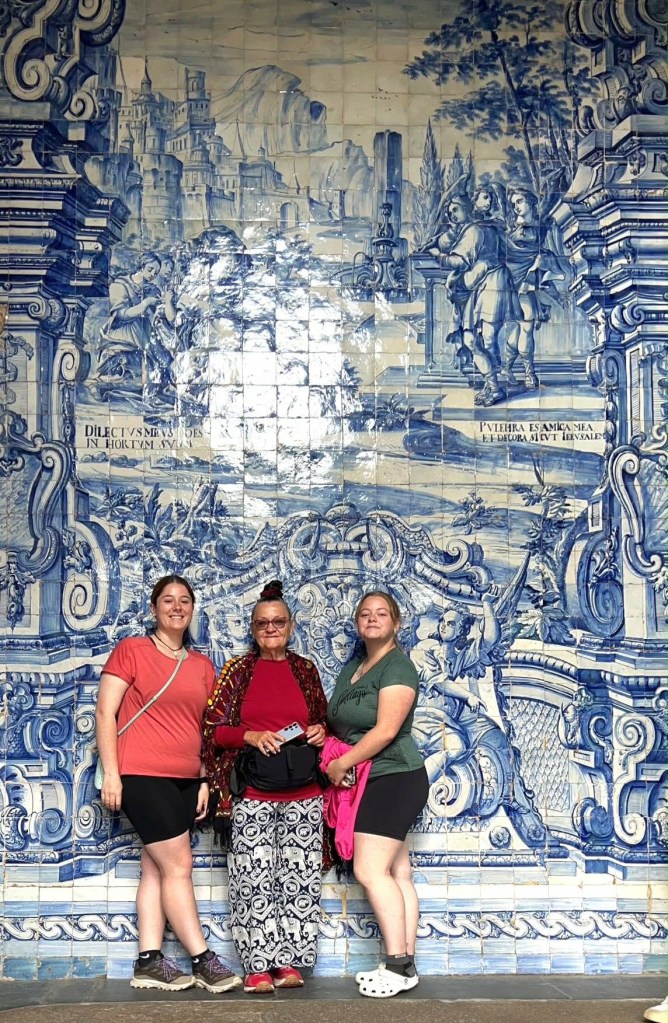
Returning home in mid-May brought the familiar post-Camino flatness as I adjusted back to everyday life. To distract myself from dreaming of Spain, I turned my attention to preparing my van for the Australian adventures planned for the rest of the year.
A family wedding also kept me distracted for a bit and gave me something else to think about.
In early September, I joined a Country Pub Tours tag-along trip — partly to test how I’d go with van life before heading off solo. Best decision ever. Travelling with about ten others, visiting historic country pubs each day, I quickly realised… I was hooked.
Soon after, I headed to Geelong to board the Spirit of Tasmania, mapping out a road trip through NSW to visit as many silo art installations as possible. It was my first long-distance solo trip in the van, and I was quietly proud that it all went smoothly.
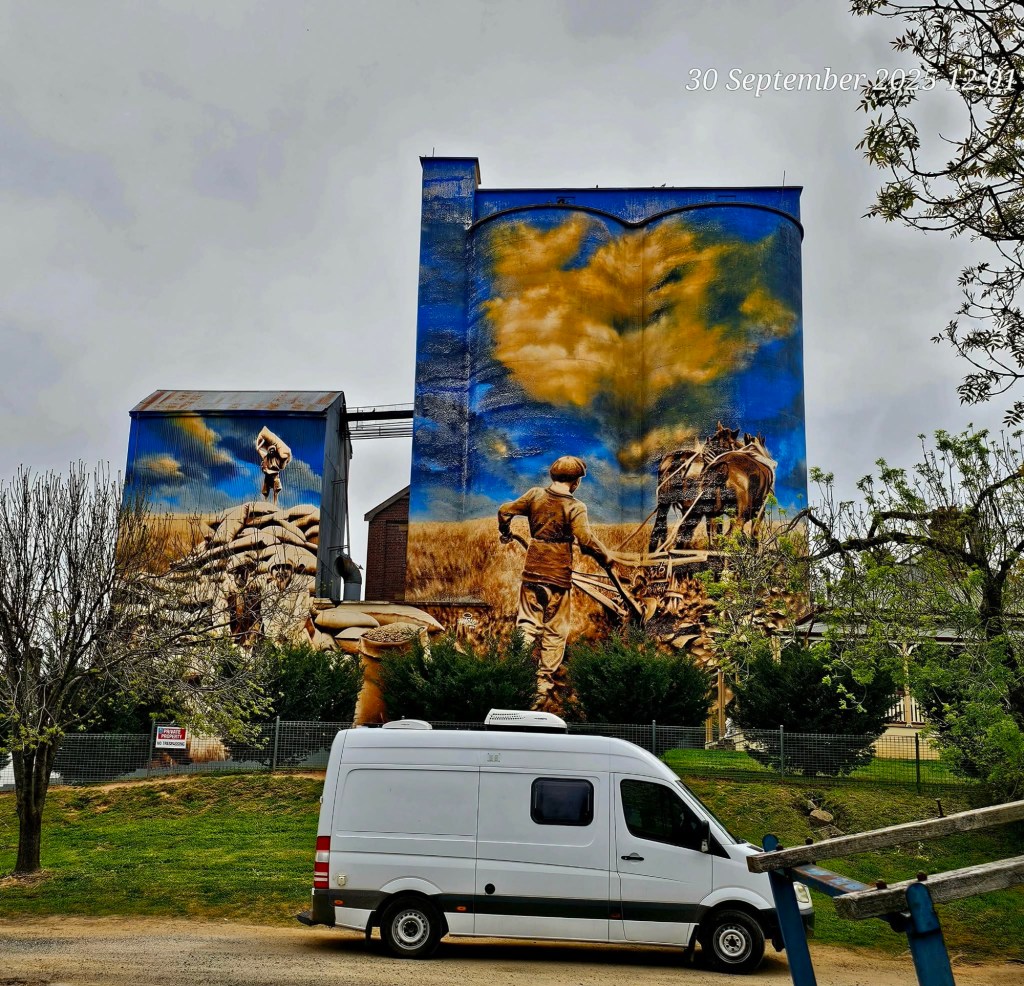
Arriving in Devonport after an overnight Bass Strait crossing, I was greeted by ferocious winds that made keeping the van on the road an adventure in itself. Tasmania, as always, had more surprises in store — including my van being off the road for several weeks. Yet another story for another time.
A hire van saved the day, and I was able to continue travelling, this time with a friend visiting Tasmania for the first time. Despite bitterly cold winds and bedding that felt like sleeping on the floor, we had an absolute ball. Highlights included spectacular beaches, turquoise waters, ever-changing landscapes — and an unforgettable Aurora Australis, with lights dancing along the horizon just for us.

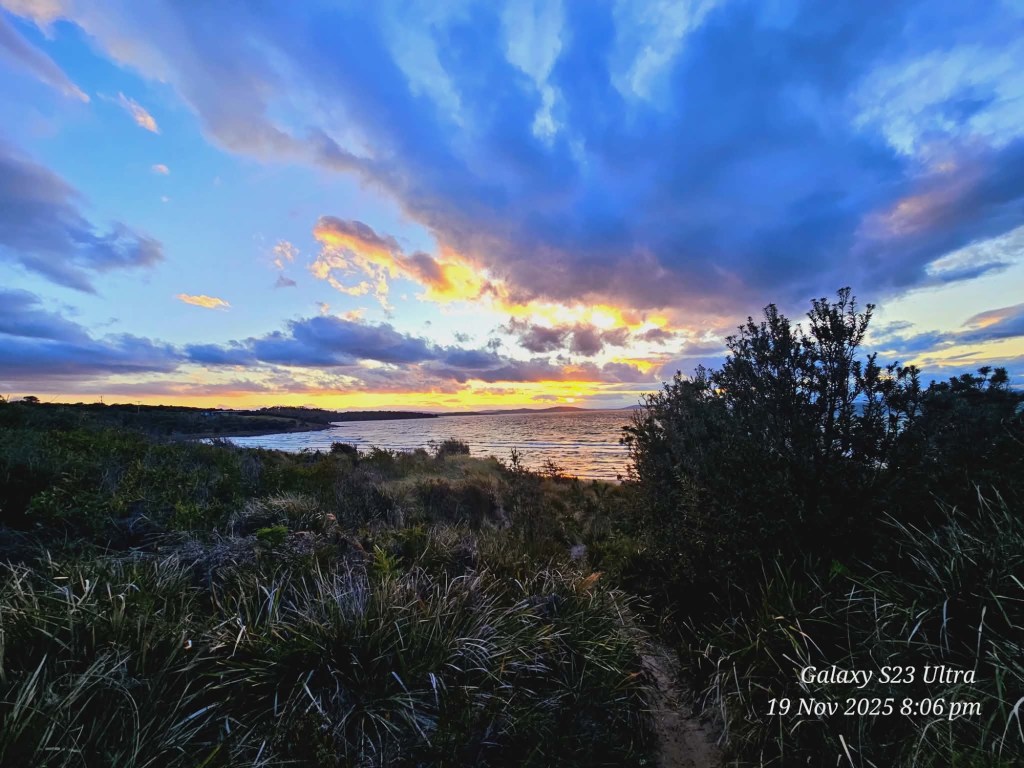
As we head into 2026, I’m back in Queensland briefly, already planning the next chapter. Tassie until April, then north through the centre to Darwin, and across to Western Australia.
If 2026 is anything like 2025, I’m ready.
-
As this journey around Tasmania comes to a close, I find myself reflecting not just on the places we visited, but on how deeply this island leaves its mark.
Tasmania is a land of contrasts — wild coastlines and gentle forests, beauty layered with brutal history, silence that speaks louder than words. Everywhere we went, stories were etched into the landscape. Convict ruins softened by moss. Memorial gardens offering peace where tragedy once unfolded. Communities shaped by hardship, resilience, fire, and flood — and still standing.
What struck me most was the human story woven through it all. The women of the Female Factories, punished for poverty, for survival, for existing on the margins of society. Their strength, defiance, and refusal to be erased echoes long after the walls that confined them. The men and women who worked the forests, the seas, the land — and the communities that continue to honour them.
And then there was the natural world.
The ocean, endlessly carving rock and reshaping the coastline. Tessellated pavements that feel almost otherworldly. Beaches that offer up new treasures each morning. The quiet thrill of searching for platypuses, the patience of waiting for an aurora that may or may not appear. These moments slow you down. They invite you to notice.Travelling this way — unhurried, open, curious — reminds me why I love the road. Even when plans change, vehicles break down, or the ground isn’t quite as firm as it looks, there is always kindness. Locals who help without hesitation. Conversations in pubs that feel timeless. Shared laughter over meals and campfires.
Tasmania doesn’t demand your attention loudly. It asks you to listen.
To sit with its stories.
To walk gently.
To remember.I leave with sandy shoes, a full heart, and a deep gratitude for this island and all it has shared. Some journeys end when you return home. Others stay with you — shaping how you see the world long after the road runs out.
This one will linger.
I am back home in Queensland for a few weeks before I head back to Tassie and all she has to offer.
My plan for the following three months is to visit some areas I have not yet seen and base myself in each area a week at a time, giving myself time to truely explore.
Watch this space…….
-
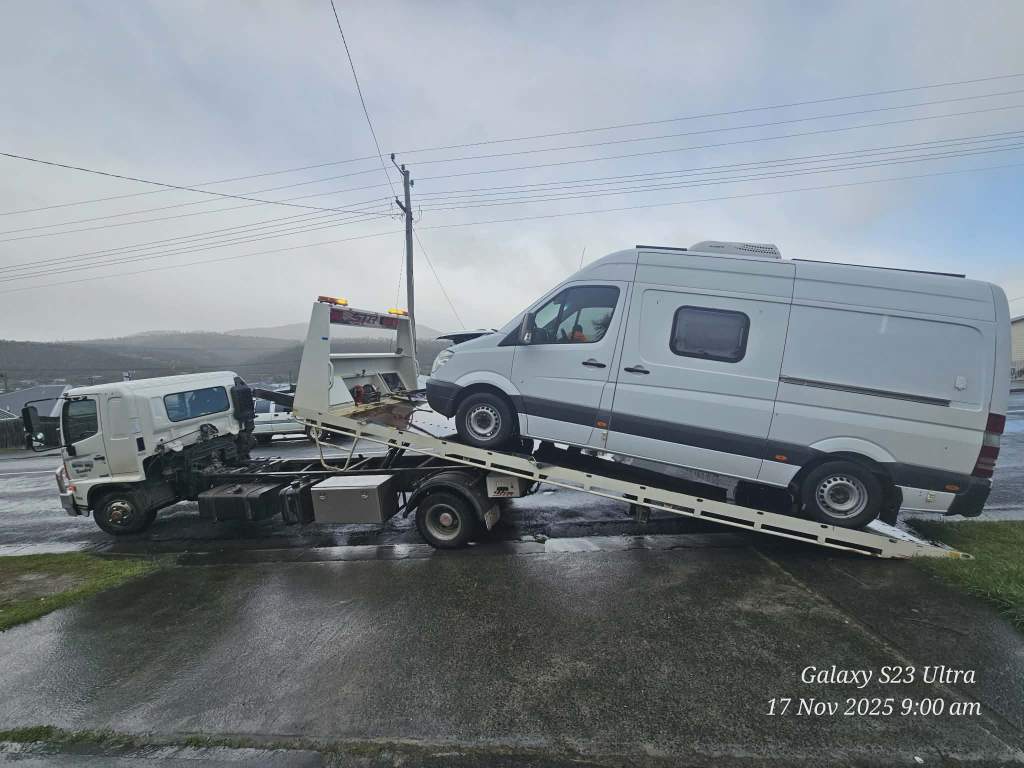
Week 4 began quietly in New Norfolk, where we spent a few days organising my van before it was collected by tow truck and taken off to the mechanics. These slower days gave us time to pause, regroup, and take a breath before continuing east.
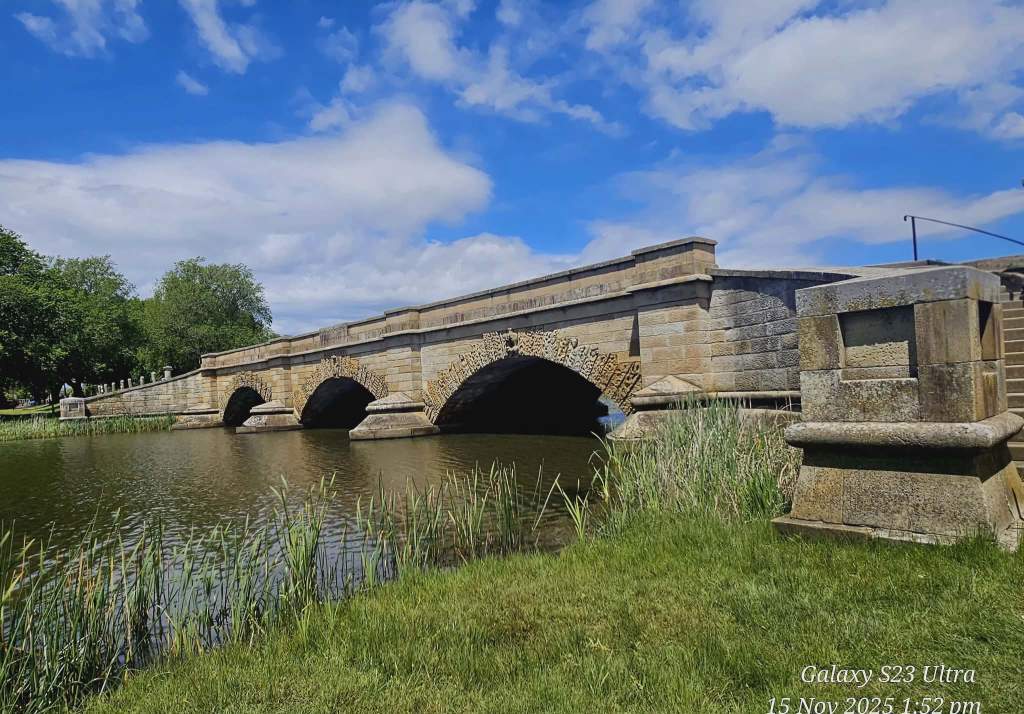
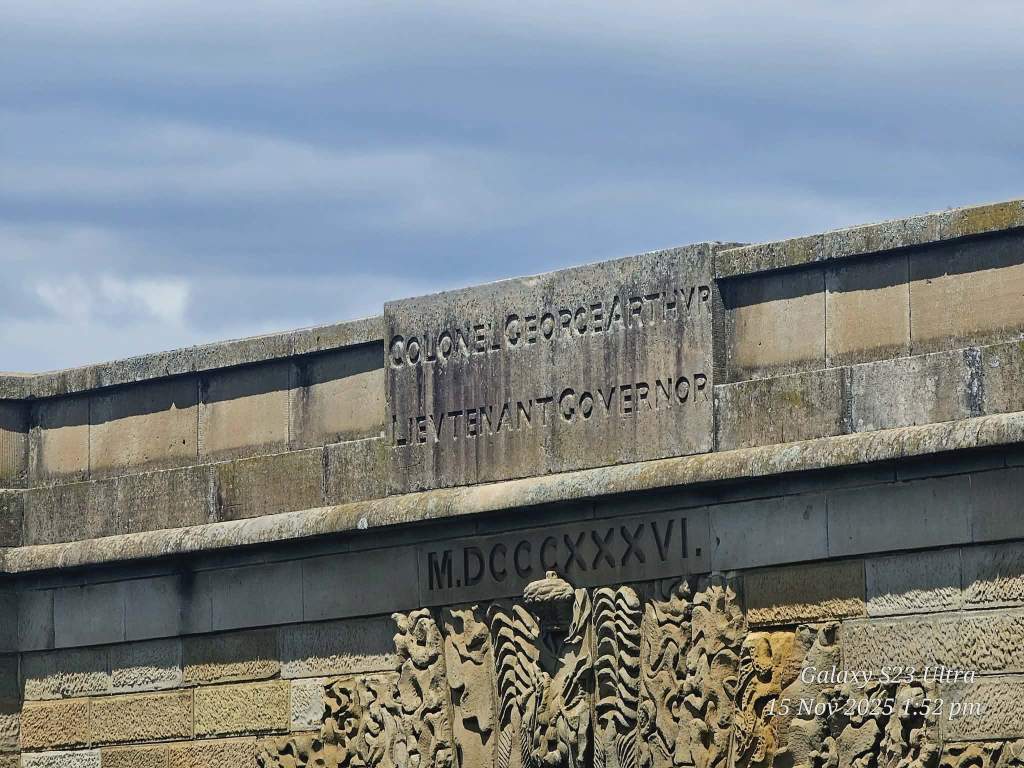
On Saturday, we set out on a day trip to the historic township of Ross. Wandering through town, it’s impossible not to feel the weight of history beneath your feet. The convict-built sandstone bridge, completed in 1836, remains one of Australia’s most remarkable colonial structures. Its 186 intricate carvings — each one symbolic — transform the bridge into a piece of living art, still carrying traffic almost two centuries later.
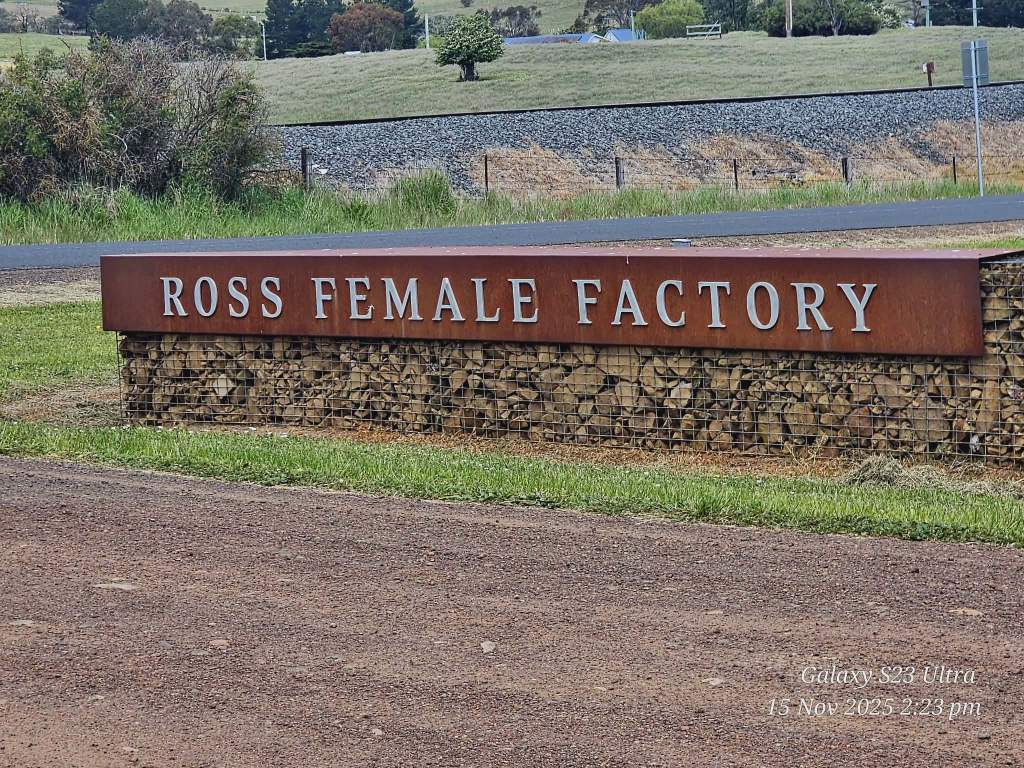
Nearby, we visited the Ross Female Factory, a former convict probation station and workhouse for women and their babies between 1847 and 1854. These places were officially intended as sites of rehabilitation, preparing women for life after incarceration. The feminist part of me couldn’t help but feel it was also deeply entwined with how women were viewed — as property, as labour, as something to be managed rather than understood.
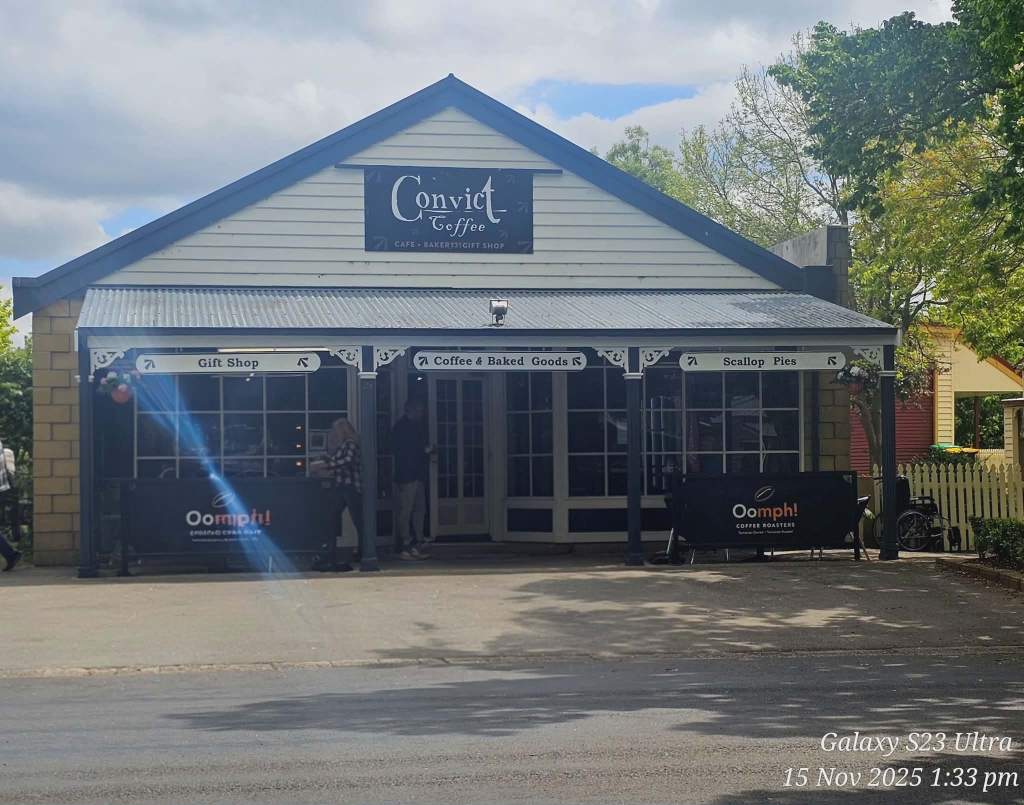
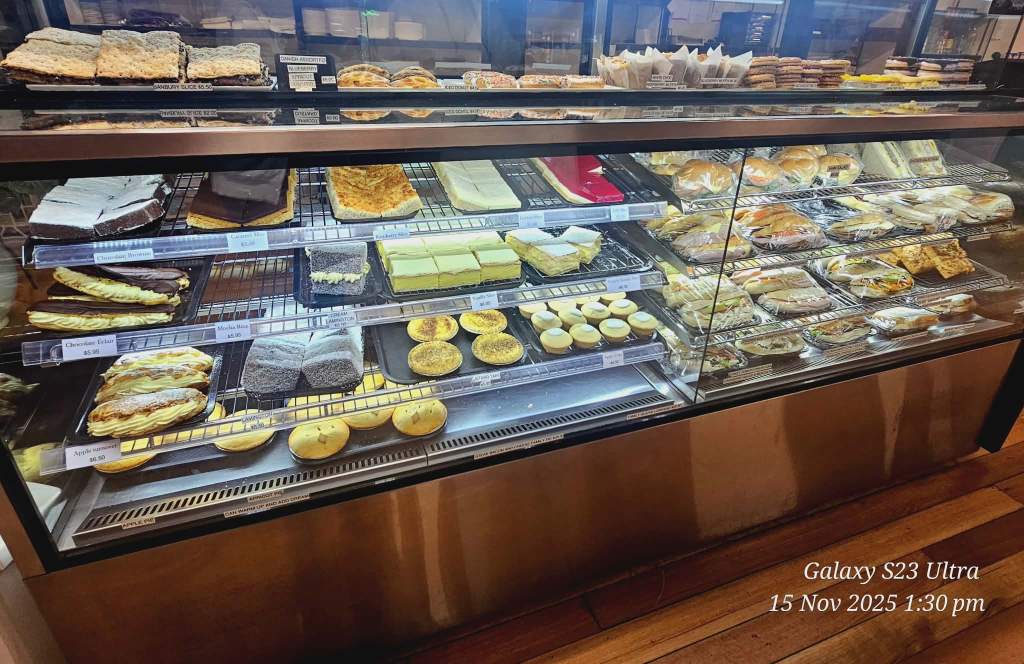
Afterwards, we enjoyed lunch at the Convict Coffee Café and Bakery — not the place most people automatically think of in Ross, but a gem nonetheless. The meal was excellent, and we couldn’t resist taking home a few decadent desserts. Definitely one for the return list.
Once the van was finally sent off on Monday, we turned our replacement vehicle toward the Tasman Peninsula.
Port Arthur & the Tasman Peninsula
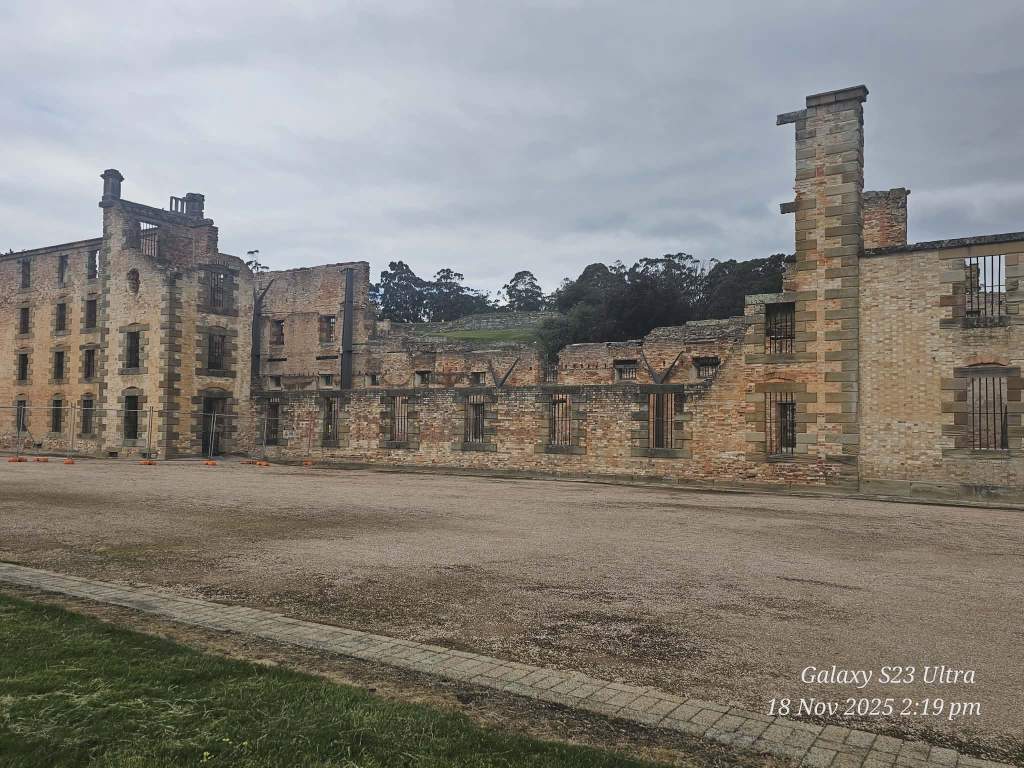
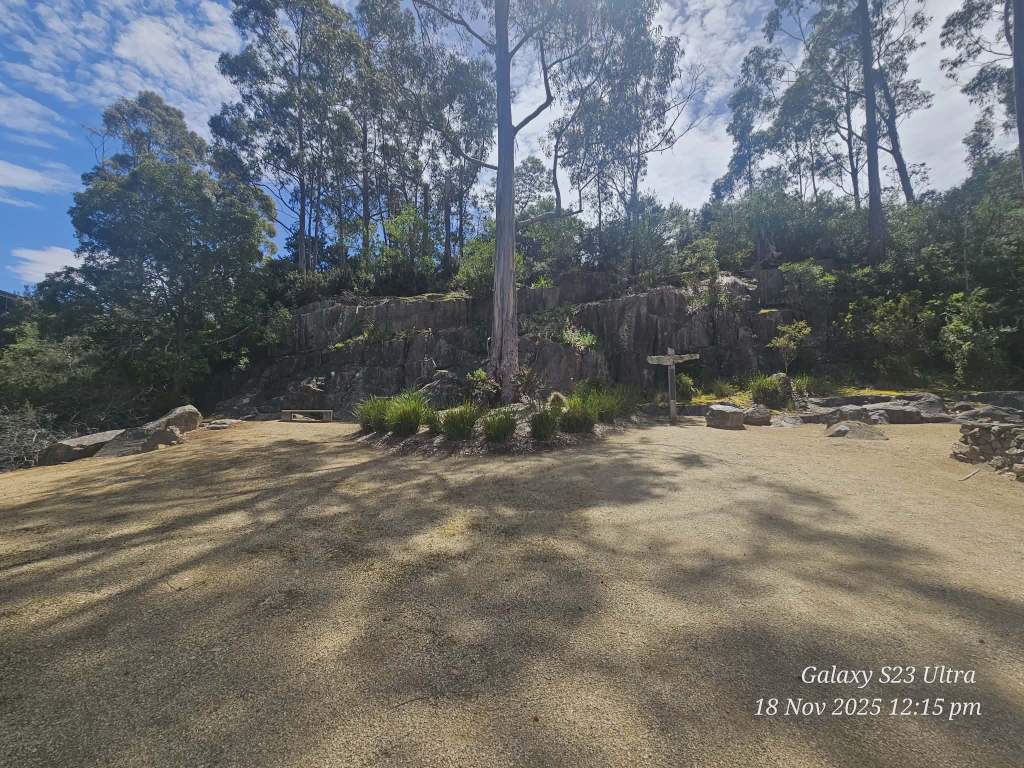
Port Arthur was next. We spent several hours wandering the site, absorbing the stories held within its walls. The memorial gardens, dedicated to the victims of the 1996 massacre, are gentle and peaceful — a place that encourages quiet reflection. Standing there today, it’s almost impossible to comprehend the events of that day when 35 innocent lives were lost.
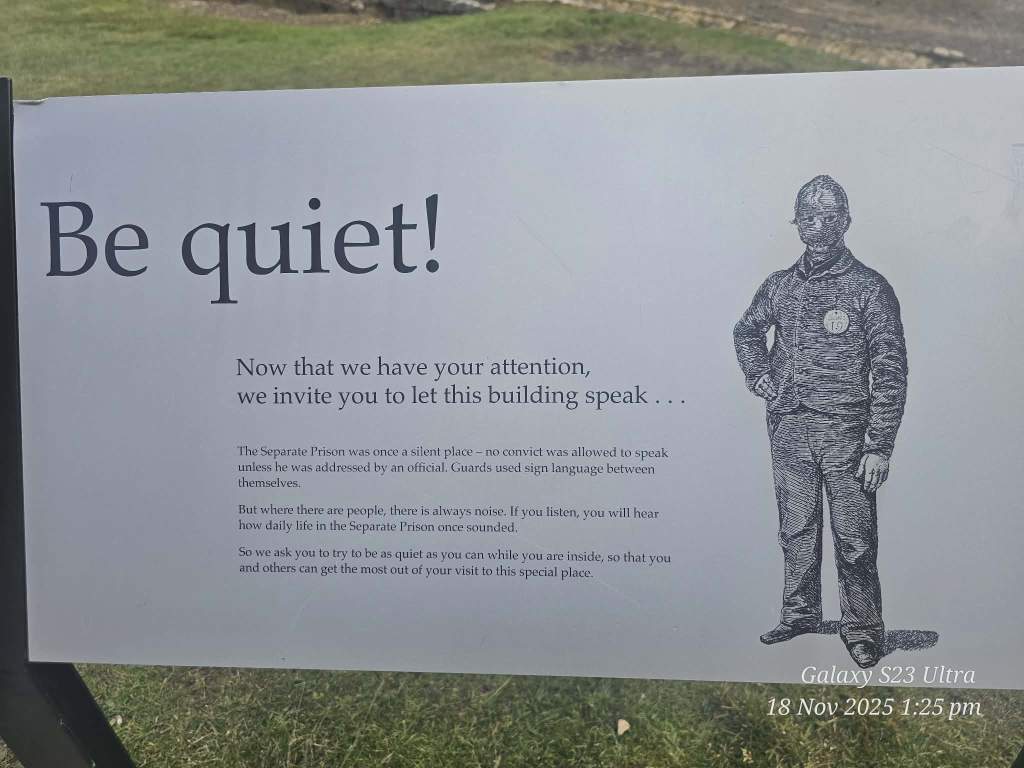
The formal gardens throughout the site are beautiful, offering a striking contrast to the brutal realities of the prison itself. Learning about the conditions endured by prisoners — prolonged darkness, enforced silence — is mind-blowing. Barbaric and deeply inhumane.
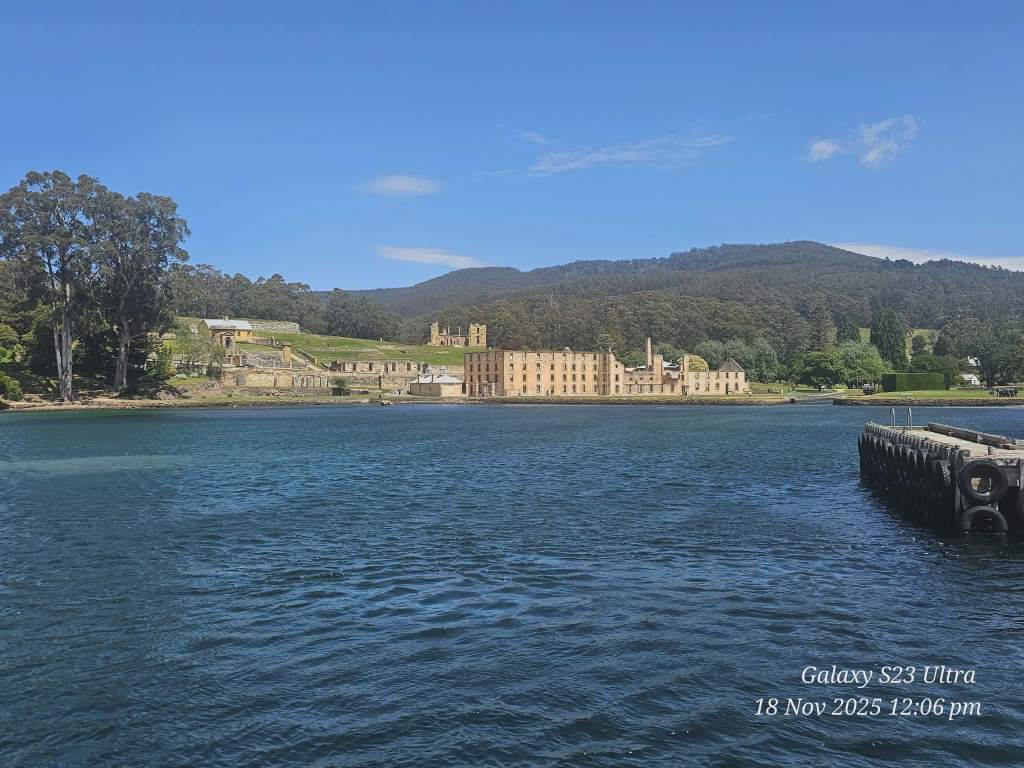
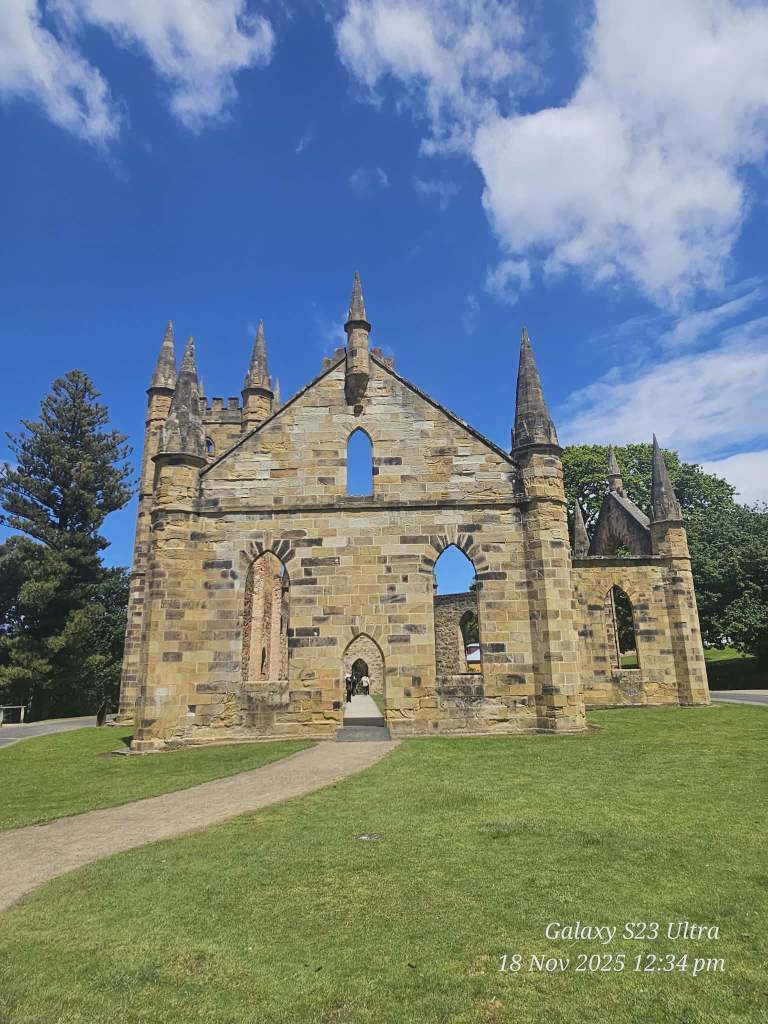
We walked up to the lookout overlooking the church ruins and took the boat tour, learning about the boys’ prison isolated on an island nearby. The intention was to separate young offenders from hardened criminals — a concept that seems compassionate on the surface, yet was still steeped in punishment and isolation.
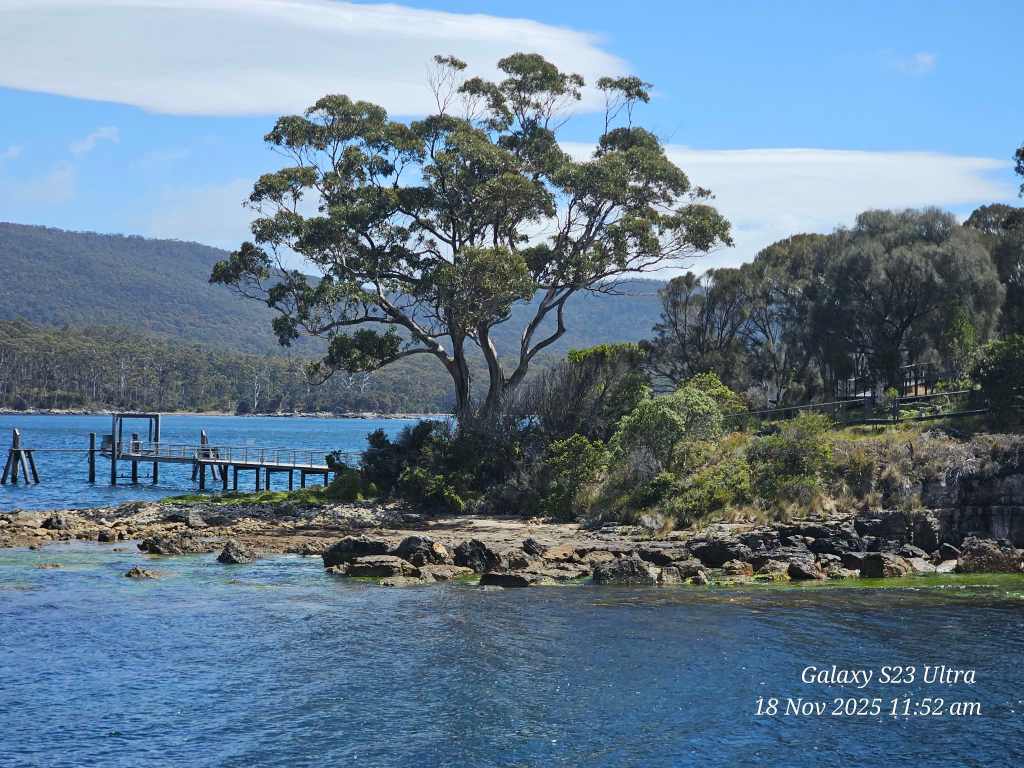
From here, we explored the area daily:
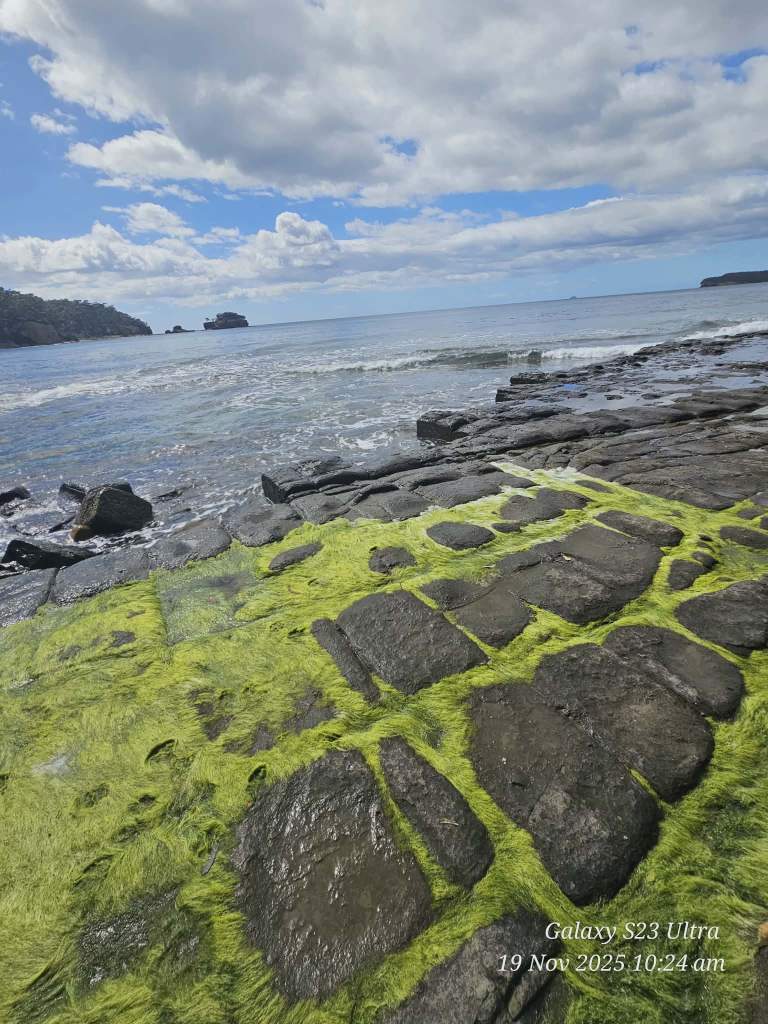
The Tessellated Pavements, Tasman National Park, Fossil Bay Lookout, Tasman Arch, Devils Kitchen, and the Blowhole.We based ourselves for three nights at Sunset Beach Campsite near Eaglehawk Neck. A peaceful, privately run site right on the water, with clean hot showers and thoughtful amenities despite having no powered sites. For $20 a night, it was hard to beat. Sunsets, birdlife, beach walks — it was the kind of place that invites you to slow down.
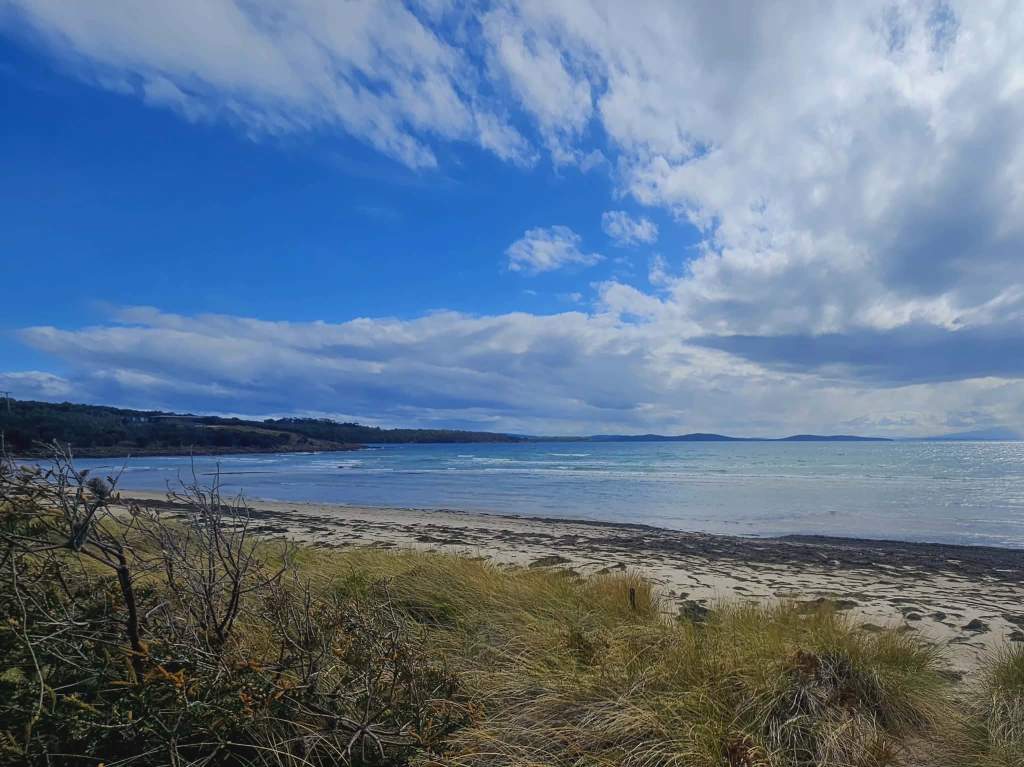
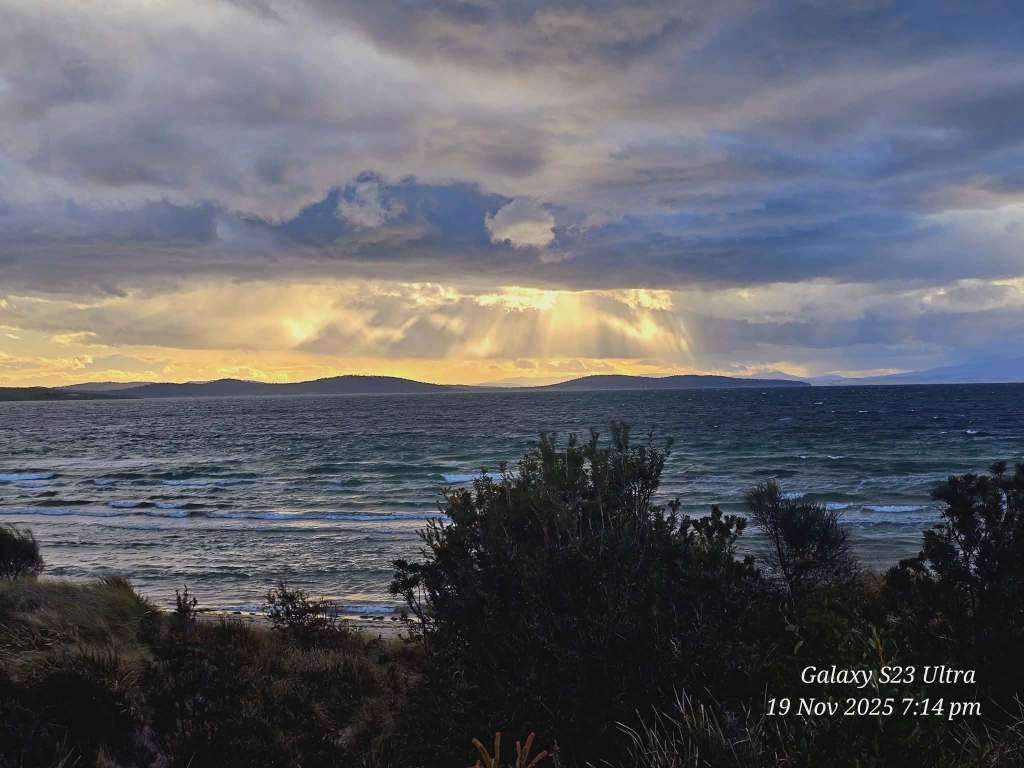
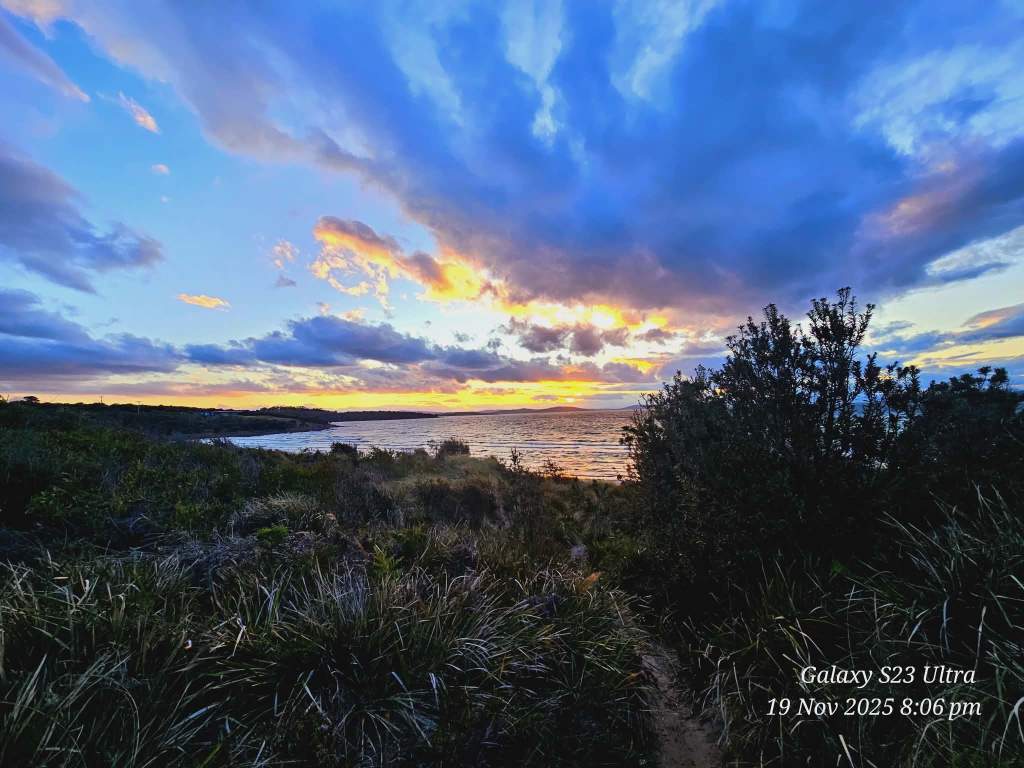
The tessellated pavement is one of nature’s great curiosities — sandstone cracked into geometric patterns like a tiled floor. The contrast of fluorescent green sea moss against the dark rock was startling and beautiful.
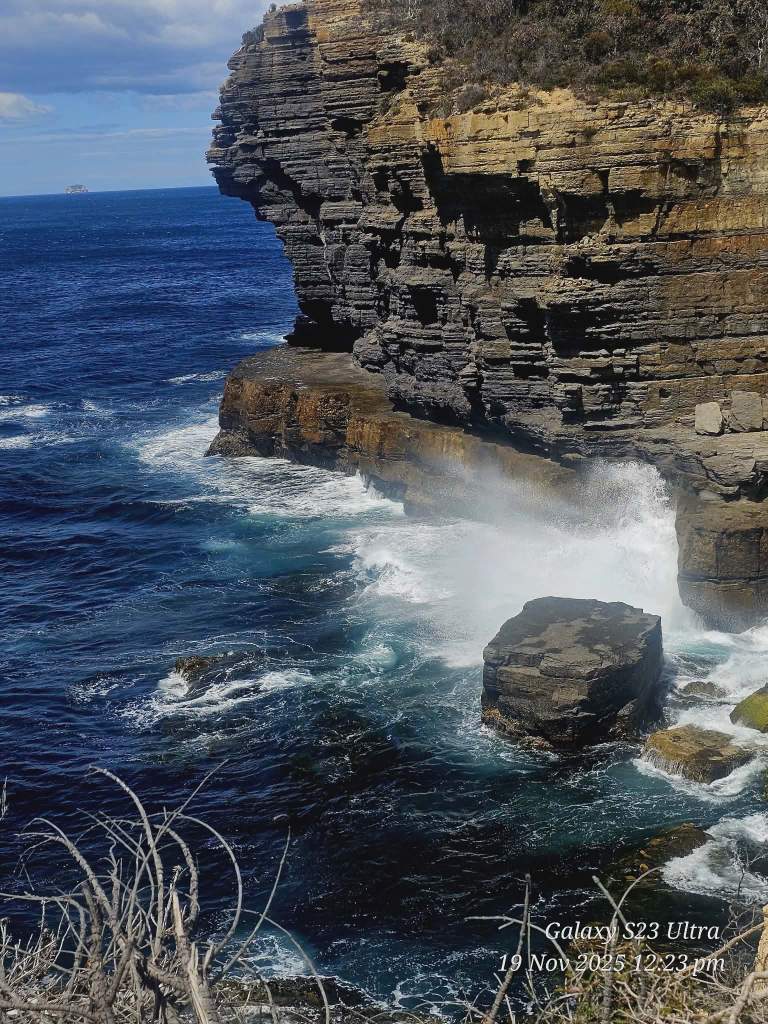
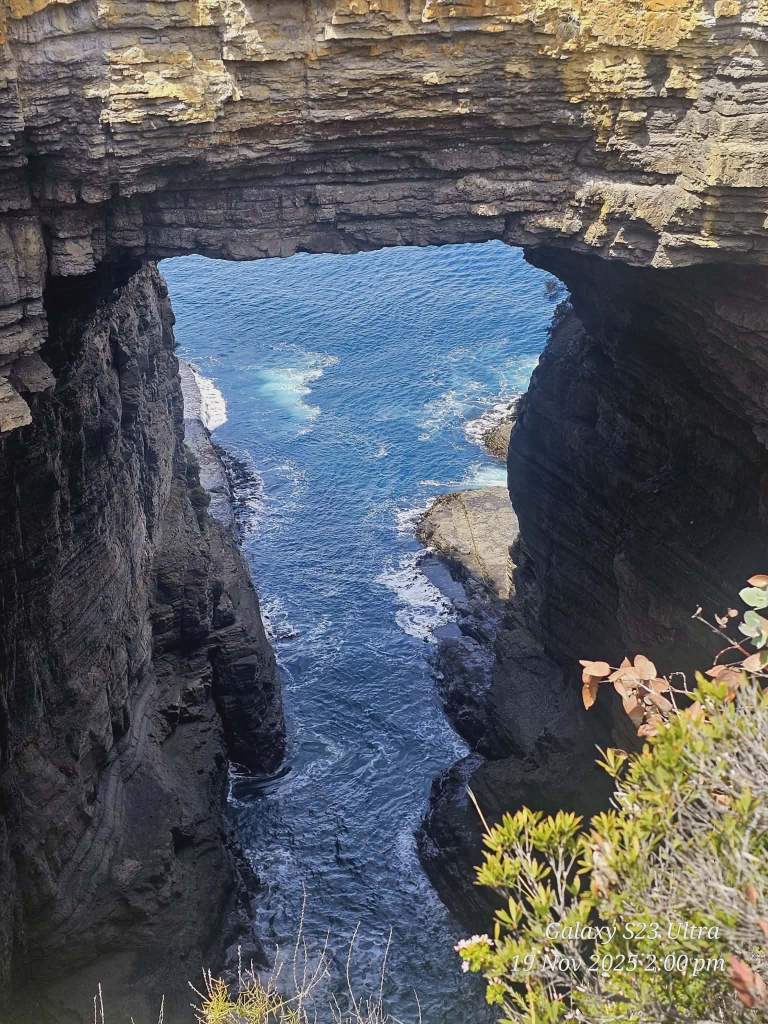
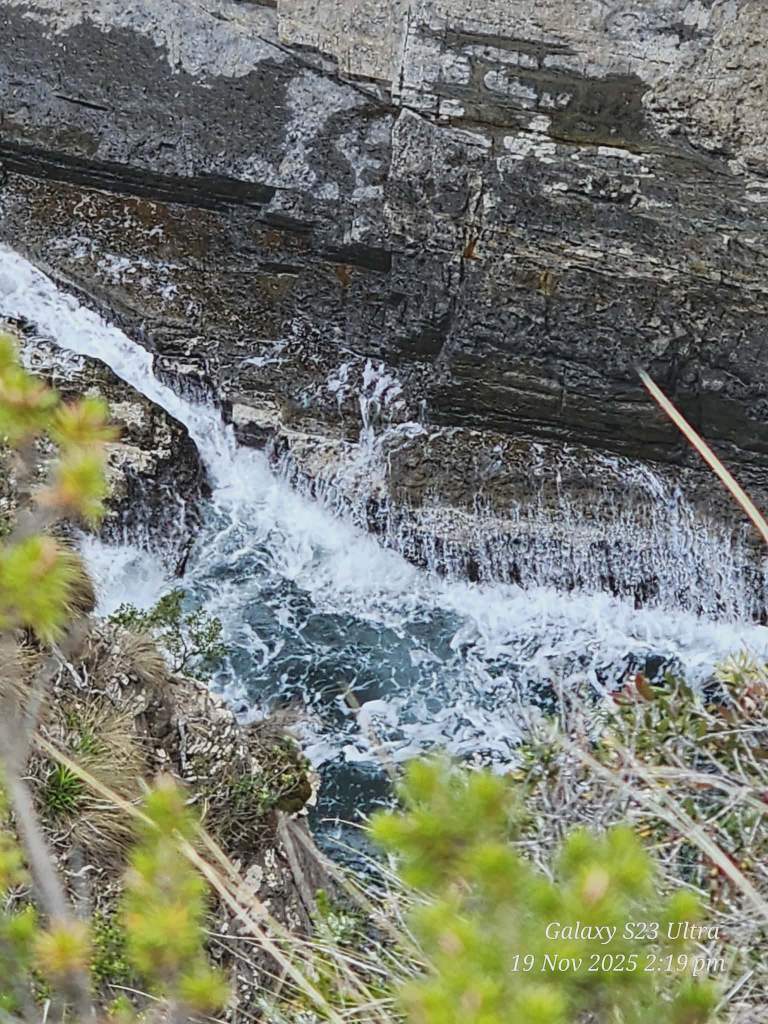
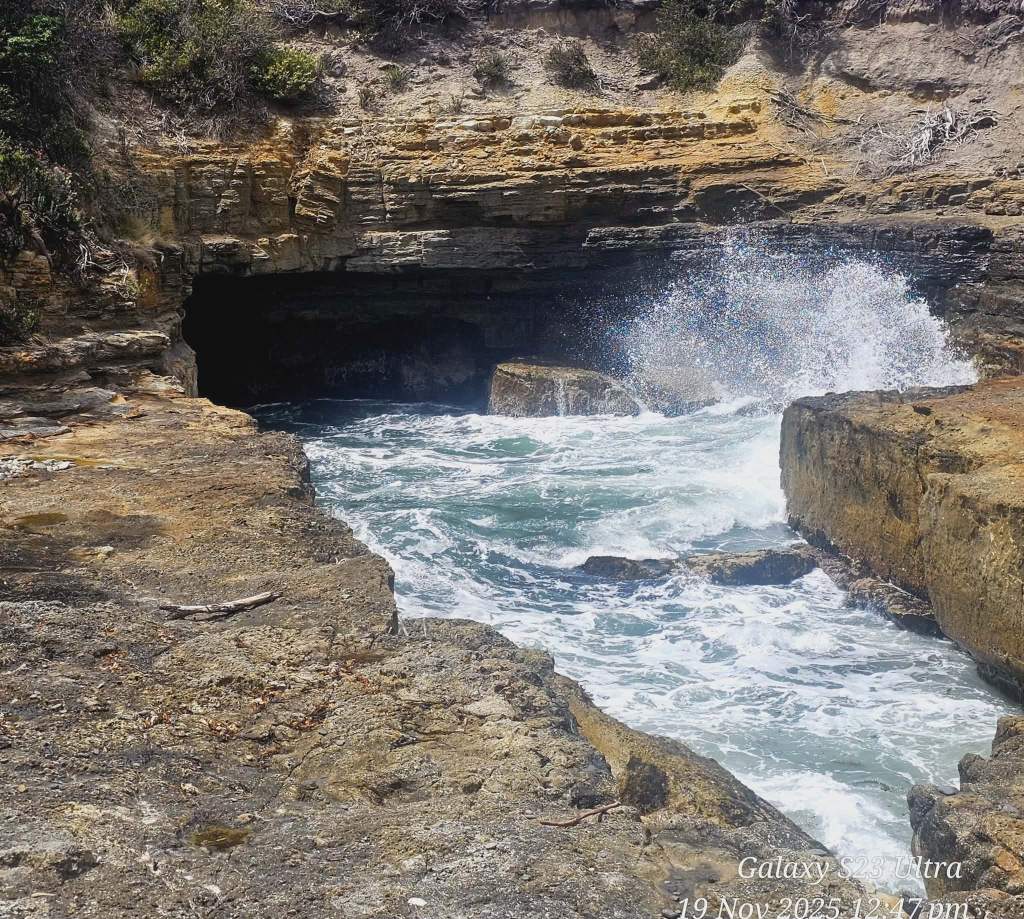
Watching deep blue waves crash against towering cliffs, surge through the Tasman Arch and erupt through the Blowhole was mesmerising. I stood in awe of the ocean’s relentless ability to carve stone. I did briefly wonder whether there was any warning before a rogue wave might surge beneath my feet — but it was only a fleeting thought and didn’t hurry me away.
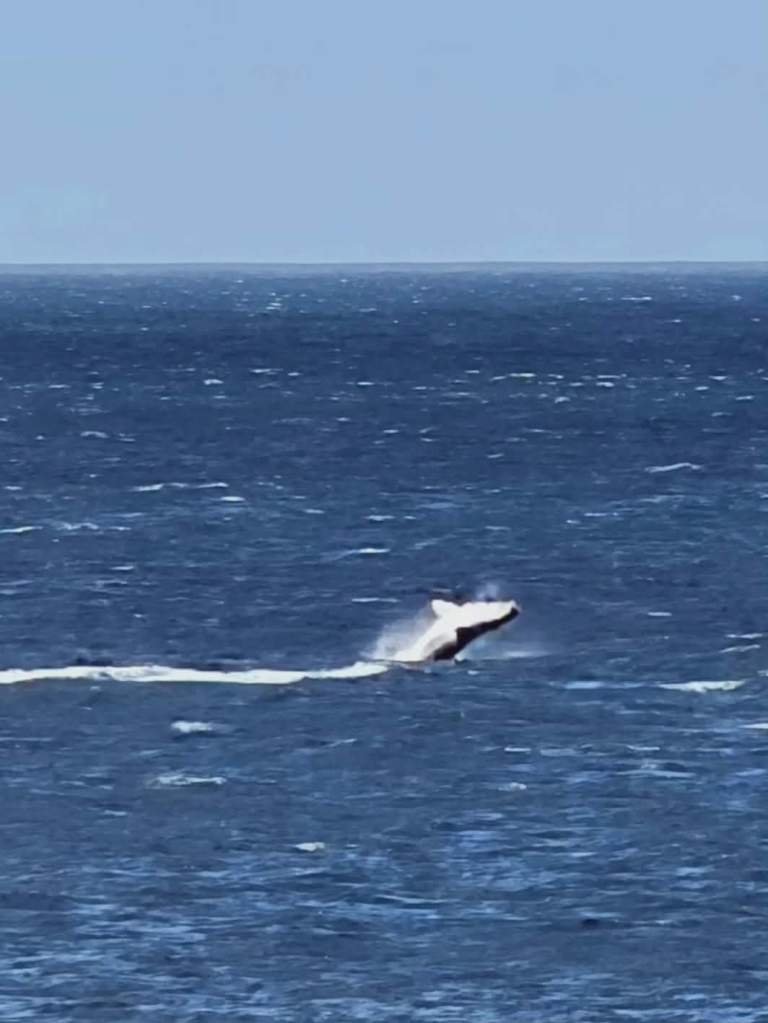
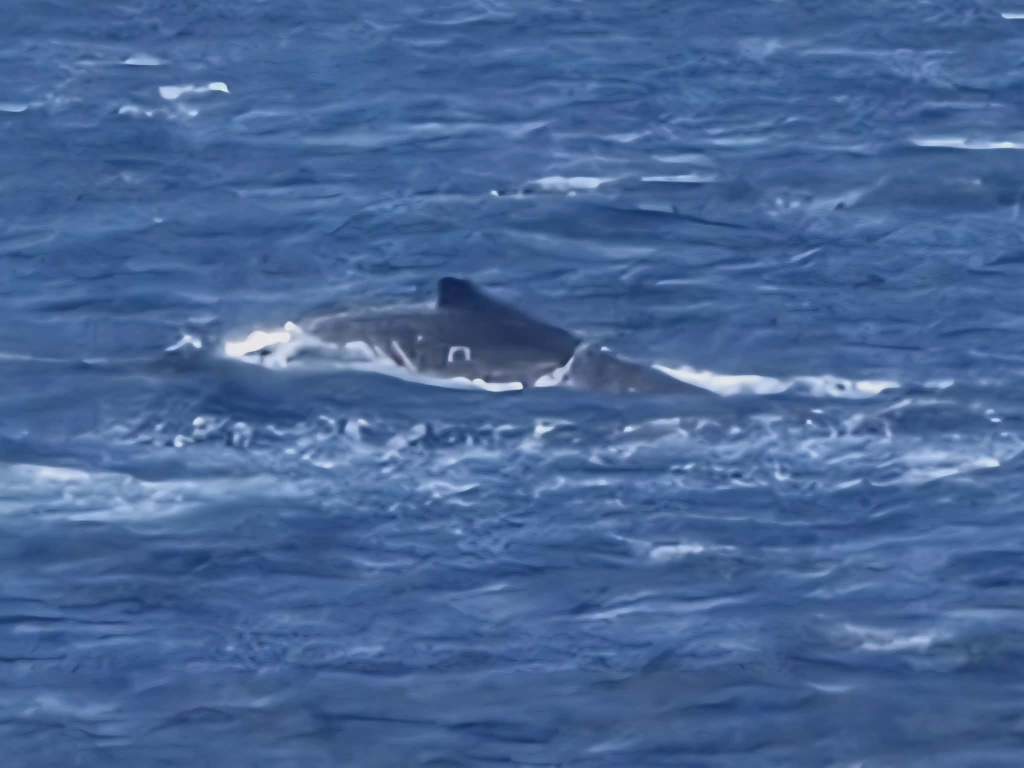
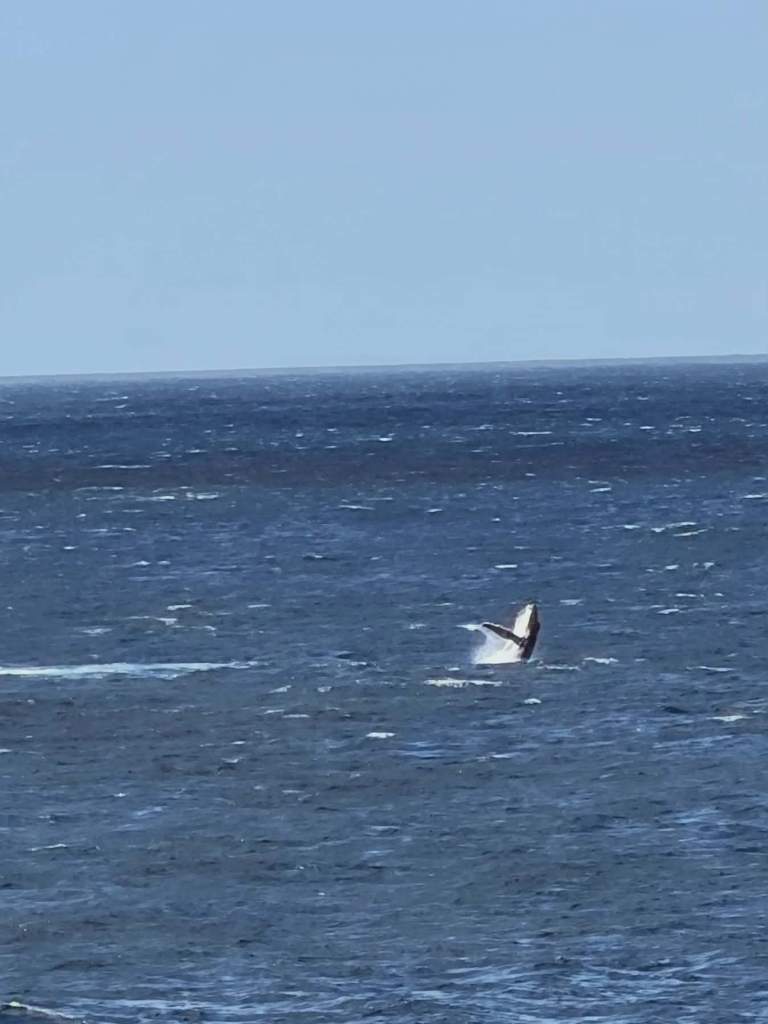
I almost forgot to mention the show put on for us by the Whales. We arrived just in time to watch a large pod of whales on their migration south. Delightful to watch as they put on a magical display right in front of us.
Hobart & Stories of Women
Leaving the peninsula behind, we headed south toward Hobart, keen to visit the Cascade Female Factory and learn more about women’s convict history.
On arrival, women were divided into rigid classes and forbidden from communicating with one another. Clothing, labour, daily life — everything was controlled. Many women were transported simply because of poverty, committing crimes to feed their families. The idea that such conditions could lead to rehabilitation seems deeply flawed by today’s standards.
Yet resistance emerged. A prisoner subculture known as the Flash Mob formed — groups of defiant women asserting control within the walls. Authorities struggled endlessly to contain them. I couldn’t help but wonder: were these acts of rebellion the earliest sparks of women’s rights? If so, women today owe them a debt for paving the way.
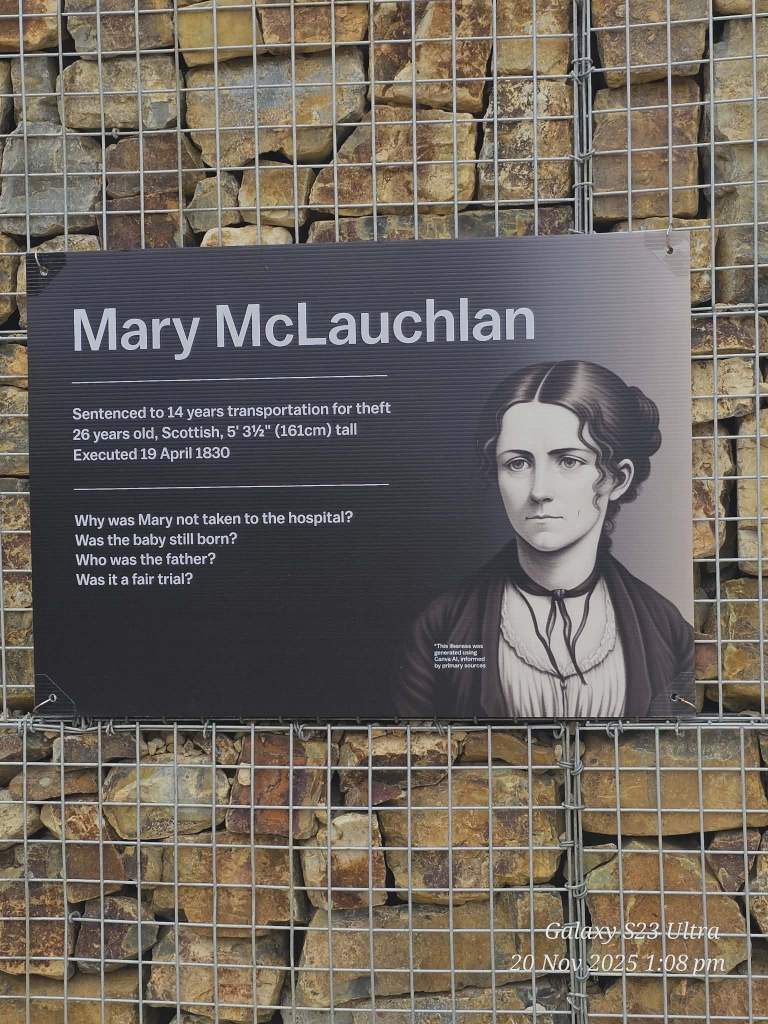
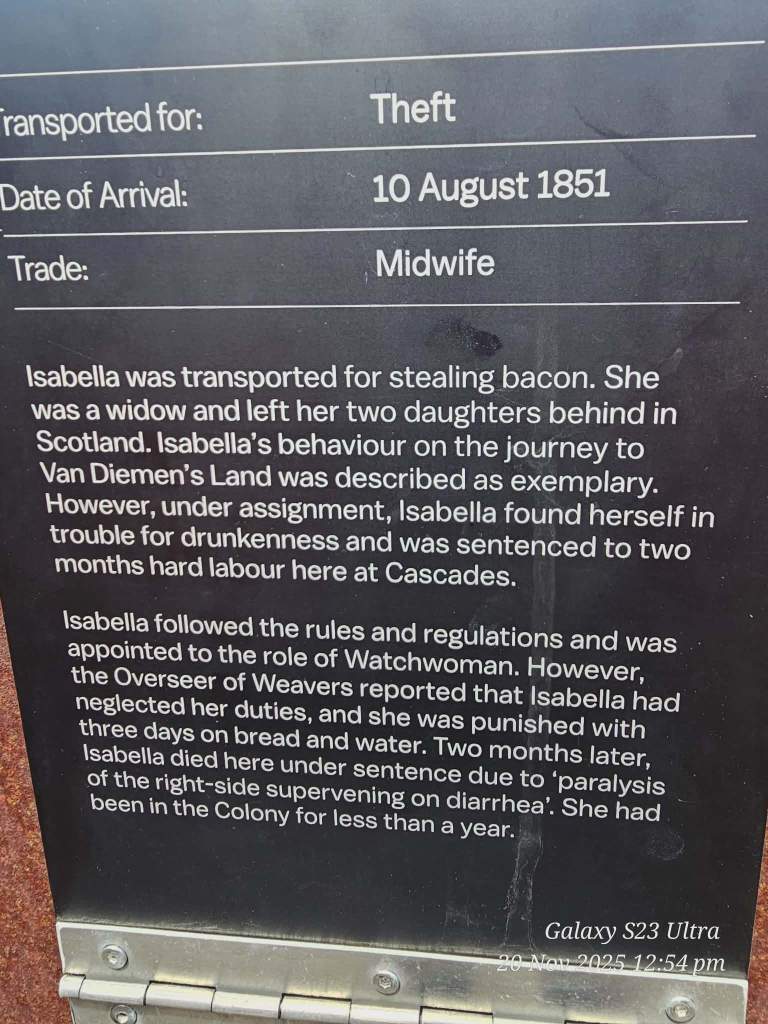
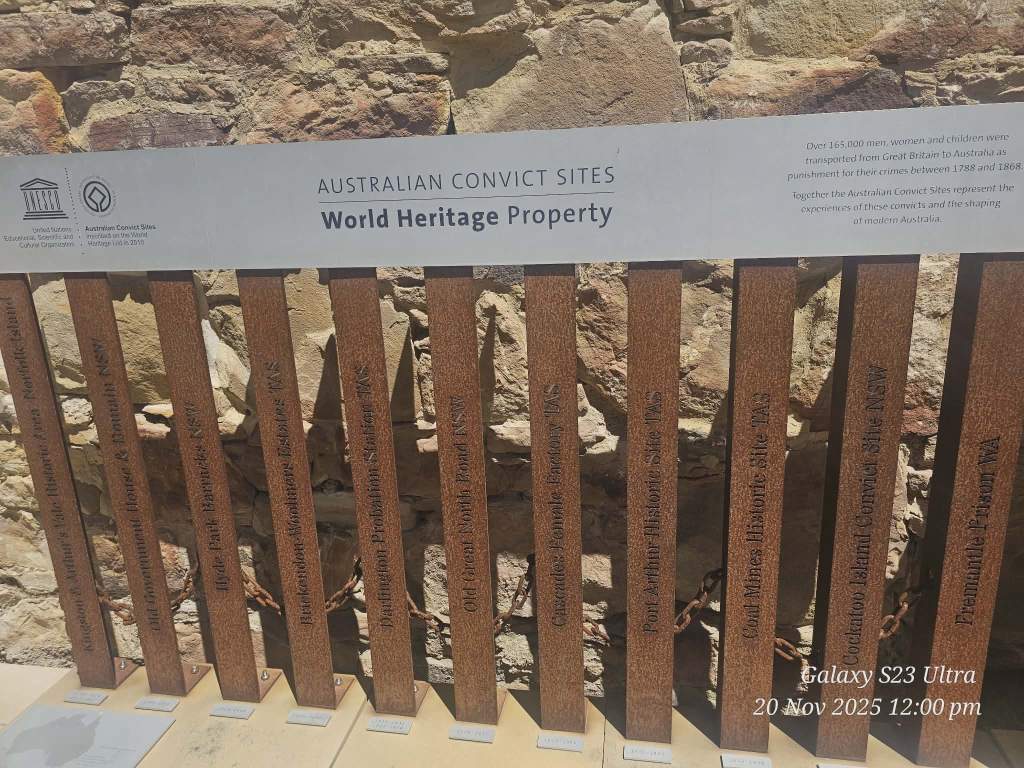
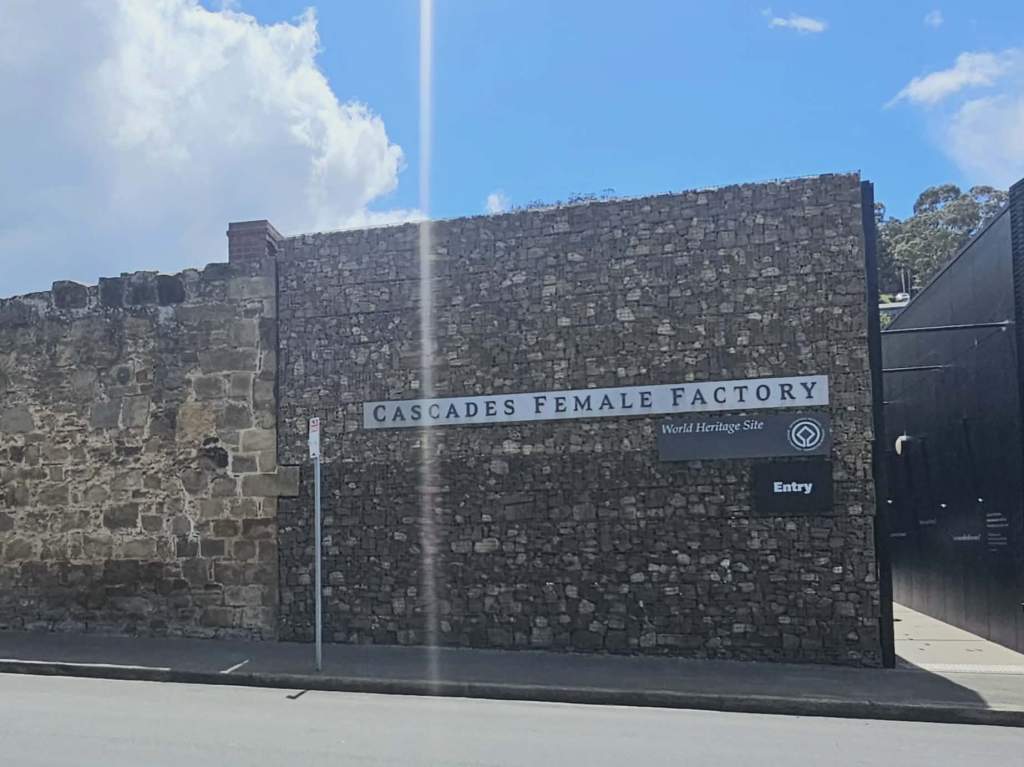
We later wandered through the Cascade Gardens, quietly searching for platypuses — no luck this time.
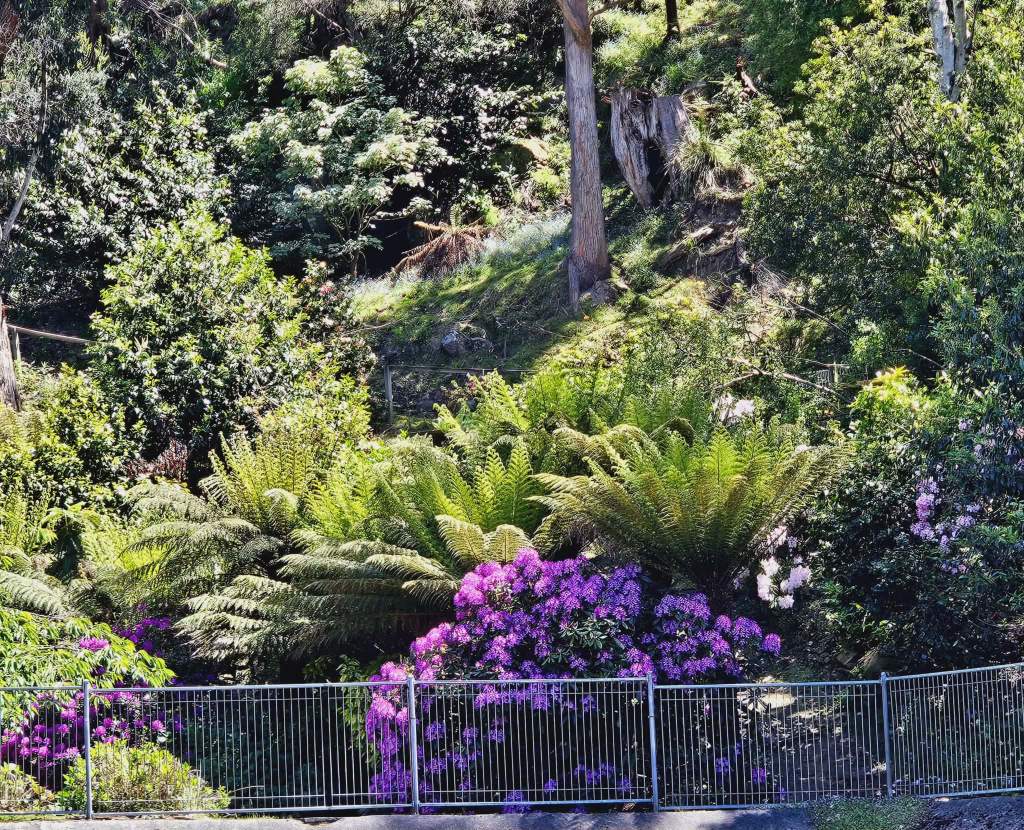
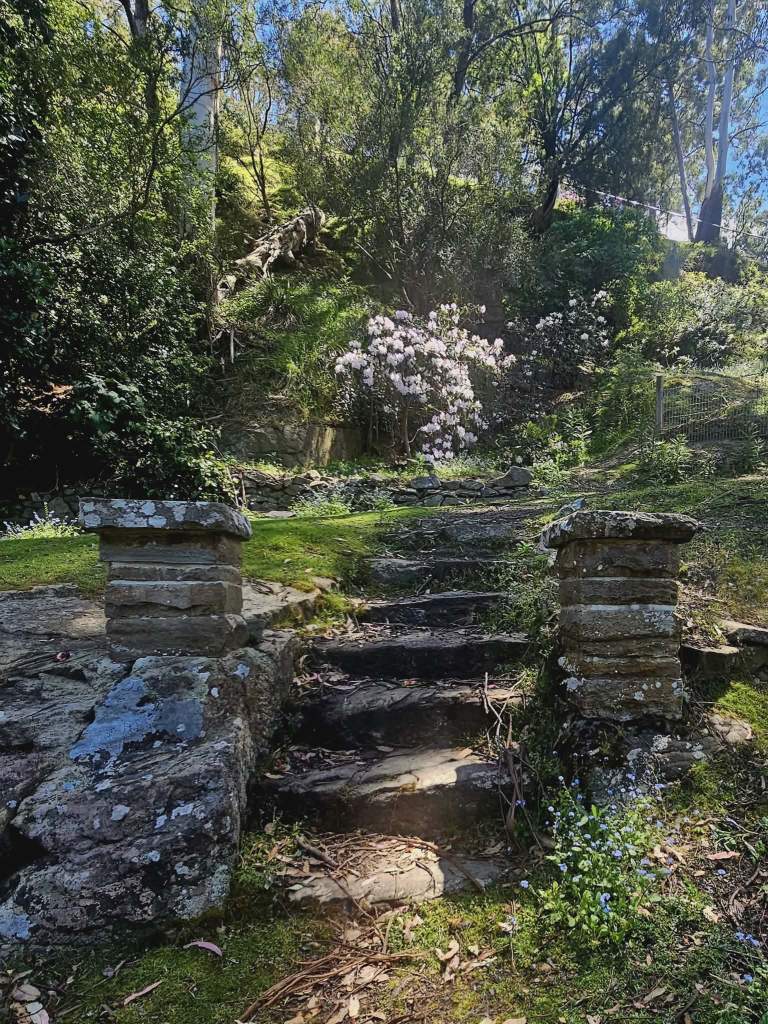
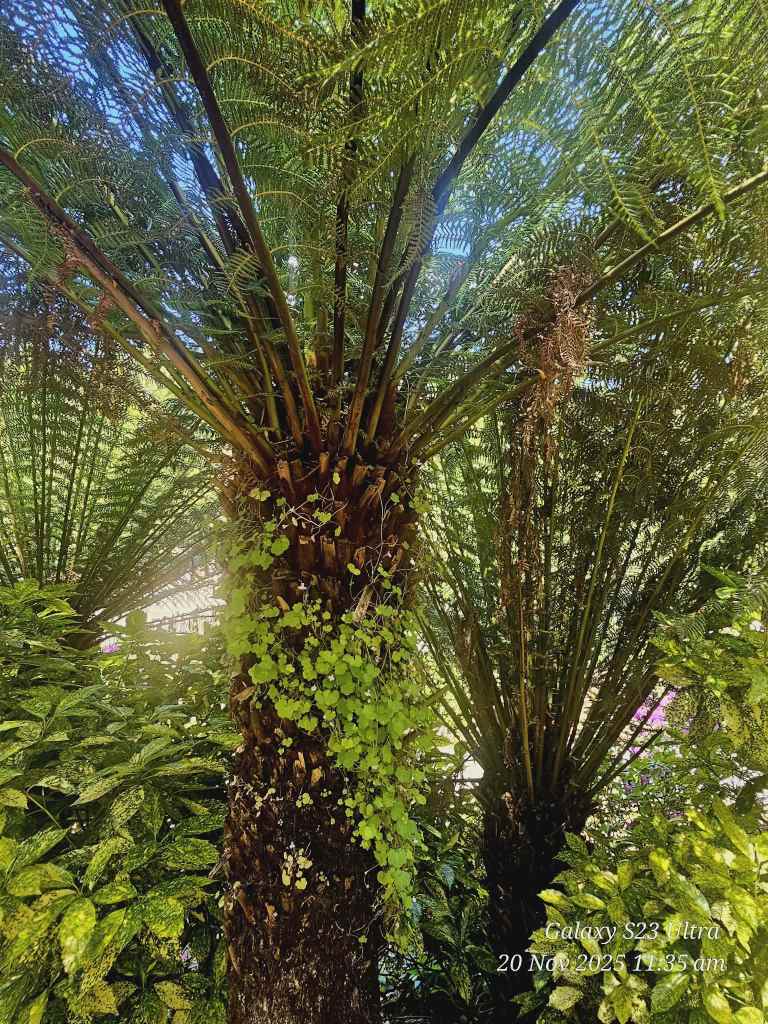
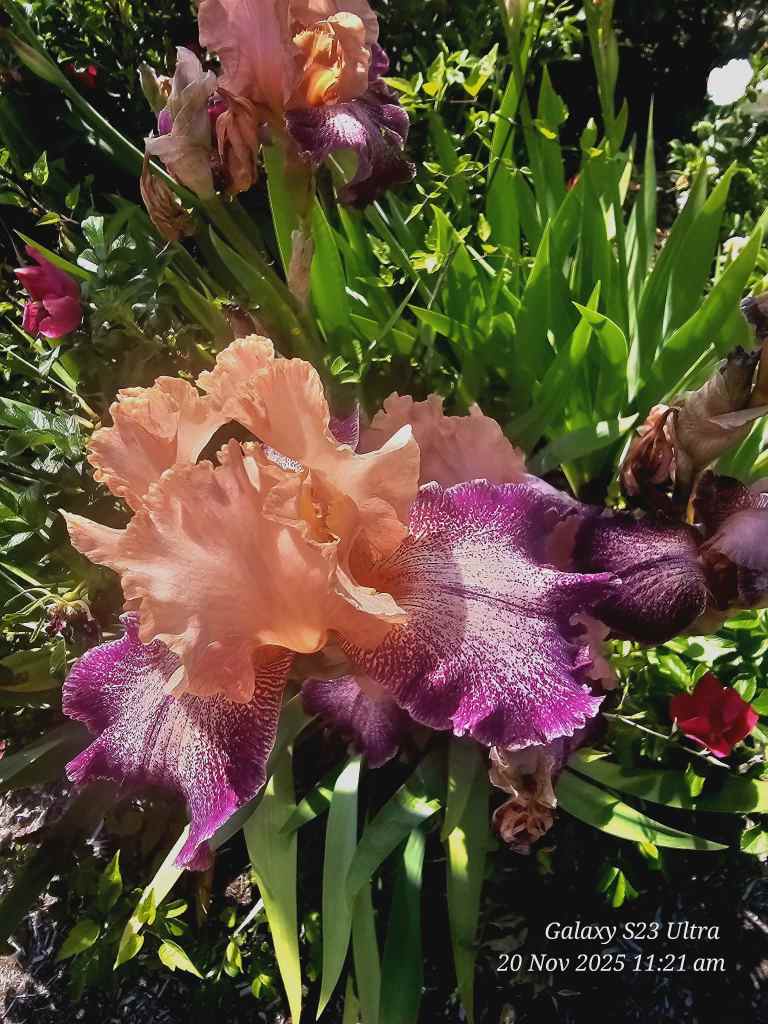
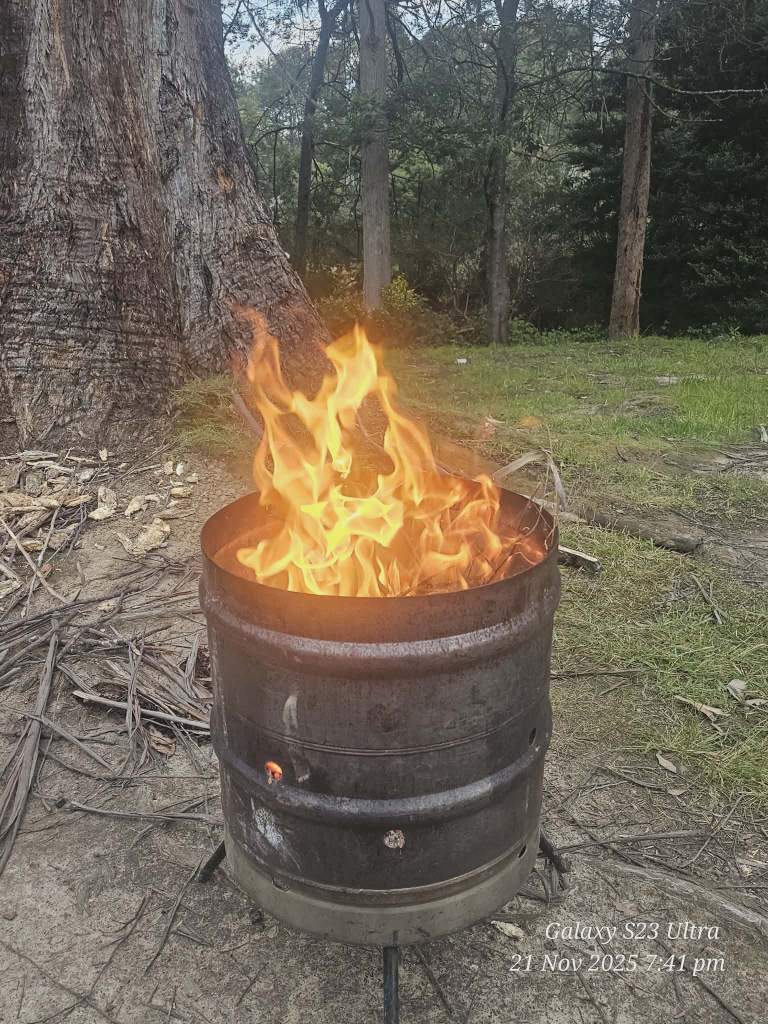
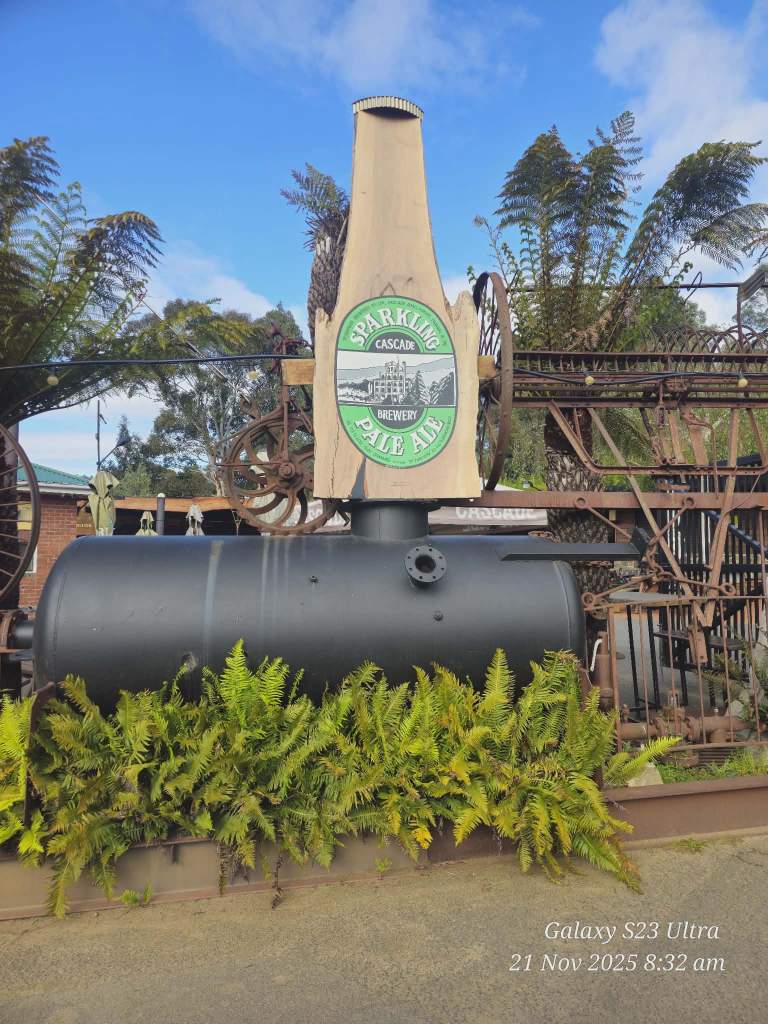
That night we camped opposite the Longley International Hotel, where the cost of dinner allowed us to stay the night. It was steak or parmi special night — and the porterhouse did not disappoint. The pub boasts the world’s longest Huon Pine bar and radiates history, hospitality, and community spirit.
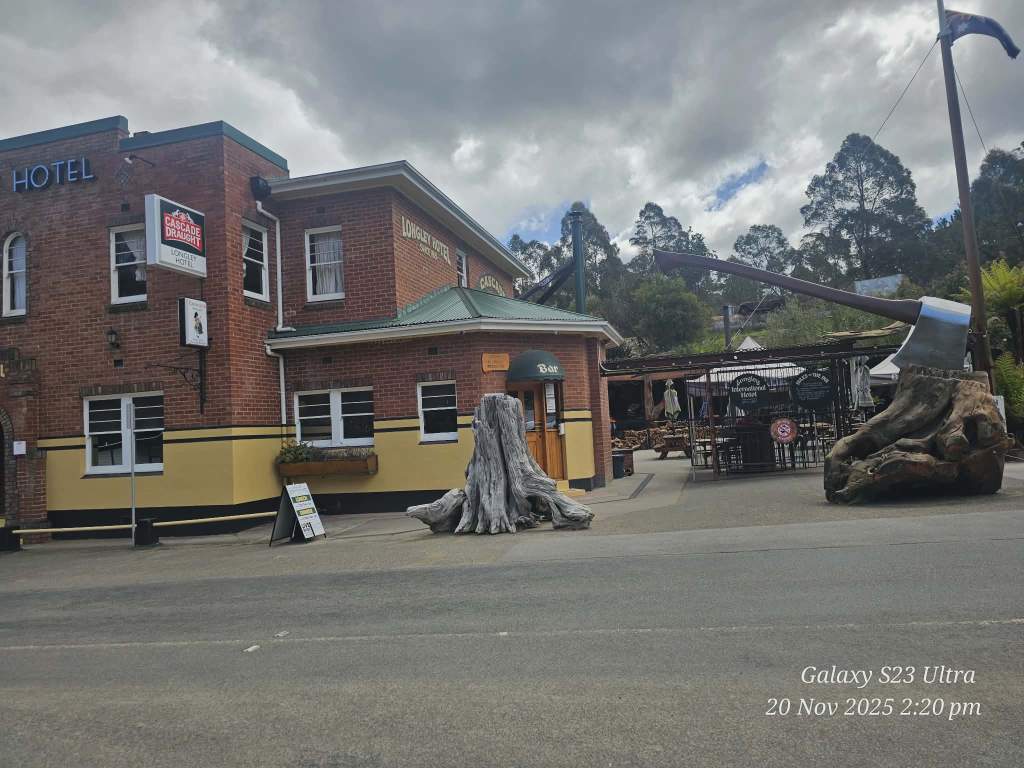
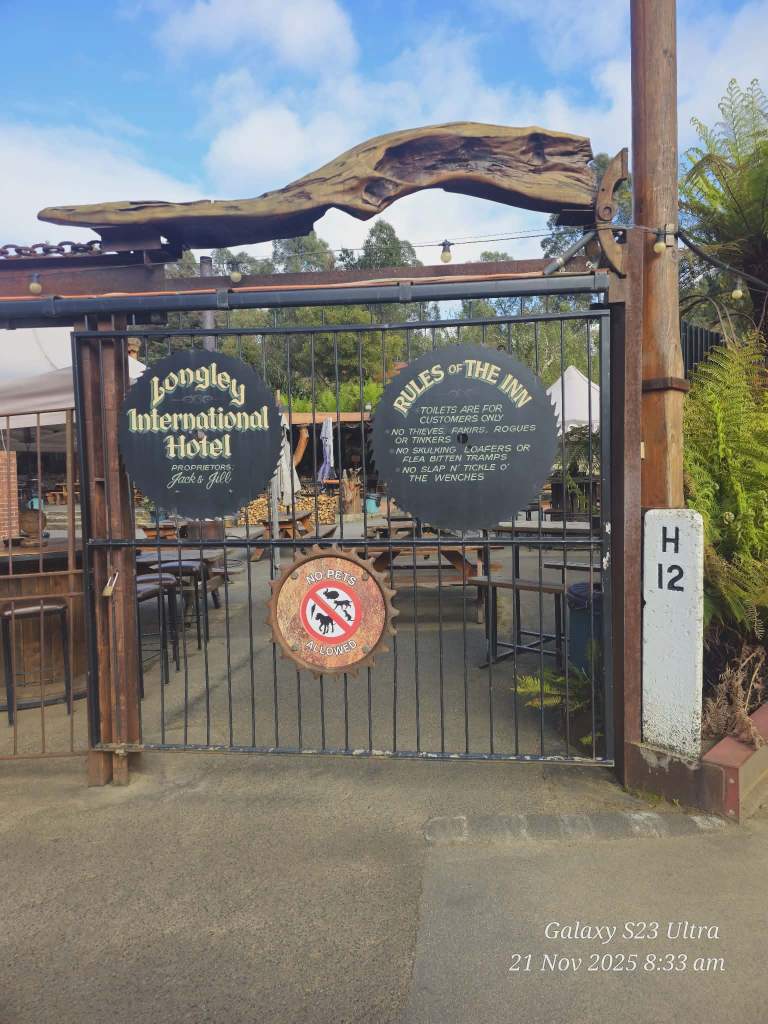
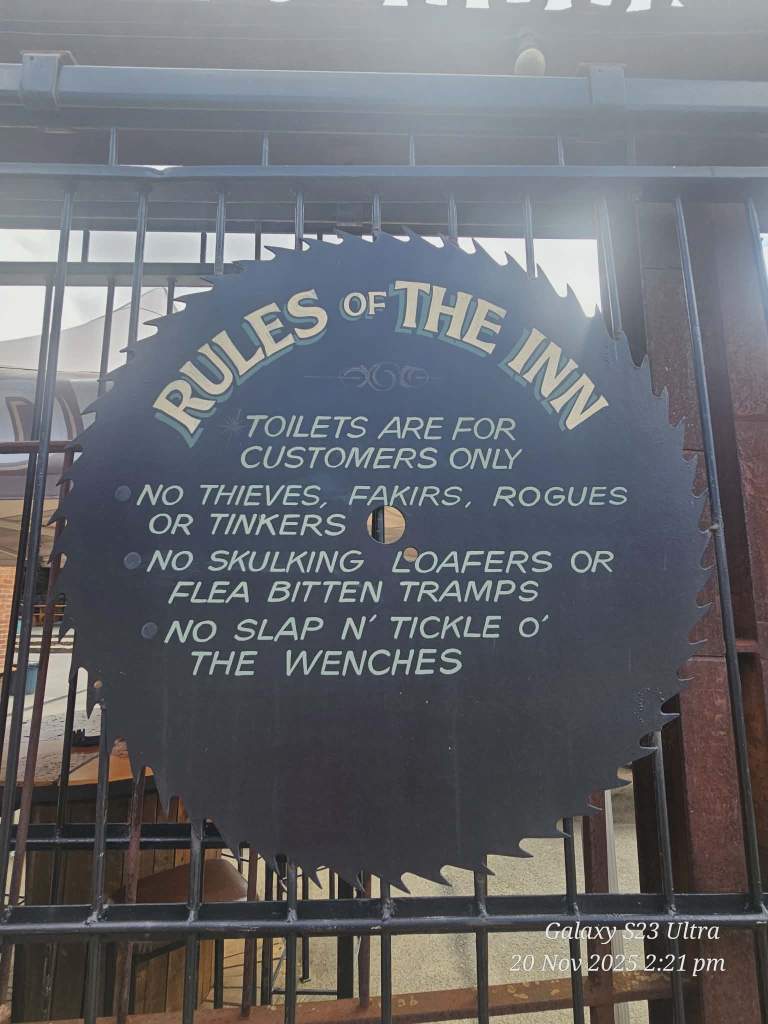
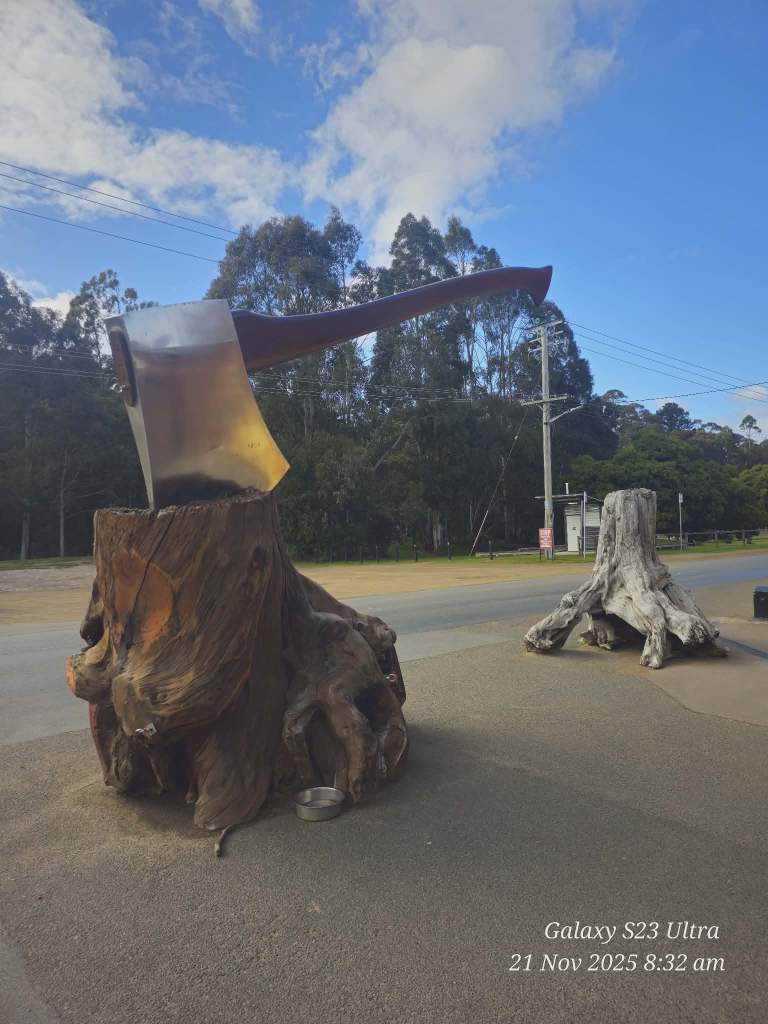
Southport & the Southern Edge
Heading further south, we pulled into the Southport Hotel and Caravan Park, Australia’s most southern pub, and stayed for three nights. Our first mishap came quickly — the ground looked firmer than it was, and we got bogged. A local kindly came to the rescue with his 4WD. Lesson learned: hire vans don’t come with recovery gear.
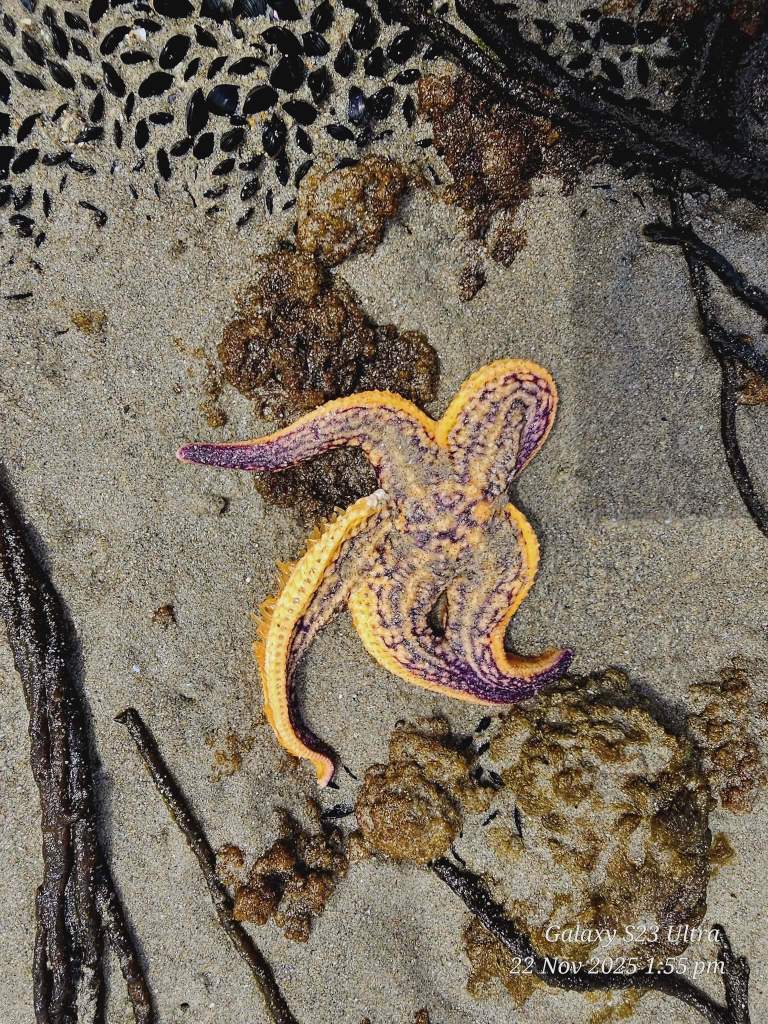
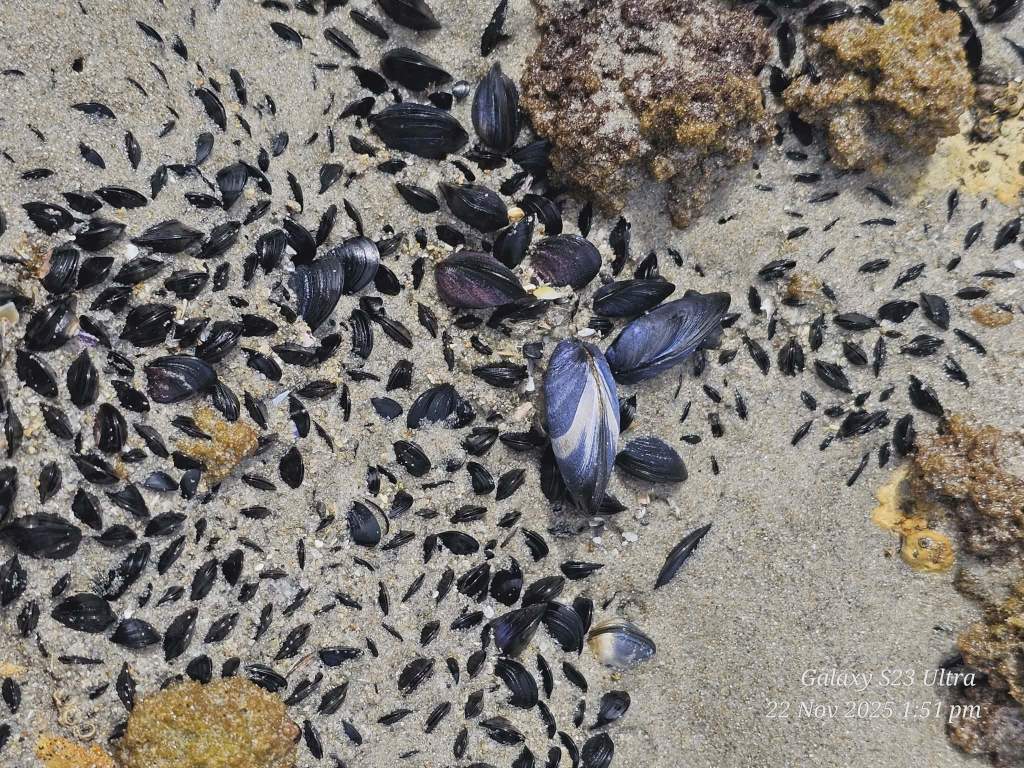
Mornings were spent beachcombing, discovering overnight treasures washed ashore. No two days were the same, and Google Lens helped identify sea creatures we’d never seen before. There is always something new to learn from the ocean.
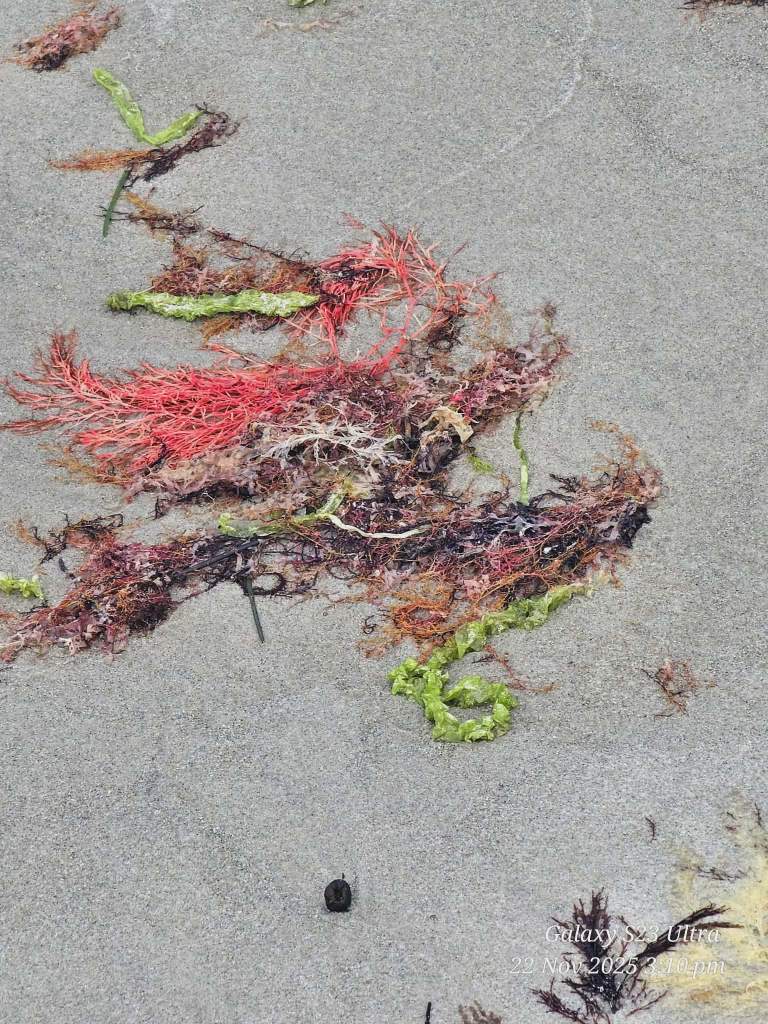
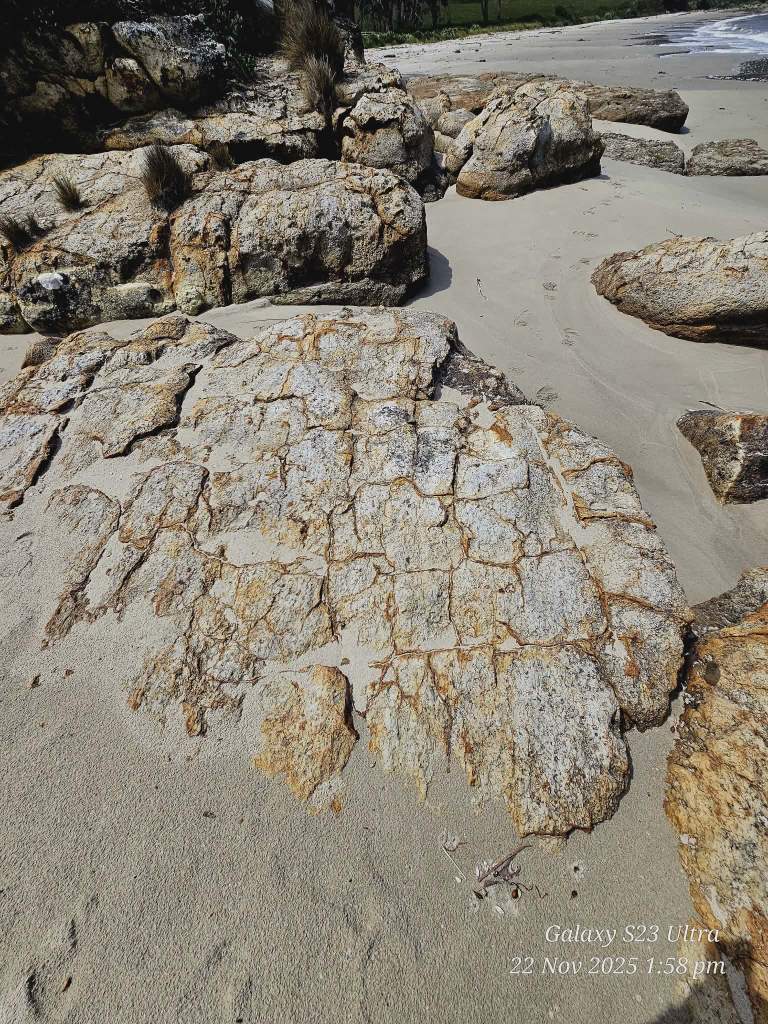
After dinner and a campfire one night, we ventured out hoping to see the Aurora Australis. The predictions were good, but cloud cover and light pollution had other ideas — no dancing lights that night.
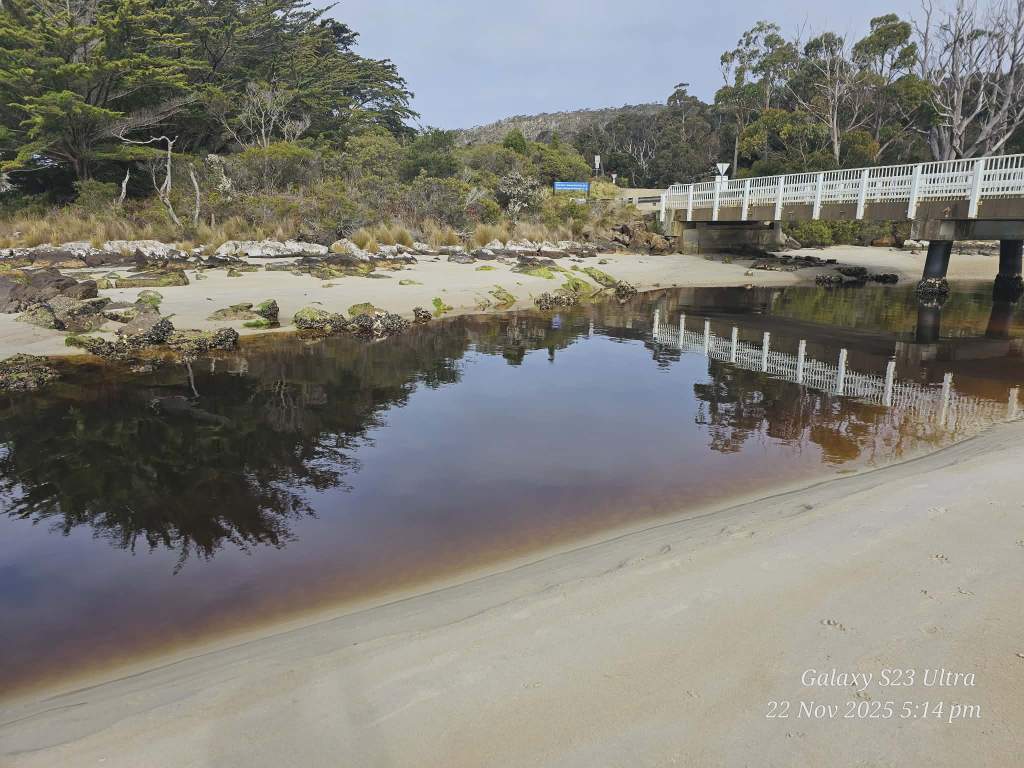
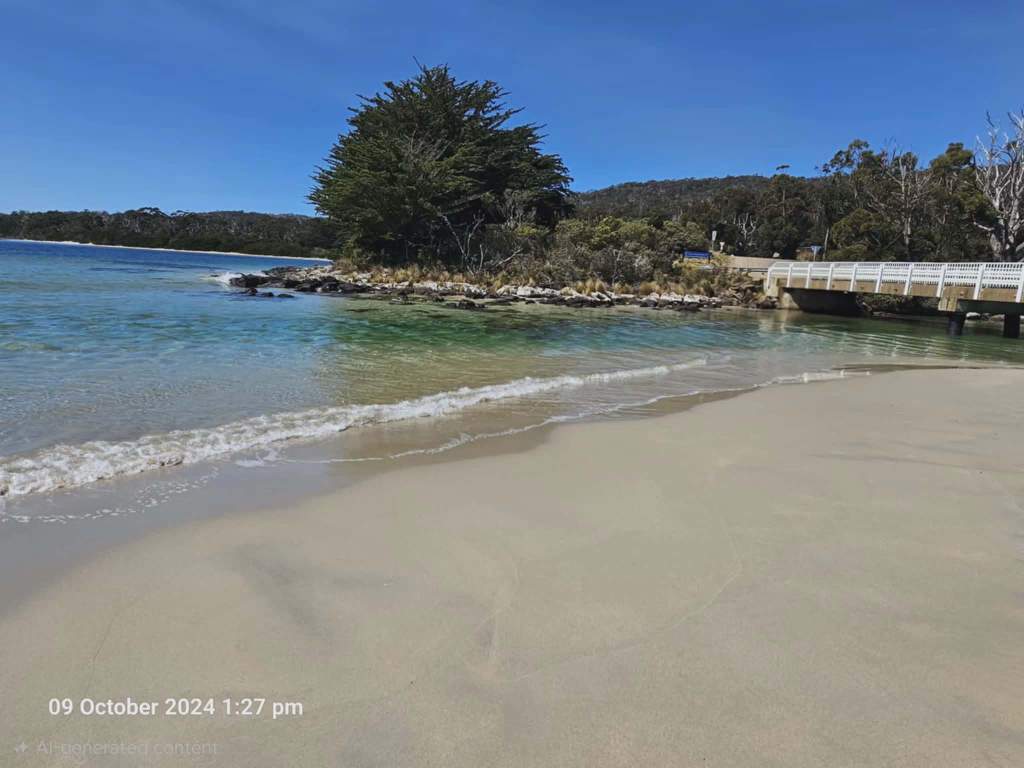
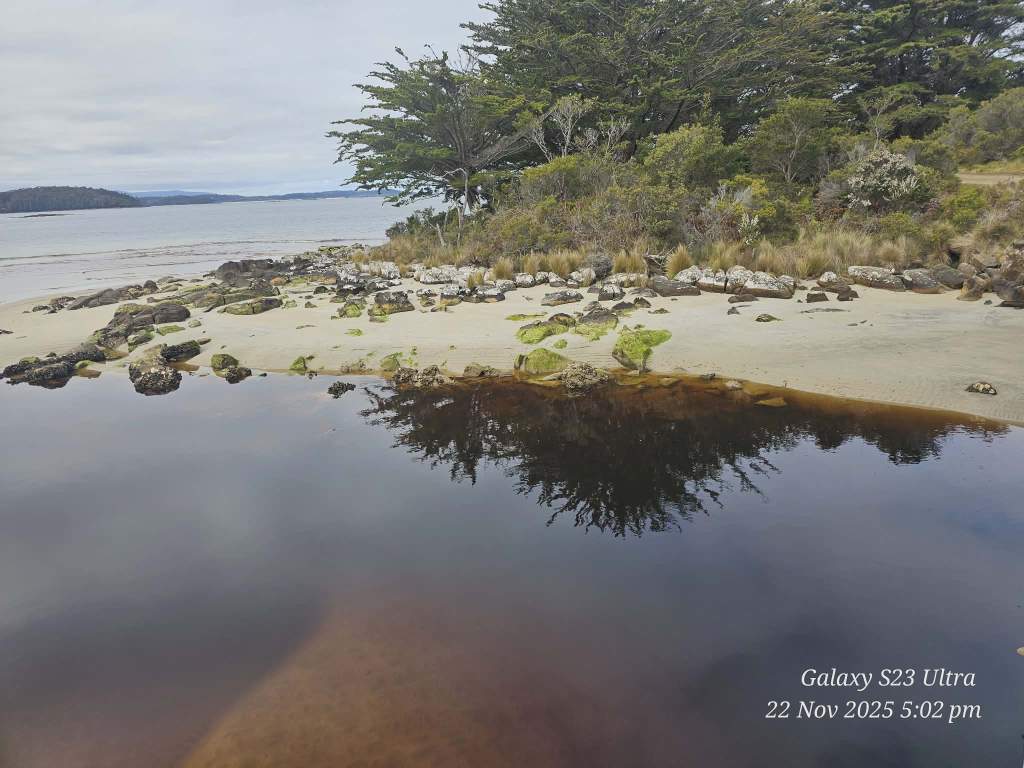
We took a day trip to Cockle Creek, where the road quite literally ends. An unspoilt stretch of coastline with free camping along the water. Last year the sea had been crystal blue; this time it was tea-brown from recent storms — different, but no less beautiful.
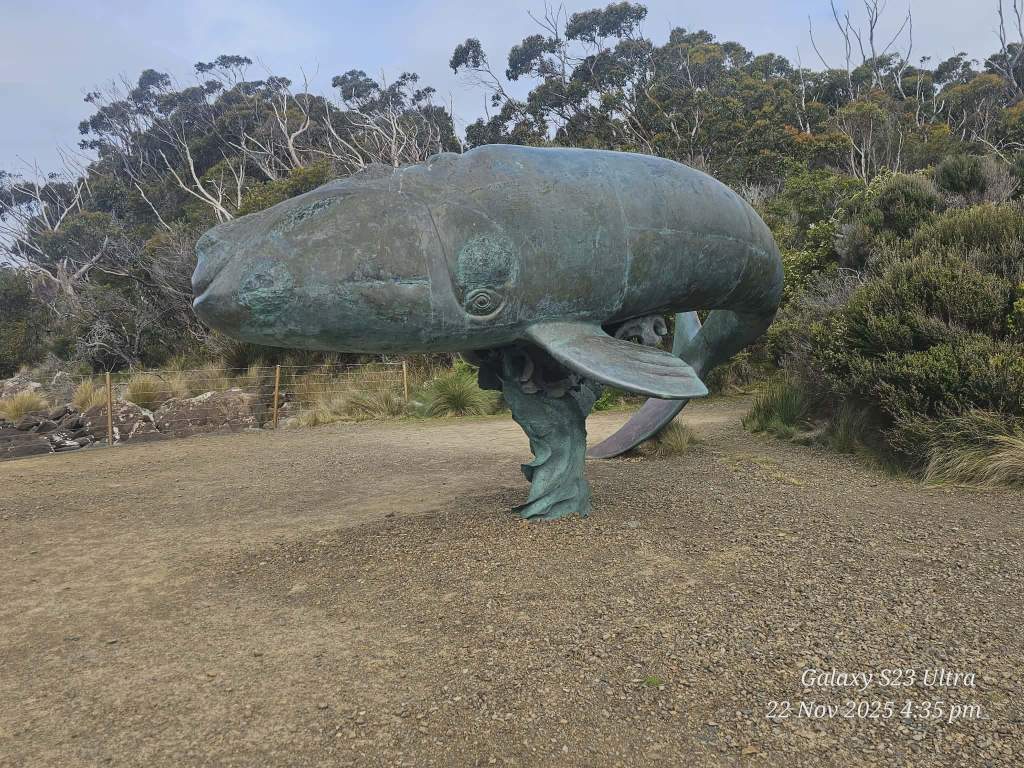
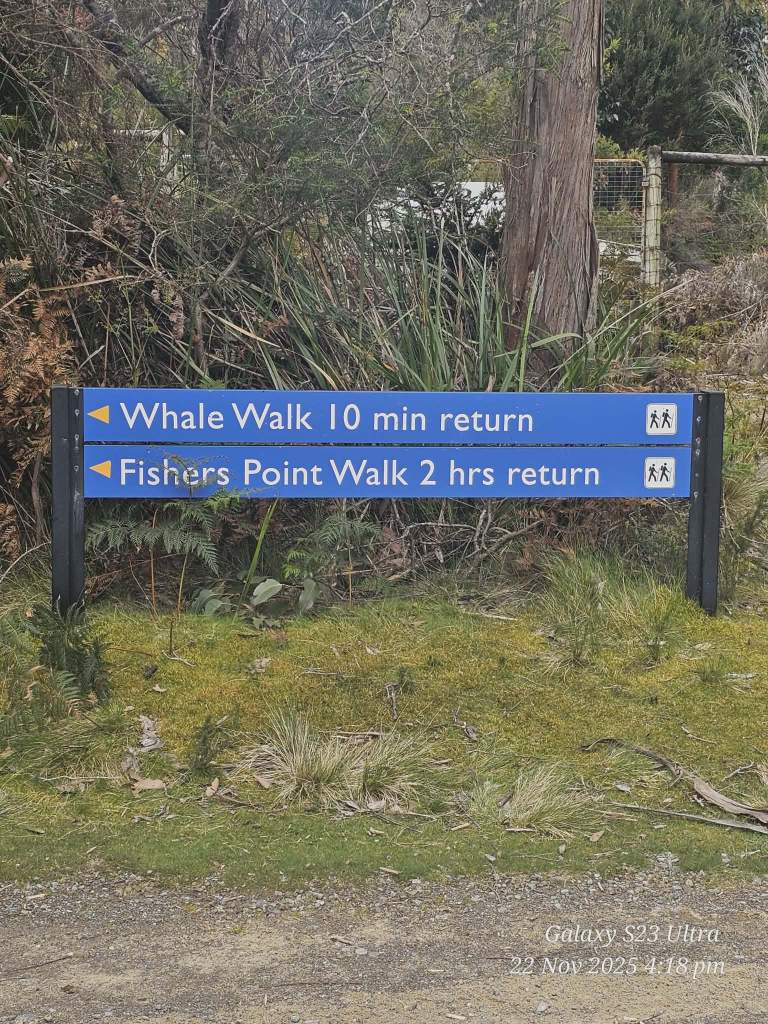
We also visited Adam’s Point, home to the Southern Right Whale sculpture, acknowledging the region’s whaling history and migration pathways.
The Journey Back
As time caught up with us — the hire vehicle due back and my travelling companion’s flight looming — we began heading back toward New Norfolk, stopping along the way.
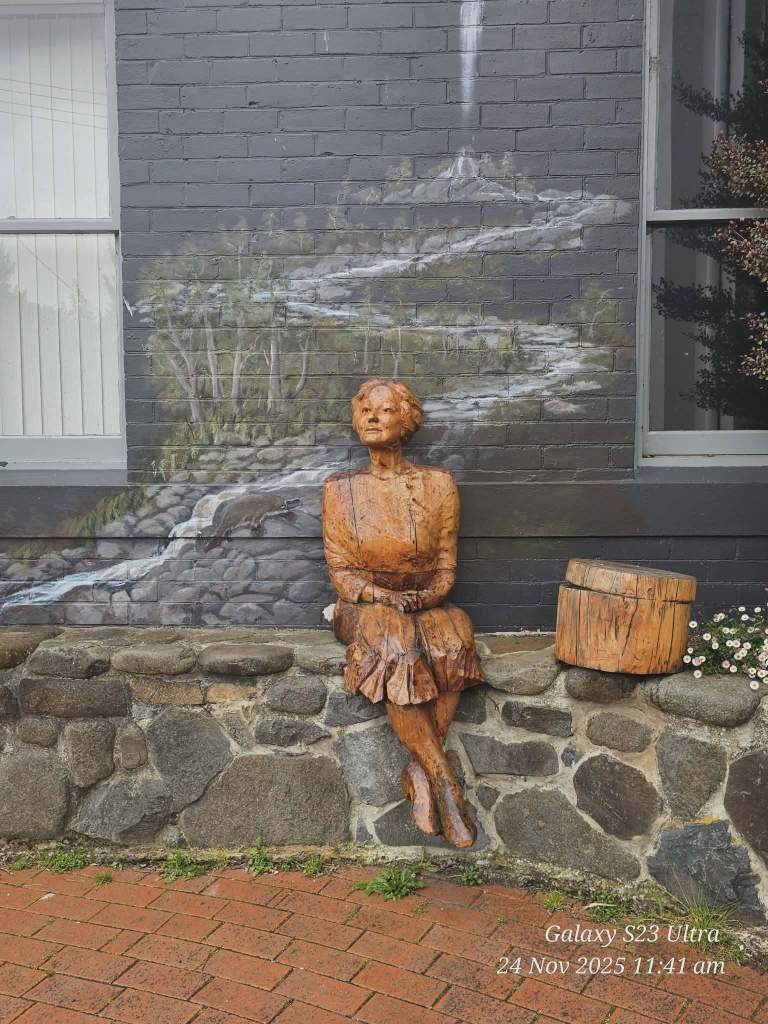
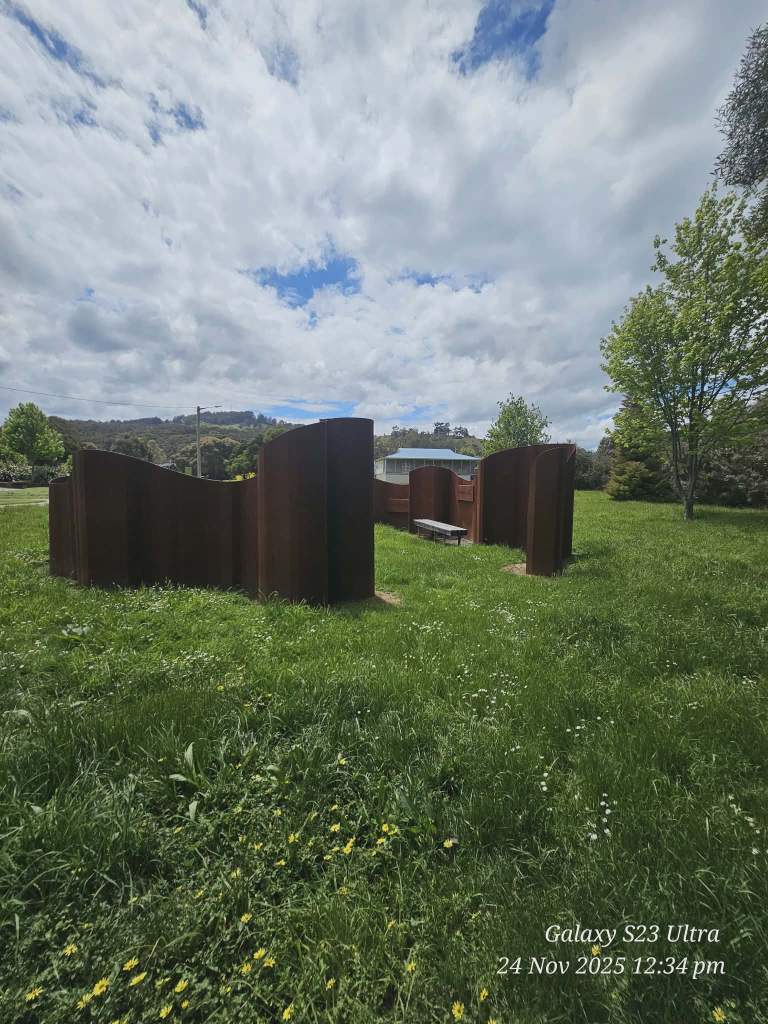
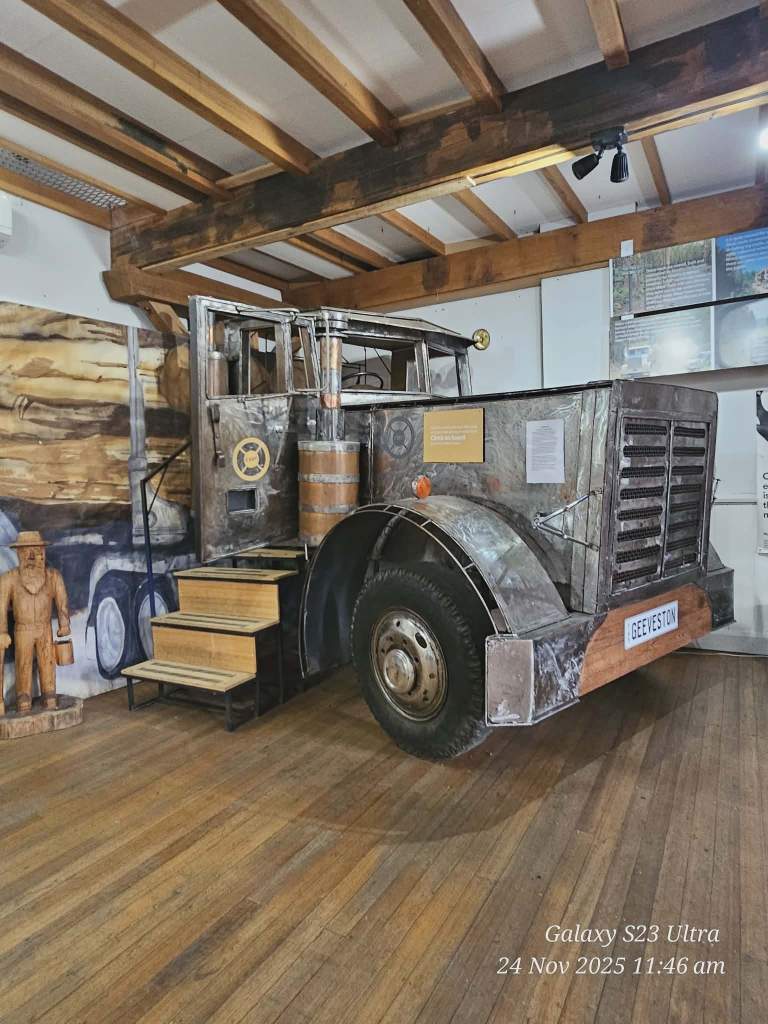
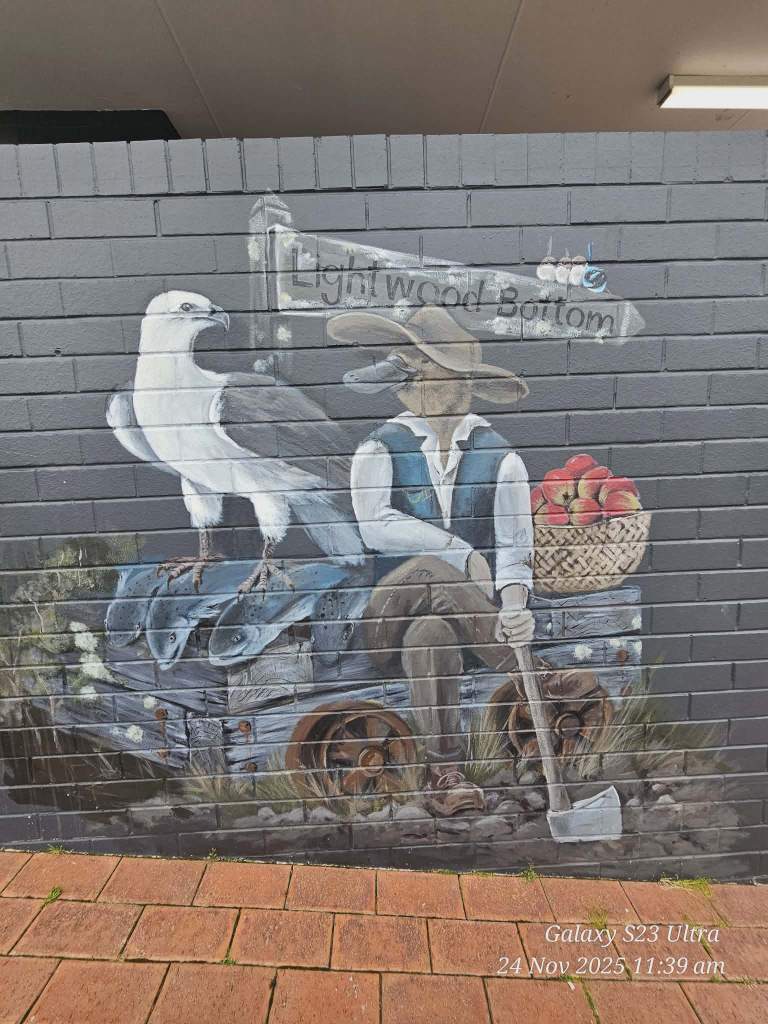
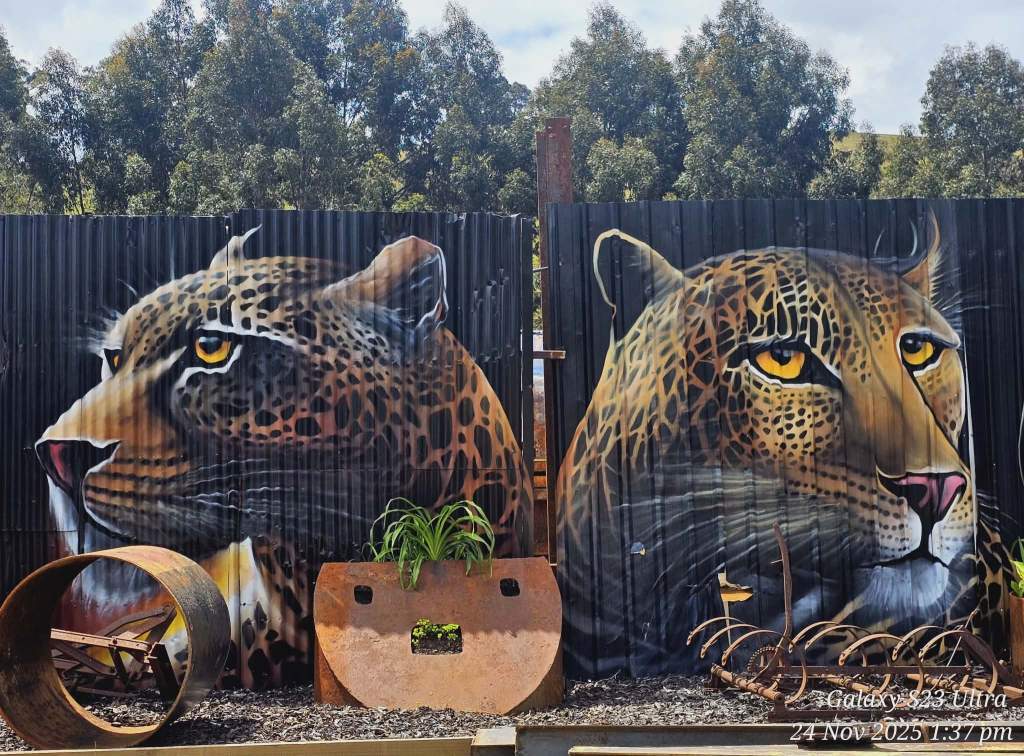
In Geeveston, we visited the heritage museum, the lolly shop, and admired the striking street art: life-sized timber carvings, murals, and yet another attempt at spotting a platypus (still no luck). We also visited the Forest Workers Memorial and the Arve Big Tree Sculpture, honouring one of Australia’s tallest swamp gums and commemorating the community’s resilience after the devastating 2019 bushfires.

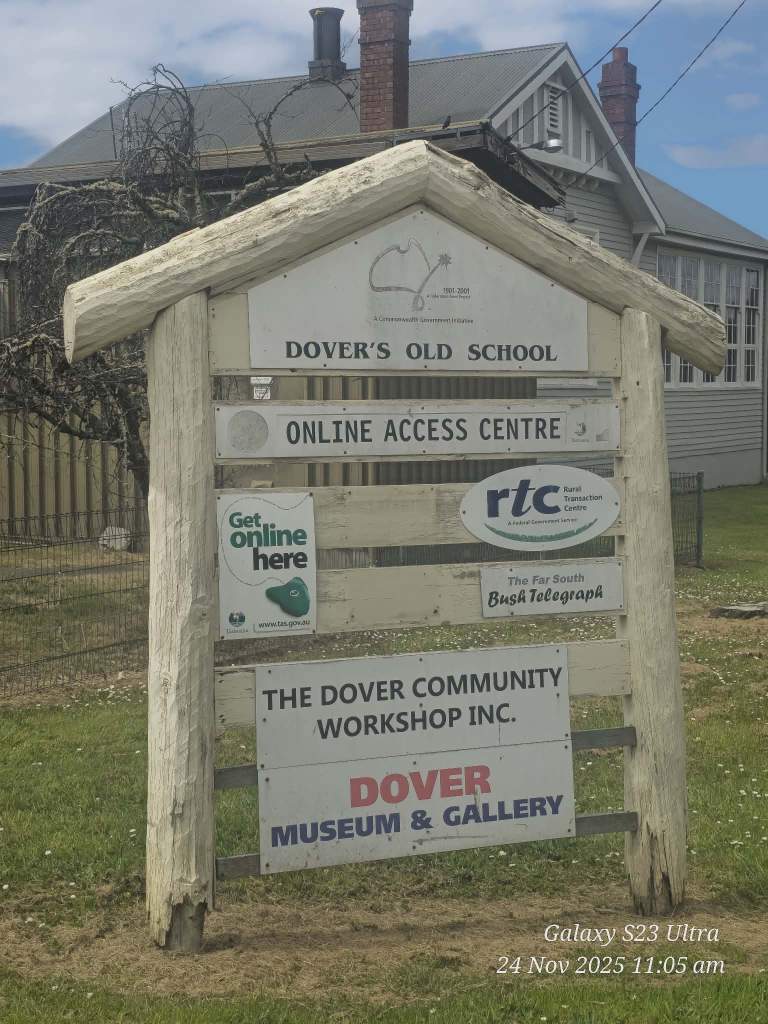
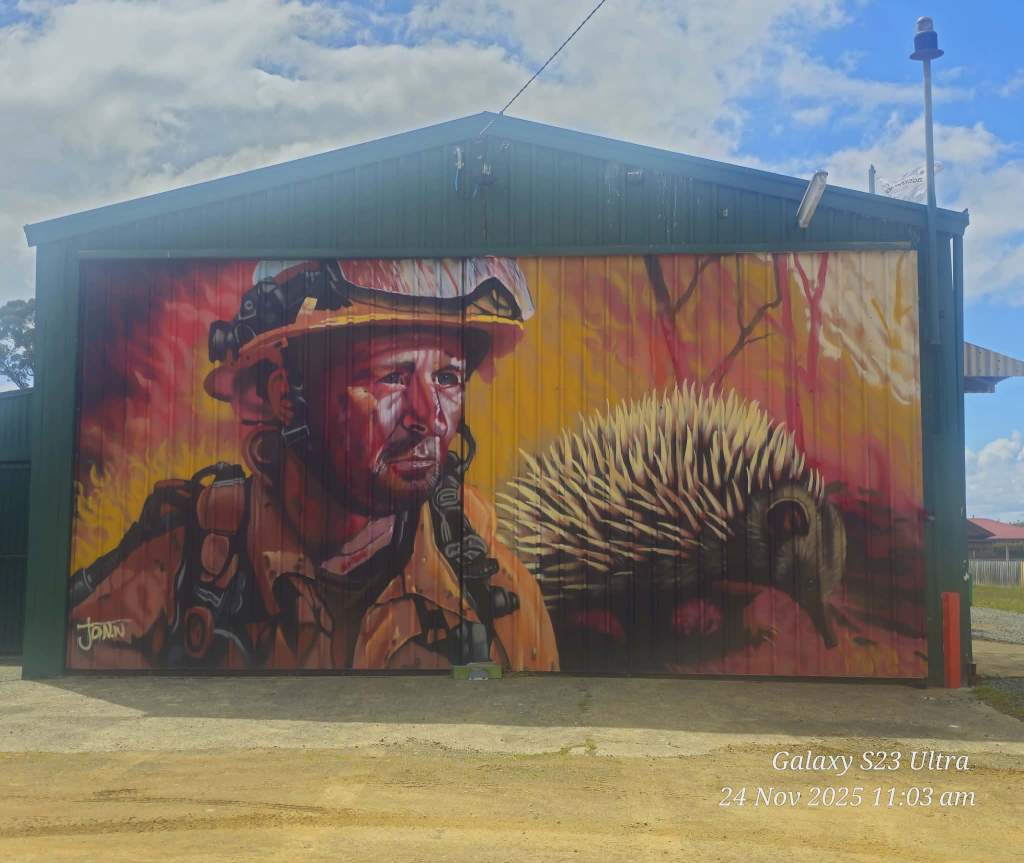
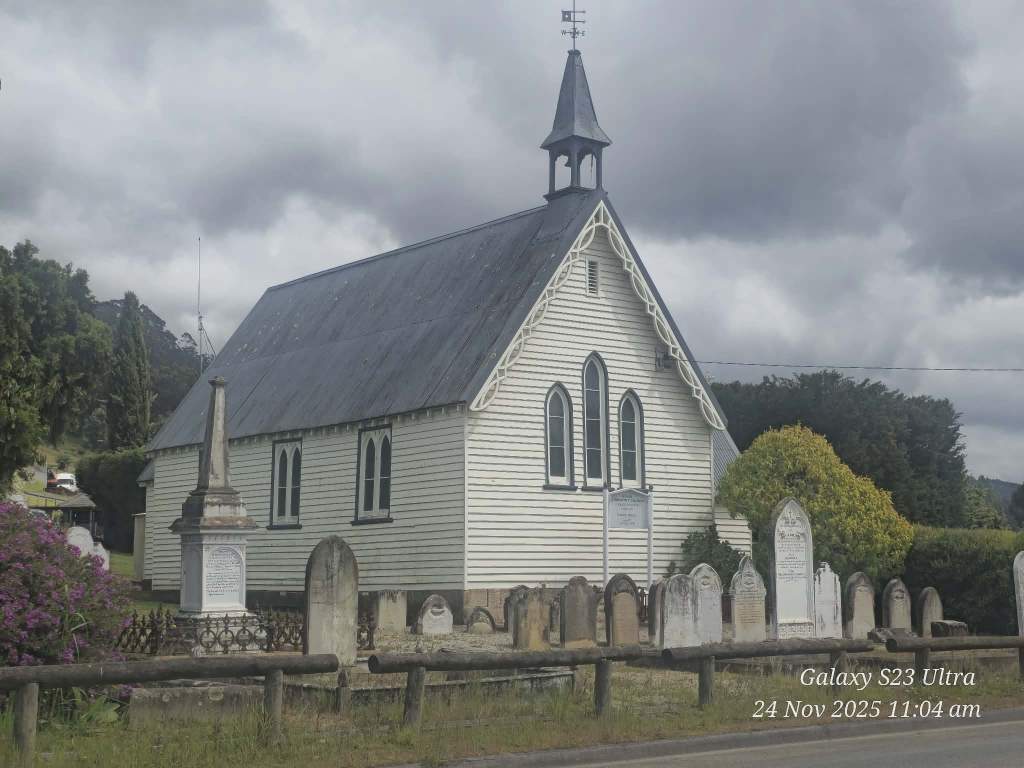
In Dover, we explored the museum, learning about maritime history and the shipwreck of the George III, and saw tributes to firefighters who battled the 2019 fires.
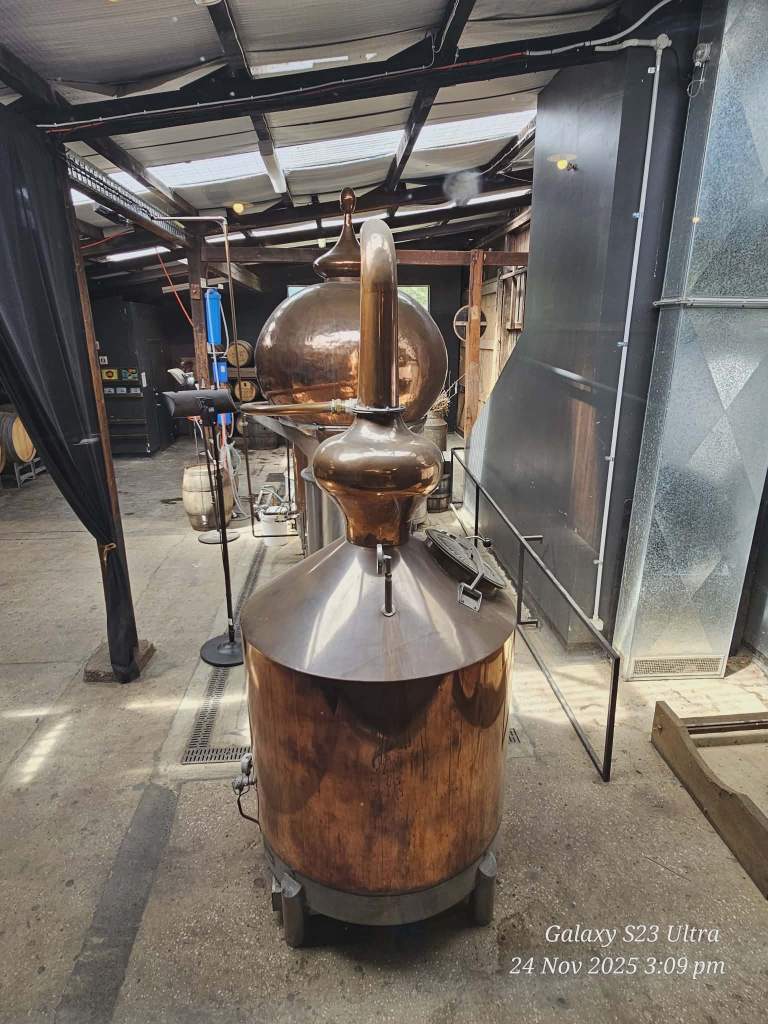
Our final stop before returning to New Norfolk was Willie Smith’s Apple Shed, where we learnt more about Tasmania’s apple-growing history — a fitting and gentle way to end the day.
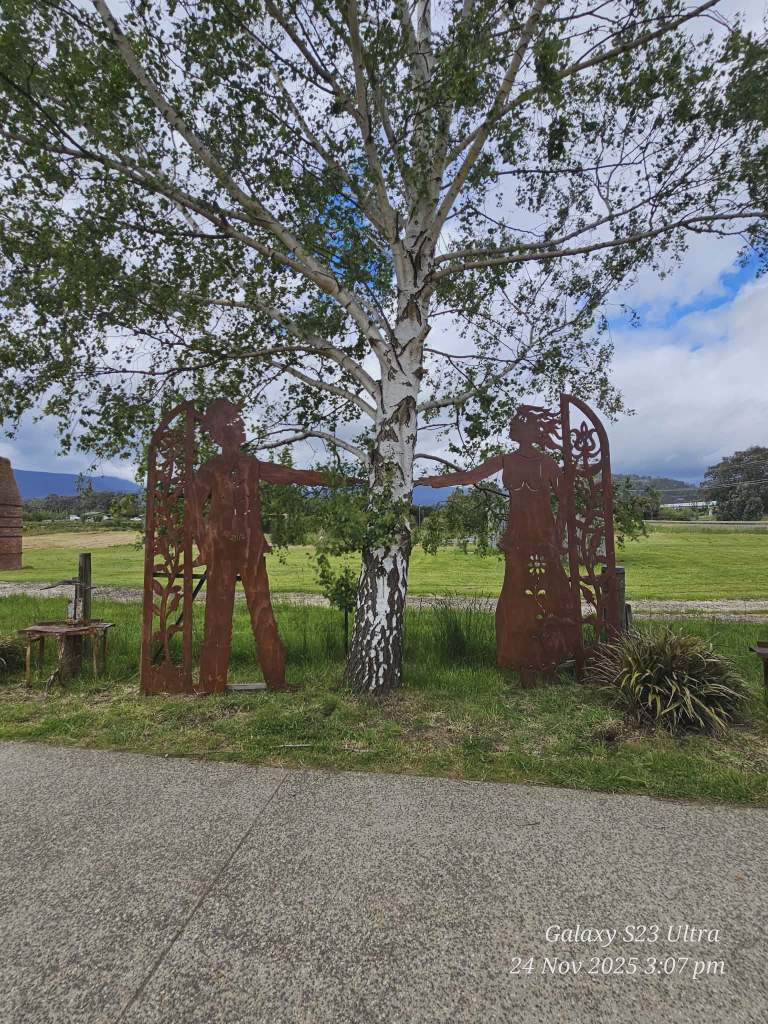
That’s all for now.
The wrap-up will come next. -
WEEK 3 — East Coast Magic, Jewel-Like Beaches & Dancing Skies
If Week 2 was about community spirit and country towns, Week 3 was all about Tasmania showing off — beaches so bright they looked photoshopped, seashells that could pass as gemstones, and an Aurora that waltzed across the sky just for us.
The East Coast is a place where nature doesn’t just whisper — it sings.
1. East Coast First Impressions — White Sand & Lichen Fire
There are some places where words barely keep up with reality, and the East Coast is one of them.
White sand so pure it squeaks.
Turquoise water that glows from within.
Granite boulders painted in blazing reds and oranges by lichen — like nature’s own graffiti.Every tide delivered fresh treasures to the shore: shells, driftwood, seaweed in jewel tones. An ever-changing gallery curated by the ocean itself.
This coastline is not just beautiful — it’s alive.
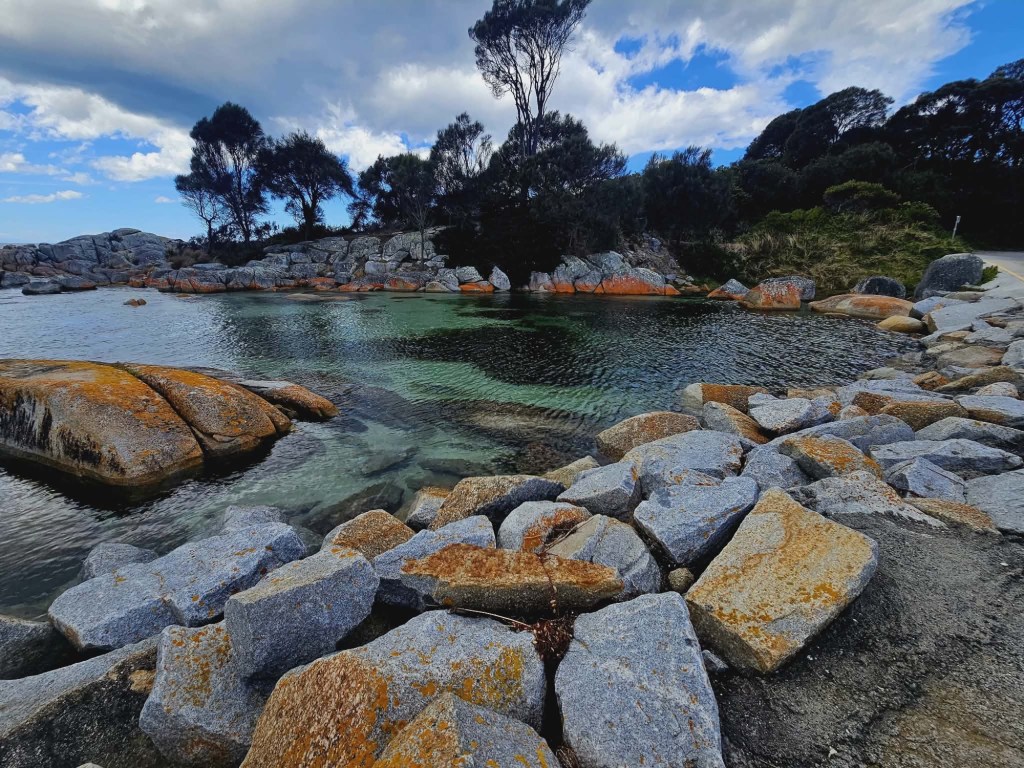
Lichen covered boulders 
2. St Helens Conservation Area — Dolphins & Daydreams
Our first stop was the St Helens Conservation Area, where we drove out to Akaroa and witnessed dolphins — actual dolphins — surfing in the waves.
I don’t often run out of words, but this time I did. Watching them dance through the swell felt otherworldly. Like the ocean had decided to share one of its best-kept secrets.
St Helens township itself was busy but cheerful. We grabbed lunch at the bakery, restocked at the IGA, and headed straight back to the coastline. The conservation area had left its mark, and we weren’t finished soaking it in.
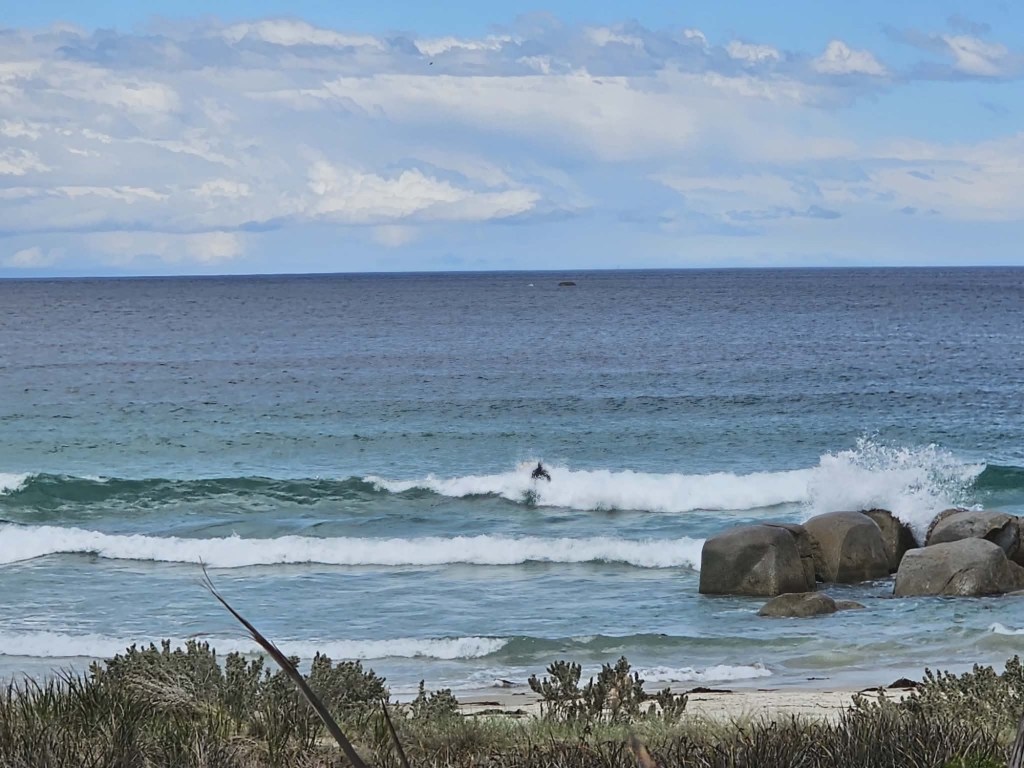
Dolphins surfing 
3. Jeanneret Beach — Seagulls With Personality
We parked up at a free beachfront camp at Jeanneret Beach, where the local seagulls introduced us to their social hierarchy.
There was definitely a boss — loud, pushy, and convinced he owned the place.
But our favourite was the one-footed gull, who held his own like a tiny feathered warrior.Two species joined us here:
✨ the elegant little Silver Gulls with their red beaks and hypnotic red eye rings
✨ and the much larger, moodier Pacific GullsSimple entertainment, but absolutely hilarious.

One-legged Silver Gull 
Pacific Gulls
4. Binalong Bay & The Gardens — Turquoise Heaven
Moving north, Binalong Bay and The Gardens offered more dazzling water, perfect sand, and the famous lichen-painted rocks of the Bay of Fires.
It’s impossible not to slow down here. Nature insists on it.
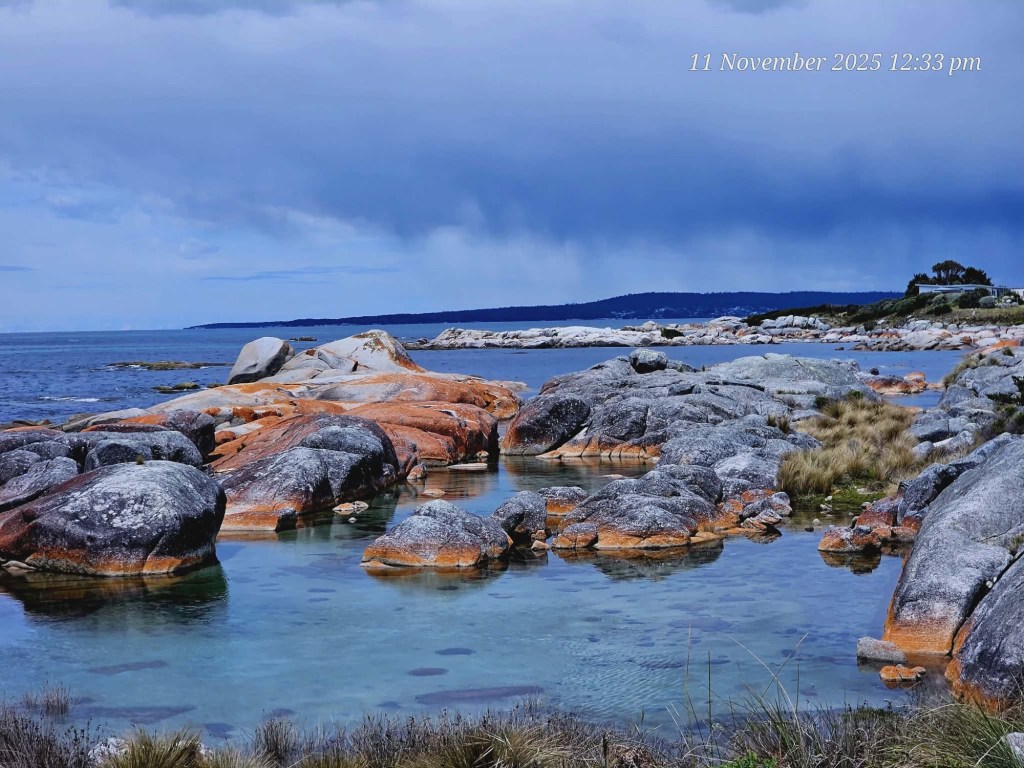
5. Shelly Point — Where the Beach Shimmers With Jewels
Shelly Point might be the most fittingly named place in Tasmania.
Turning right on the beach: thousands of cockle and scallop shells.
Turning left: tens of thousands of tiny spiral shells.Candy Cane Shells. Mermaid’s Tears. Their real name temporarily escaped me, but the magic did not.
They shimmered in the sun like tiny pearls — like the beach was sprinkled with diamonds. I could have stayed there all day, sifting through nature’s treasure.
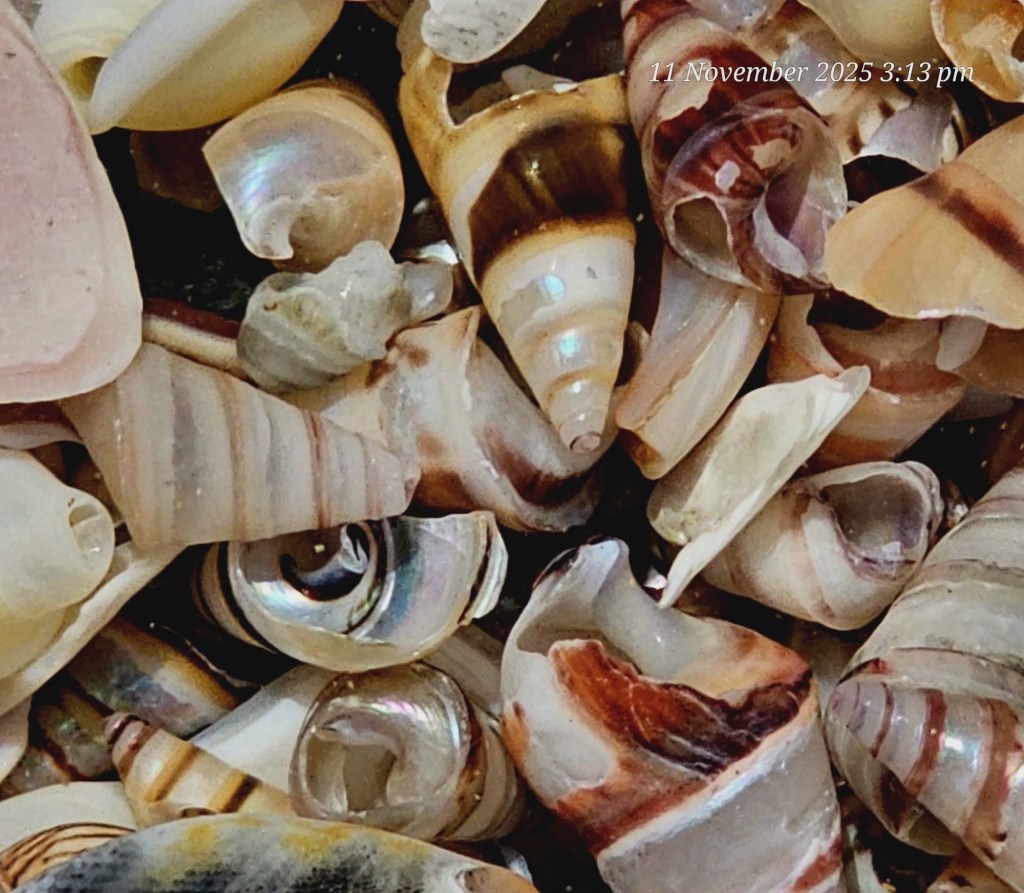
Mermaids Tears, Shelly Point
6. Scamander Sanctuary — Driftwood Art & Home-Cooked Comfort
Next stop: Scamander Sanctuary Holiday Park — $37 a night, and worth every cent.
The ensuite showers were heavenly, the camp kitchen was the best we’d seen (we even cooked roast pork and vegetables like proper grown-ups), and the local birdlife kept us company.
On the beach, someone had used driftwood to create public art — a natural sculpture garden shaped by tide, time, and whoever wandered through with an artistic impulse.
Scamander felt untouched. Quiet. Unspoilt. The kind of place you could easily lose a week — or more.

Scamander Beach Natures art 
Green Roaella
7. Bicheno Blowhole – at low tide
Yes it was low time but we still managed to capture the force of nature as the ocean erupted between the massive rock formation that creates the blowhole.
Once again nature provided with her magic, little sea creatures and shells caught in the water in crevices, perhaps waiting for the tide to return transporting them back from where they came.

Bicheno Blowhole 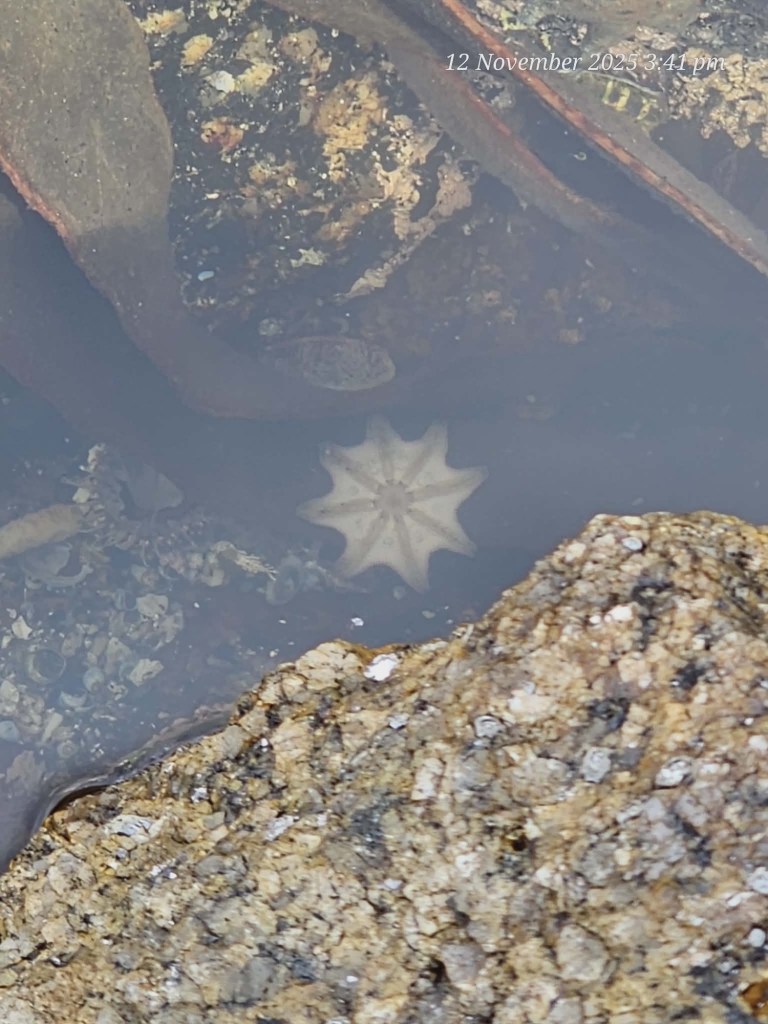
8. Spiky Bridge — Convict Engineering at Its Quirkiest
Heading south, we pulled in at Spiky Bridge, built in the 1840s by convicts who either had a very practical purpose in mind, or a quirky sense of humour.
Made entirely of spiky upright stones, it’s part art installation, part engineering relic — unmistakably Tasmanian.
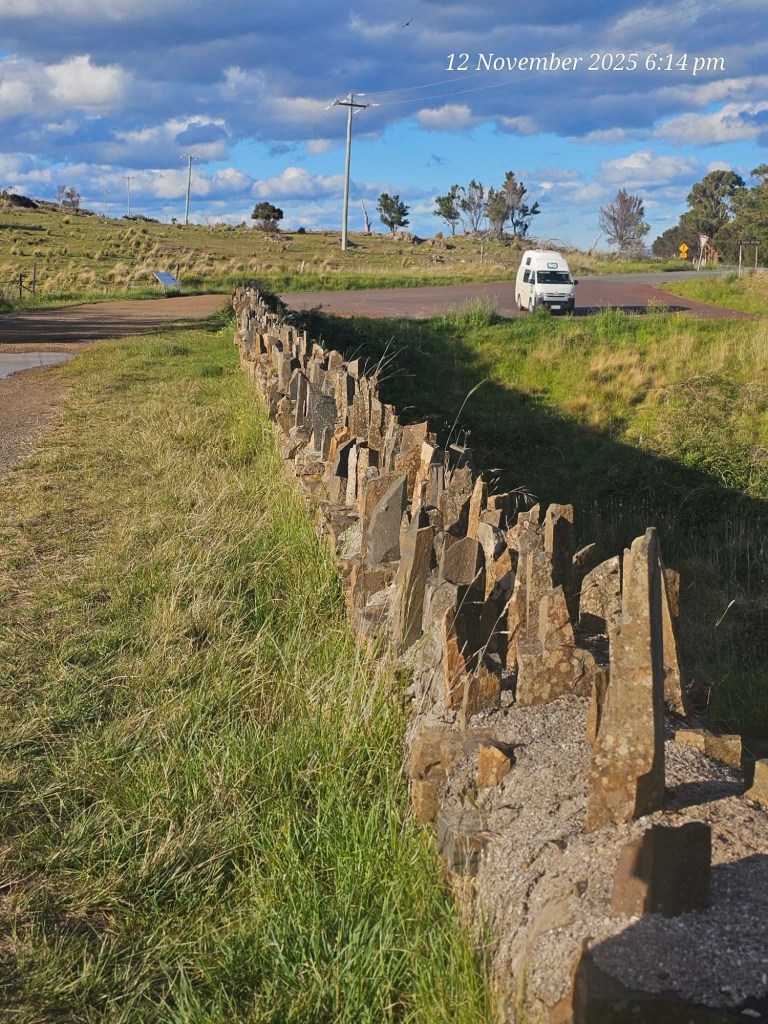
Spiky Bridge
9. Forest Tunnels — Mayfield Bay, Rocky Hills — Chasing the Aurora
We passed through a beautiful forest tunnel on the way to our next stop for the day. There is something quite surreal about driving slowly beneath the canopy of trees as they arch across the roadway to meet the trees from the other side thus forming a tunnel.
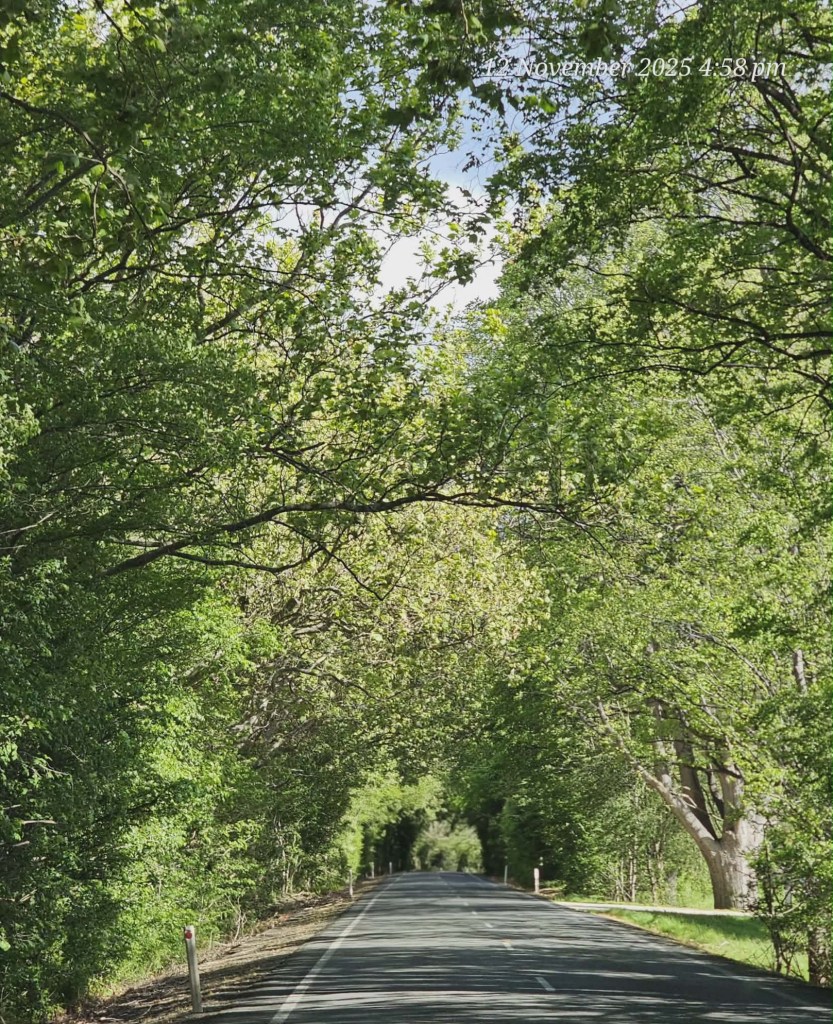
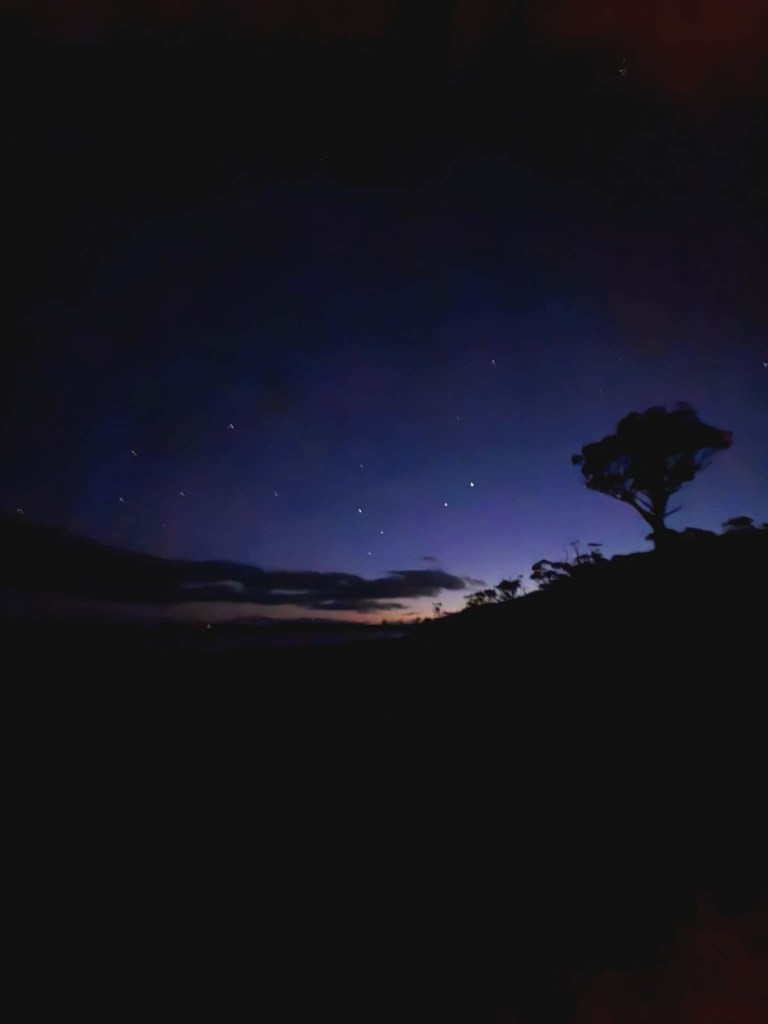
Forest Tunnel near Swansea We found a rustic beachside campsite at Mayfield Bay — toilets only, but a million-star location.
And we had a mission:
✨ see the Aurora Australis ✨
Bucket list for both Leslie and me.Aurora activity was predicted from midday, and we noticed strange colours in the sky shortly after. Was it aurora? Was it cloud play? Unsure — but intriguing.

Unusual daytime colours before the Aurora 
Was this the beginning of an Aurora or something else That night we bundled up in the freezing cold and waited.
And then…
Magic.The sky danced.
Not bright to the naked eye, but through the camera — breathtaking.
Greens, reds, purples — a celestial curtain swaying across the southern sky.A moment I’ll never forget.
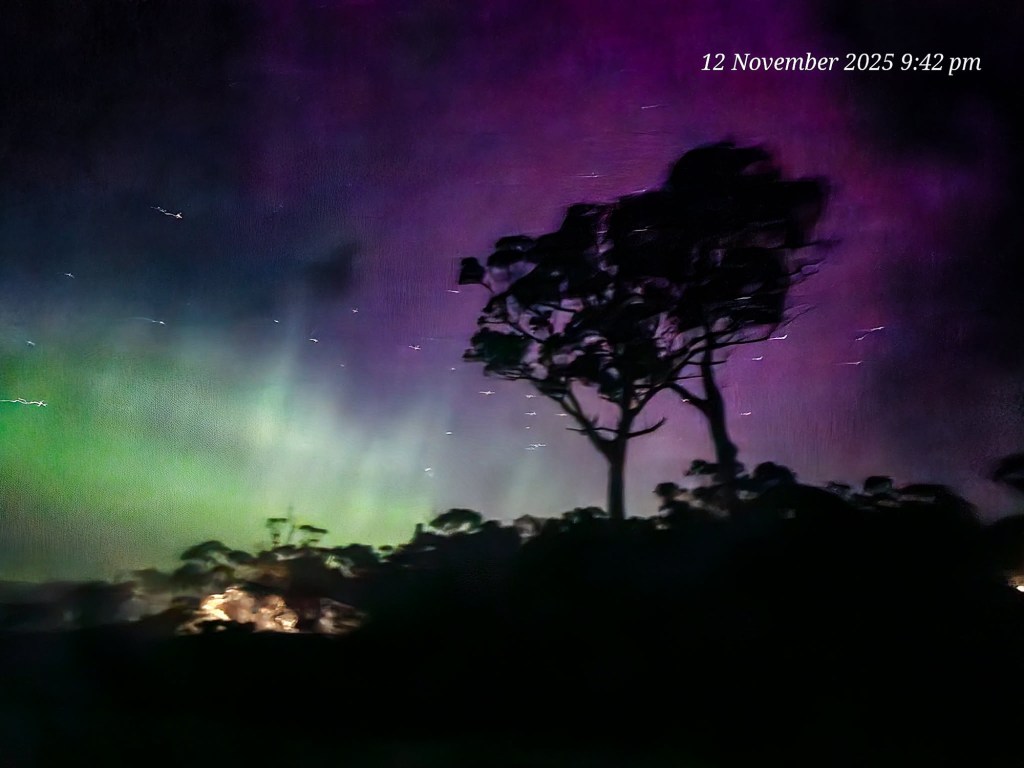

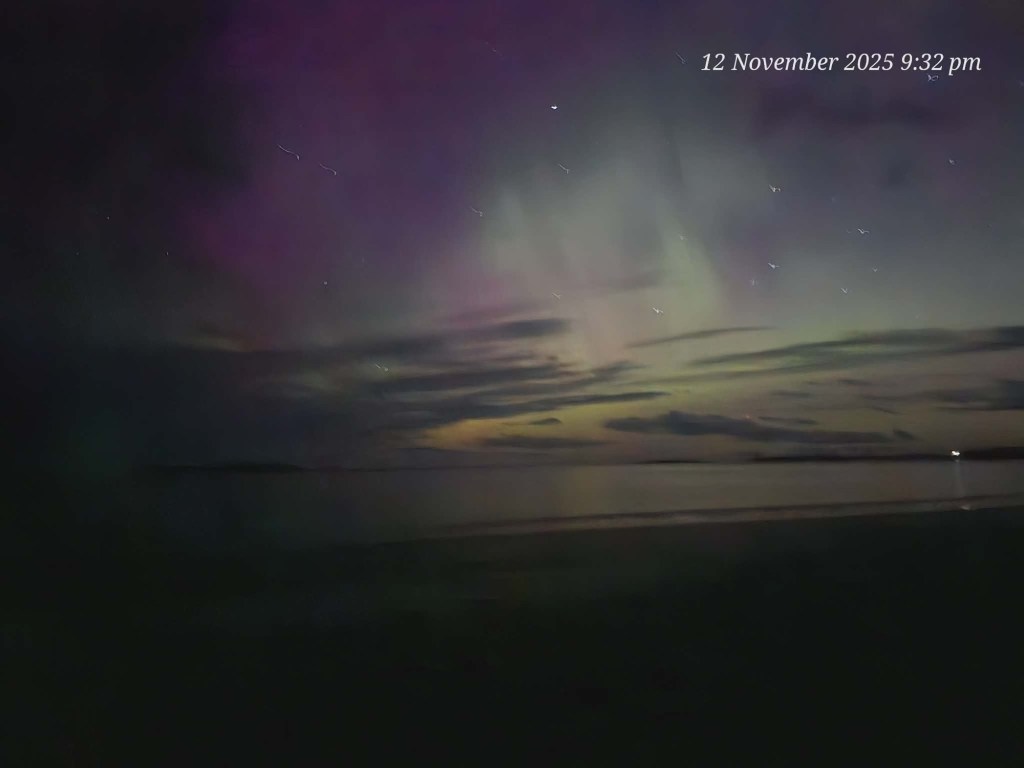

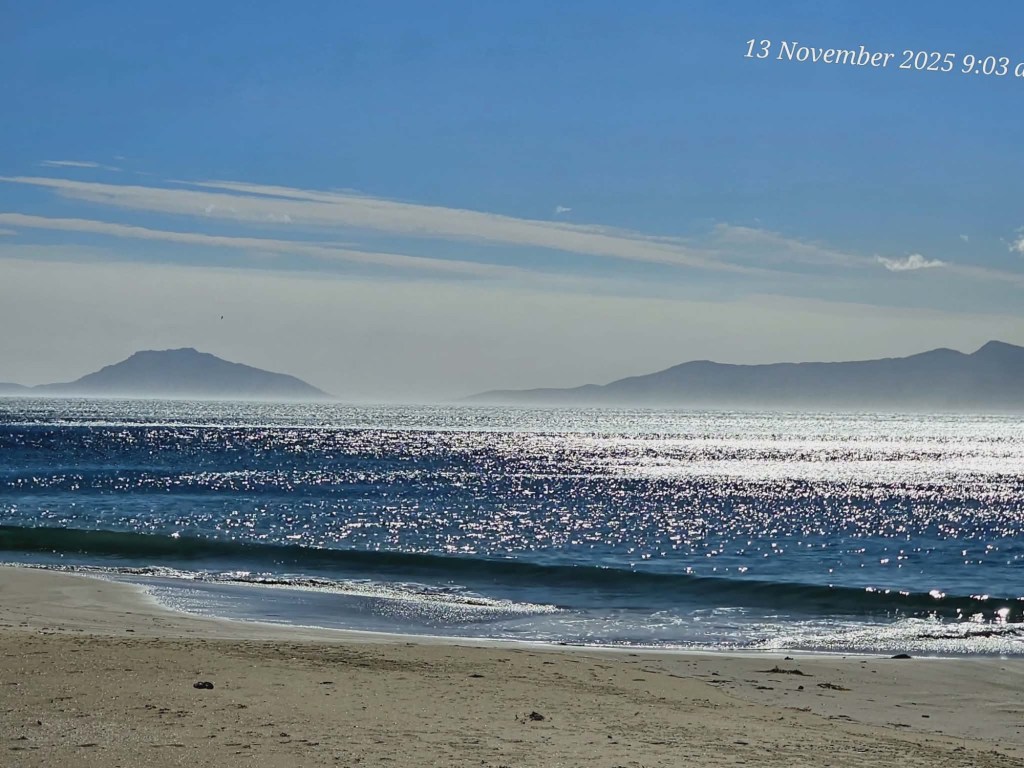
We stayed a second night in the wild wind, hoping for a repeat. A full rainbow greeted us in the morning, sun shimmering jewel like over the water like a promise. That night we captured some night colours, but no definite aurora. Still — the cold was fierce, so we surrendered and headed to bed early.
10. Triabunna — Maria Island Will Have to Wait
We stopped into Triabunna to check ferry times for Maria Island. With the van needing to be back in New Norfolk soon, we knew we’d save that adventure for later.
Maria Island wasn’t going anywhere — Tasmania always leaves you with reasons to return.
11. Buckland — A Church of Light & History
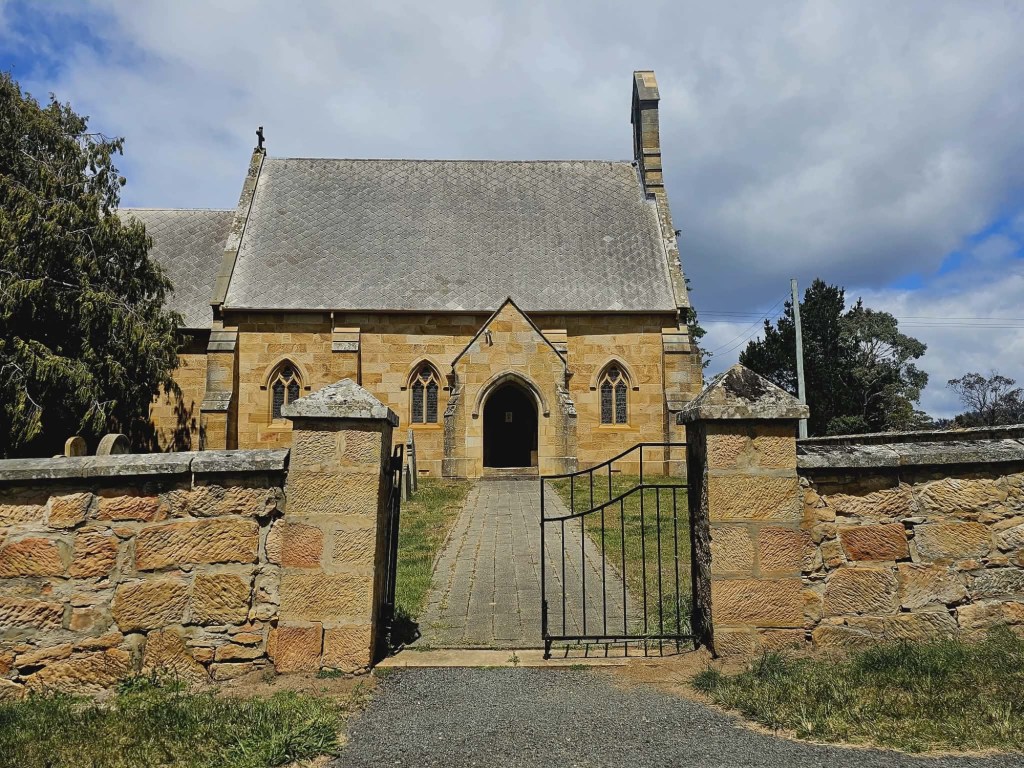
In Buckland we visited the 1846 convict-built Anglican Church of St John the Baptist.
Its famed East Window — believed by some to date from the 14th century — glowed spectacularly in the sunlight. Ten panels forming a tall, elegant lancet structure, illuminated in stunning colours.
Outside, the old graveyard whispered stories of early settlers.
Nearby stands Ye Olde Buckland Inn, one of Tasmania’s oldest pubs, built around 1840 and full of character.
St John The Baptist church 
12. Tasmanian Bushland Garden & Sculpture Park — Volunteers With Vision
This garden is a quiet treasure.
What began as the dream of a few locals — showcasing native plants of South East Tasmania — has grown into a beautiful space filled with sculptures, interpretive storyboards, and native flora.
I’d visited in 2018. Returning now, I could see how much progress had been made. Proof of what small, dedicated groups can achieve.

Gardens
13. The Sorell Causeway — A Road Through the Water
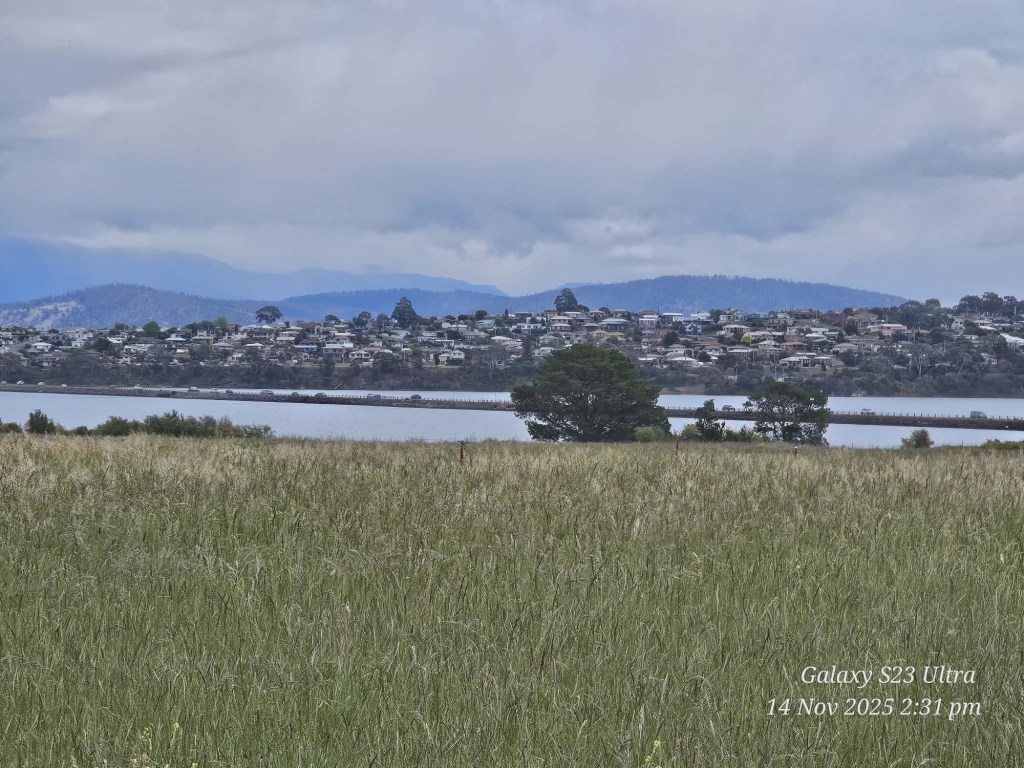
Leslie was fascinated by the Sorell Causeway, and I remember the first time I drove it years ago — high tide, waves curling up the side, and my knuckles gripping the wheel in a delicate shade of terror.
This time the tide was low and the history revealing itself:
Convict-built beginnings in 1850
Completed in 1872
Designed to shorten travel and support a railway
Modern reconstructions linking with McGees BridgeA road with a story.
Sorell Causeway
14. Back to New Norfolk — Rest, Real Beds & Regrouping
Week 3 was shorter for travel because we aimed for New Norfolk — a couple of days of real beds, long hot showers, and a break from the road.
My van needed to be organised to go back on the tow truck for repairs, so we paused, recharged, and prepared for Week 4.

New Norfolk sunset
🌊 And That’s Week 3
If Week 1 was mountains and mist, and Week 2 was heart and history, then Week 3 was pure nature worship.
From jewel-like shells to turquoise water…
from driftwood art to dolphin dancers…
from ancient stained glass to a sky alive with colour…The East Coast gave us everything — calm, wonder, and a little cosmic magic.
-
WEEK 2 — Caves, Cheese, Coastlines & Community Spirit
Travelling with Leslie is one of life’s great certainties. We’ve done enough adventures together to know we share the same travel philosophy: slow down, take the roads less travelled, and always stop for anything involving nature, cheese, or suspiciously magical-looking moss.
Week 2 served all of that — and more.
1. Sunshine, Mountains & Mole Creek Bound
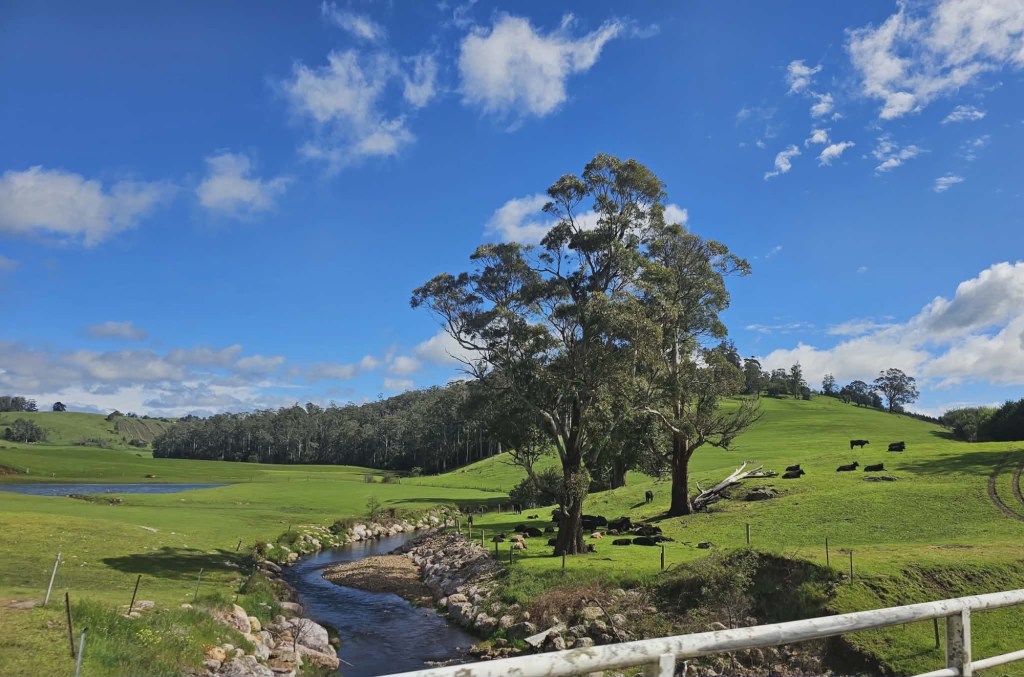
We woke to a morning so bright it felt like Tasmania was apologising for Week 1’s dramatic weather. With the sky scrubbed clean and the air fresh enough to taste, we turned the van north before curving south along yet another winding mountain road — the kind Tasmania specialises in.
Everything about the drive to Mole Creek felt like a gentle invitation to slow down and see. Not just look, but see — the way morning light falls through trees, the sweep of green hills, the tiny wonders most people miss when life moves too fast.
Marakoopa Caves — Glow Worms & Quiet Bravery
In 2018, I did something I never thought I would: I stepped into a cave despite my claustrophobia. It changed something in me. Ever since, I’ve carried a quiet kind of courage — the kind that only grows when you do the thing that scares you.
So back I went, this time with Leslie, and we picked the Great Cathedral & Glow Worm tour. Beautiful, yes. Impressive, yes. But after the magnificence of the Underground Rivers tour I’d done previously — the one that stole my fear and replaced it with wonder — the Cathedral felt gentler, smaller.
Still, caves are extraordinary.
A constant 9°C.
Walls shaped by time and water.
Glow worms clinging to ceilings like fragile stars.And endless opportunities to bash your head if you forget to duck.

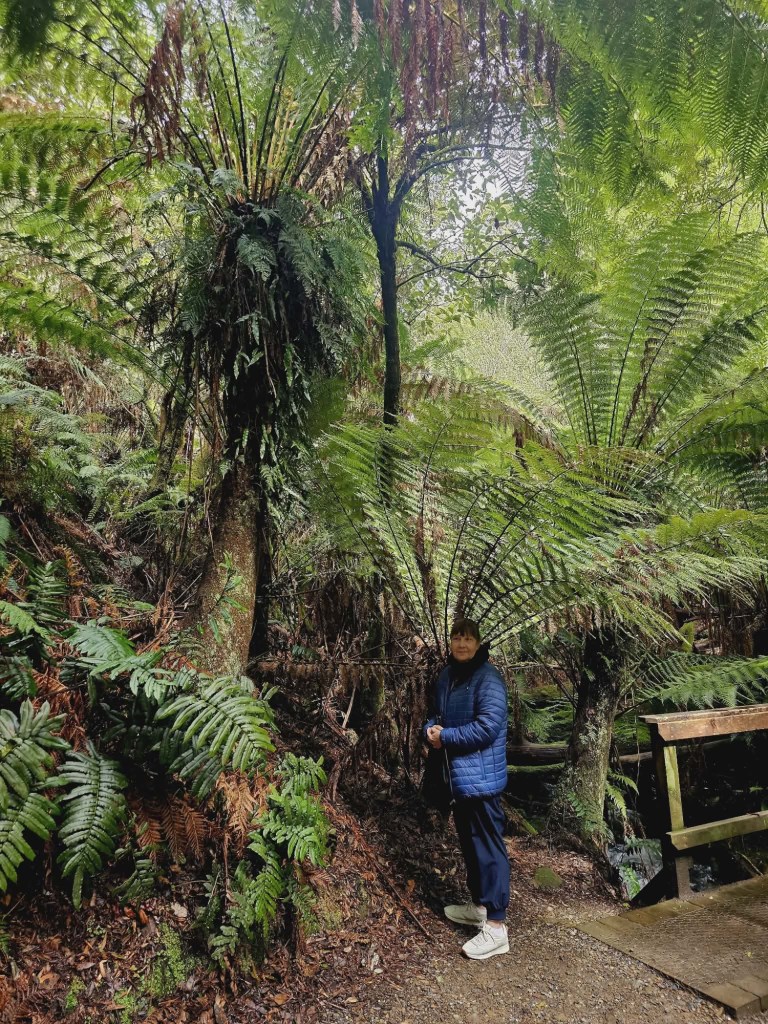
Leslie dewarfed by the beautiful regal tree ferns 
Mole Creek Caves 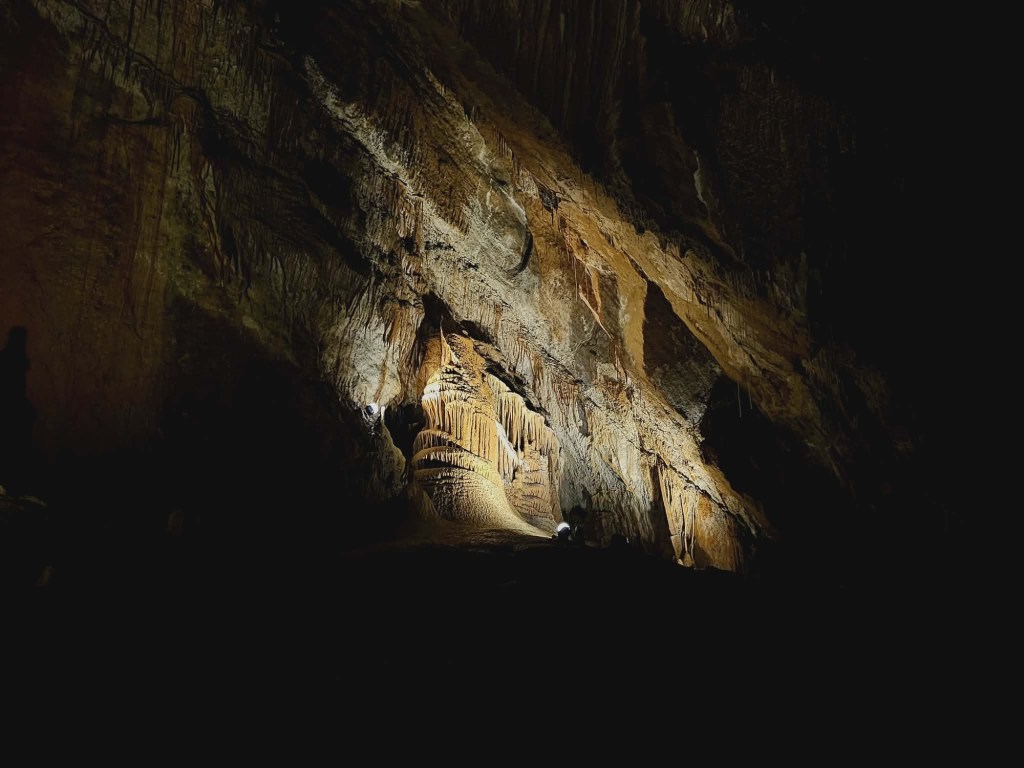
In the Cathedral
3. Honey, Cheese & Ice Cream — The Holy Trinity
Back on the road, our tastebuds led the way.
Melita Honey Farm — Chudleigh
My daughter had placed an order for her favourite Red Gem honey — the only honey she’ll eat. Naturally, we complied.
Naturally, we taste-tested everything in sight.
Naturally, a Pistachio Honey came home with us too. 🍯
Melita Honey, no other distribution point and can be purchased online. Ashgrove Cheese
My all-time favourite. You’re greeted by painted cows — part art project, part dairy education — and it’s impossible not to smile. We stocked up on our bodyweight in cheese, doing our bit for the local economy.
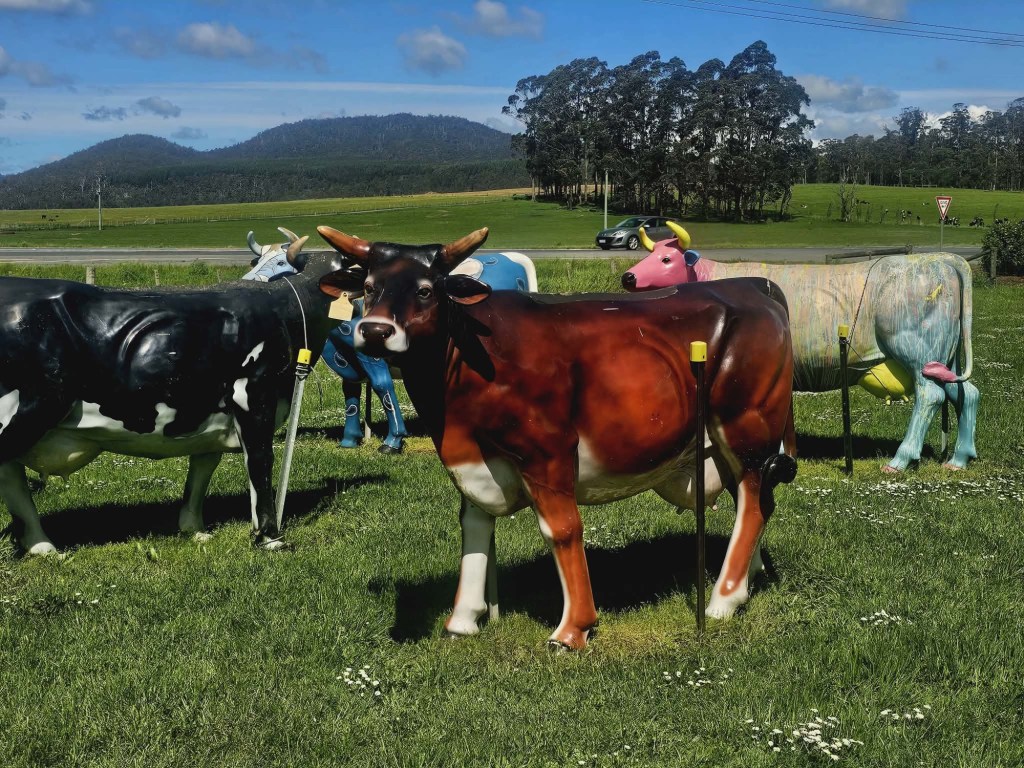
Ashgrove Cheese painted cows 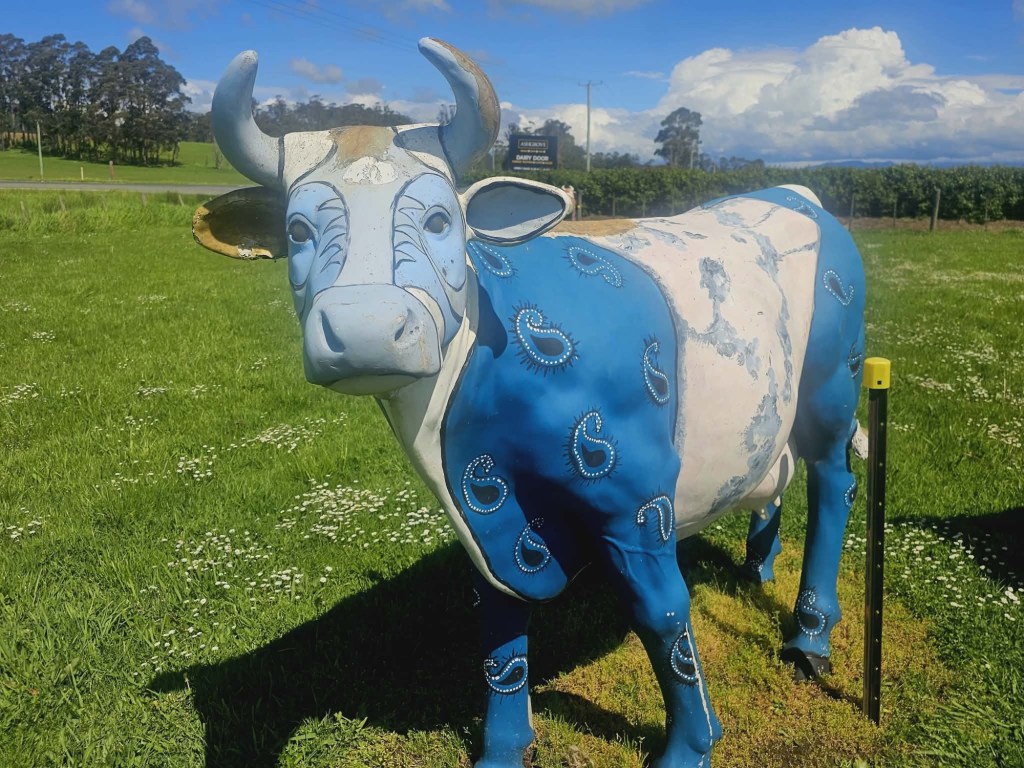
Another painted cow, too many to share them all 
Ashgrove Cheeses Christmas Hills Raspberry Farm (…too early!)

Delish ice cream Not a raspberry to be found. But consolation was just across the road at Van Diemen’s Land Creamery, where we indulged in ice cream and admired some stunning cotton thread artwork by a local artist. Her work has to be seen, photo doesn’t do it justice. The colours are vibrant and detail is intricate. https://www.facebook.com/cindywatkinsartist?

Cotton Thread work by Cindy Watkins.
4. Launceston: When the Bunnies Lie to You
Our overnight stop near Launceston looked promising at first: adorable bunnies hopping everywhere like tiny omens of cuteness.
And then we saw the amenities.
Oh dear.So bad that even our low expectations backed slowly away and refused to participate. We opted for a “road trip bath” instead of the showers and avoided the camp kitchen entirely. Cleanliness? Not today.
Leslie’s attempt to climb to the upper bunk — which was more board than mattress — became the comedic highlight of the evening. I, smugly, had my 15-cm mattress rescued from my dearly-missed van.
Lesson learned: ALWAYS check the reviews.

Deceiving cuteness 
Hijinks on the top bunk
5. Grindelwald — A Swiss Surprise in Tasmania
Morning saw us fleeing Launceston at speed and heading to Grindelwald, a charming Swiss-style village created by a Dutch migrant with a dream.
Chalets, flower boxes, a bakery that delivered a beautiful breakfast — it was whimsical and strangely peaceful.

6. Beaconsfield Mine — Strength, Memory & Community Spirit
This visit was different.
Quiet.
Emotional.
Grounded.Like many Australians, I remember the 2006 Beaconsfield mine disaster vividly — the collapse, the rescue operation, the endless days of uncertainty. I was glued to the news each night after work, watching a small community hold its breath.
But visiting the site — standing where those events unfolded — stirred something deeper.
You know this already: I’ve worked alongside communities after natural disasters. I’ve seen what resilience really looks like — ordinary people rising to extraordinary challenges, linked together by something invisible but powerful.
Walking through Beaconsfield Mine’s displays and stories brought all of that back.
The strength.
The heartbreak.
The unity.
The determination to keep going even when the outcome was unknown.One life lost. Two lives saved.
A community forever changed.It’s hard to find words for the feeling — but it’s something like reverence.
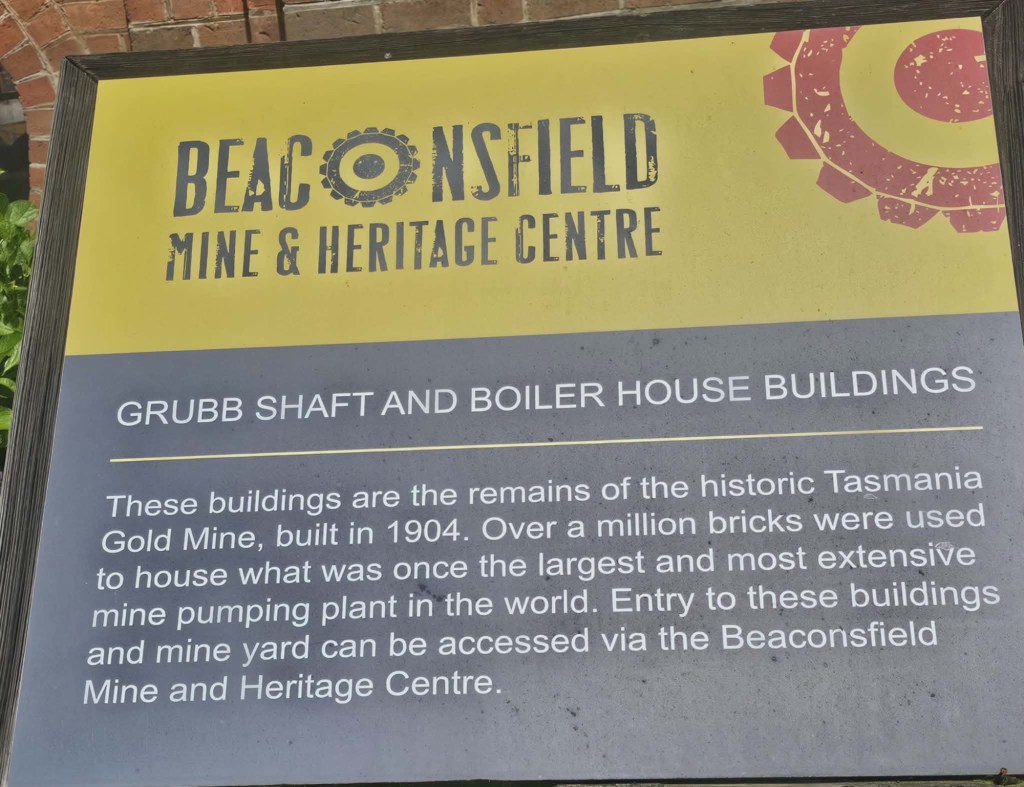
Insert photo: Beaconsfield Mine exterior or exhibits]
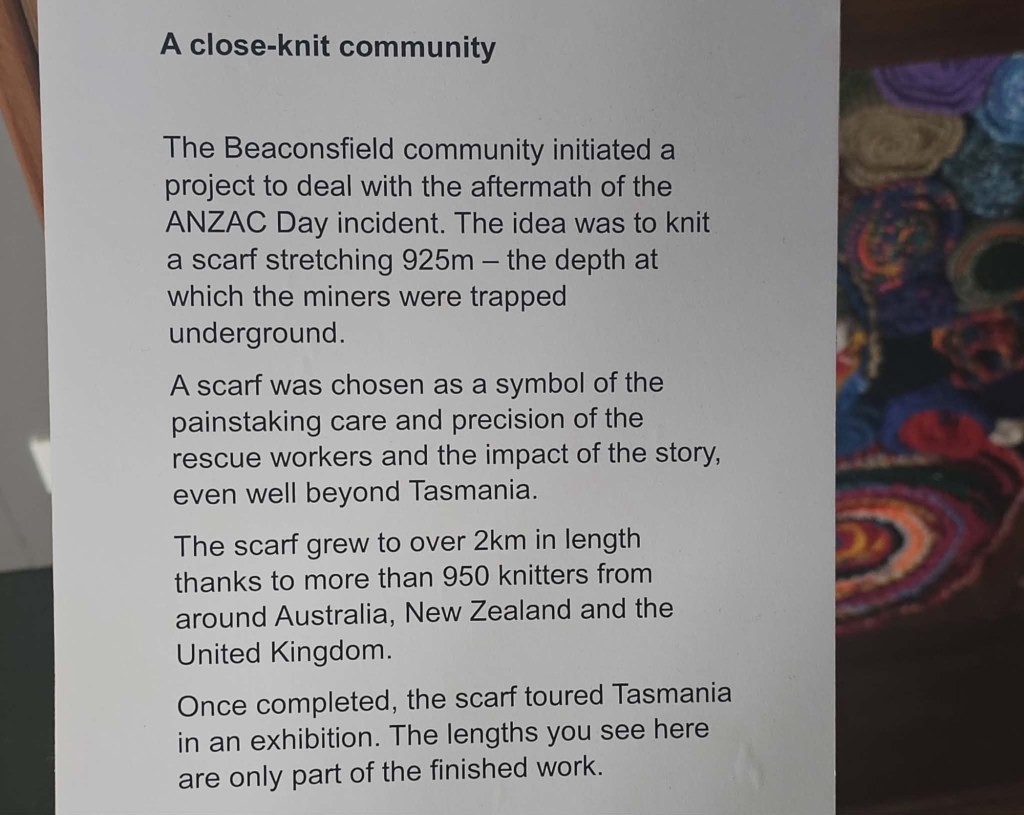
An amazing project linking community together across the oceans. 
A visual reminder of the strength of what can be achieved when community come together
7. Seahorse World, Handfish & Blue Fairy Wrens
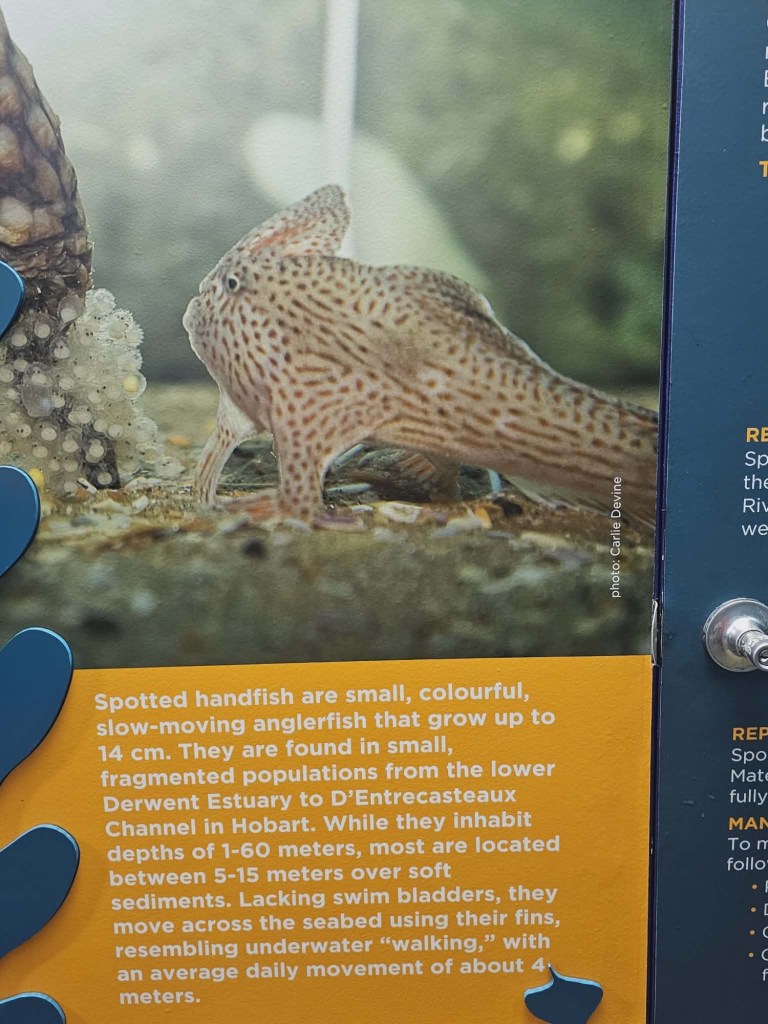
A gentler rhythm returned at Beauty Point. Seahorse World offered colour, curiosity, and the charming oddity that is the Handfish — rare, unusual, and full of personality.
Our caravan park was the opposite of Launceston’s: peaceful, clean, and alive with blue fairy wrens dancing around the van like living confetti.
We stayed two nights, rested, and watched the moon shimmer across the water — my favourite kind of quiet magic.


Moonlight on the water
8. Greens Beach & A High-Point View
We drove up to Greens Beach and began to venture toward the lighthouse, but the track through the National Park looked questionable. Instead, we wound our way to the highest viewpoint and admired the sweeping coastline from above.
Beautiful, moody, windswept — classic Tasmania.
9. Low Head — Penguins, Rain & Nature’s Little Artworks
Cold. Rainy. Wind-whipped.
But we were determined to find penguins at Low Head — and we did: one adorable bird peeking from a nesting box.The lighthouse still boasts the only operational Type D Diaphone Foghorn in the world, lovingly restored. It sounds at noon every Sunday and must shake the souls of seagulls for kilometres.
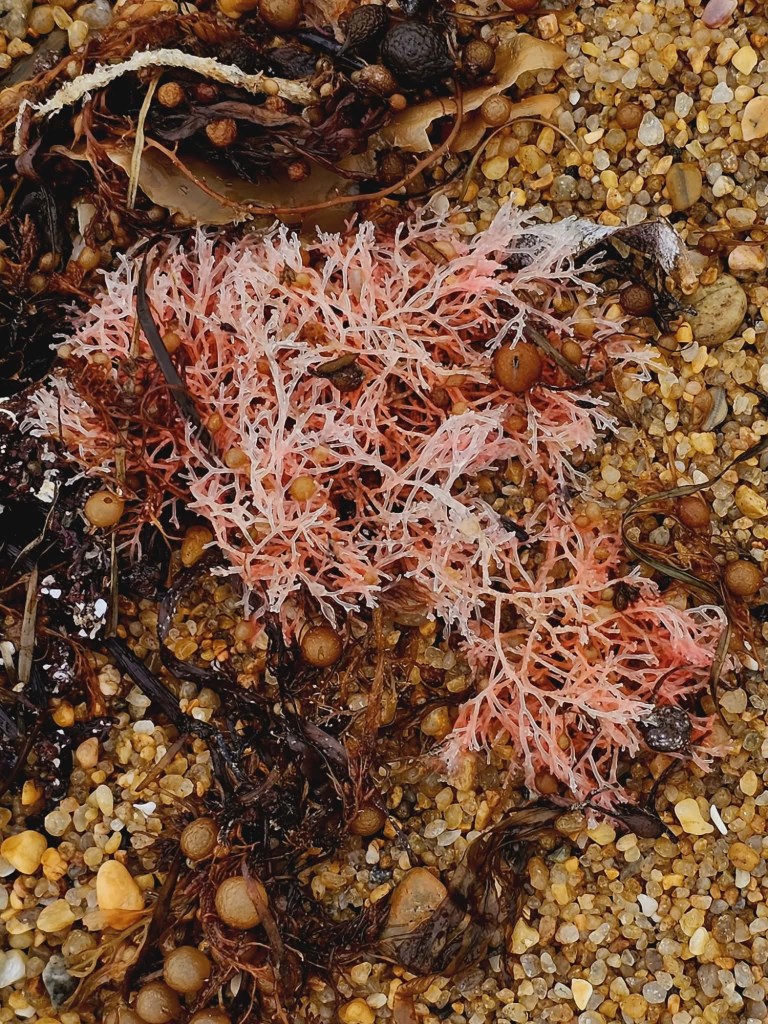
The beach looked ordinary at first glance, but as we walked, its secrets revealed themselves: coloured algae, tangled seaweed, shells, tiny treasures the sea gifts to those who slow down enough to notice.
This is why I love nature.
This is why I travel slowly.
Beauty is always there — but you must meet it halfway.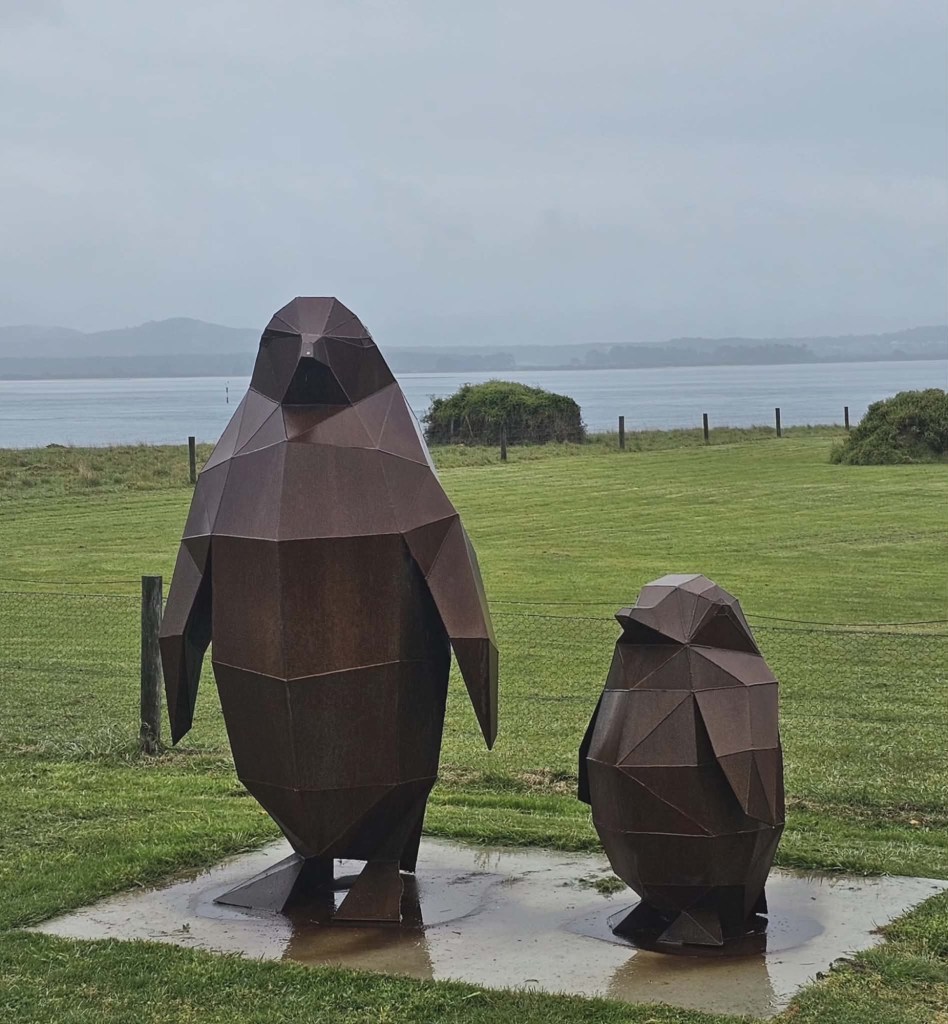

10. Scottsdale — Clouds, Quiet & War-Time Stories
Driving inland, clouds hung low over the mountains like soft grey blankets. Scottsdale RV park was peaceful, with ponds, ducks, and donated facilities that were surprisingly good.
But the standout was the Children’s Park — a thoughtful blend of play space, gardens bursting with rhododendrons, and heartfelt tributes to men and women who served in war. A gentle way of teaching history to young hearts.


A small section of the war memorabilia in Scottsdale Children’s Park
11. Pyengana Recreation Reserve — Good Food & Good People
Pyengana was a delight.
We met three lovely local women having their own Melbourne Cup celebration, complete with paddock “race.” Their laughter was infectious and became one of those unexpected moments that make travel feel human and warm.
The next day brought a car boot sale at the Pub in the Paddock, home of Priscilla the drinking pig. We declined to fund her next beer — someone has to think of her liver.
Lunch at the Pyengana Farmgate Café was incredible. Bangers and mash so good I’m still thinking about them. We toured the automated dairy and watched contented cows wander in whenever they felt like being milked — absolute queens.
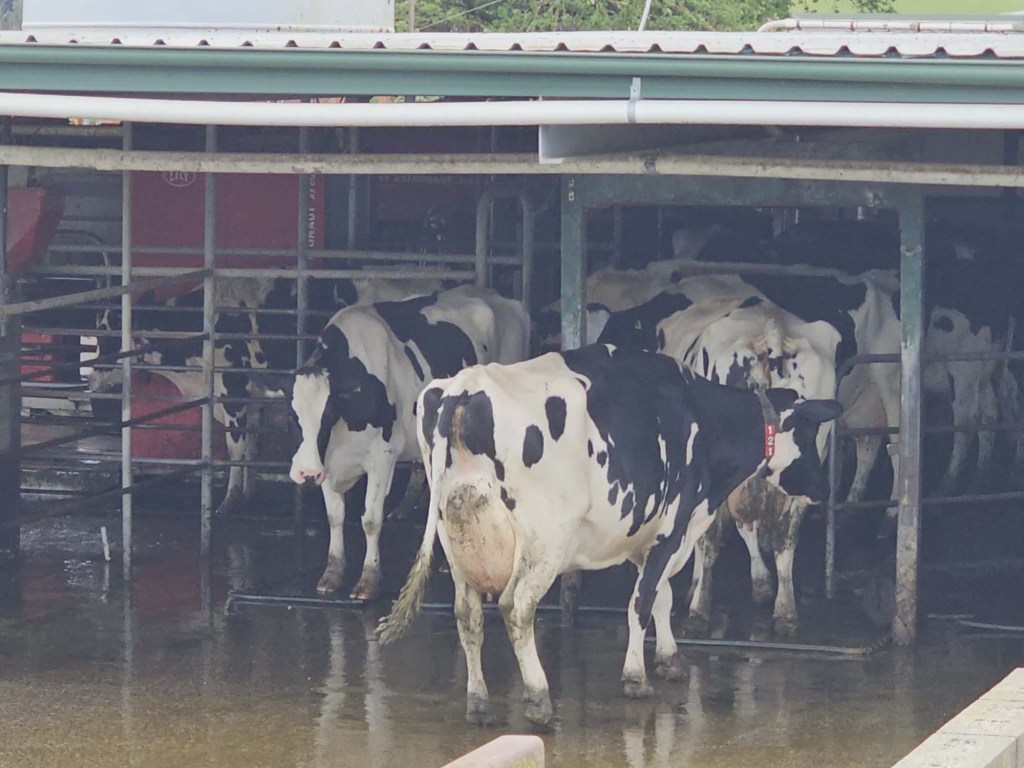
Very contented cows patiently waiting to be milked 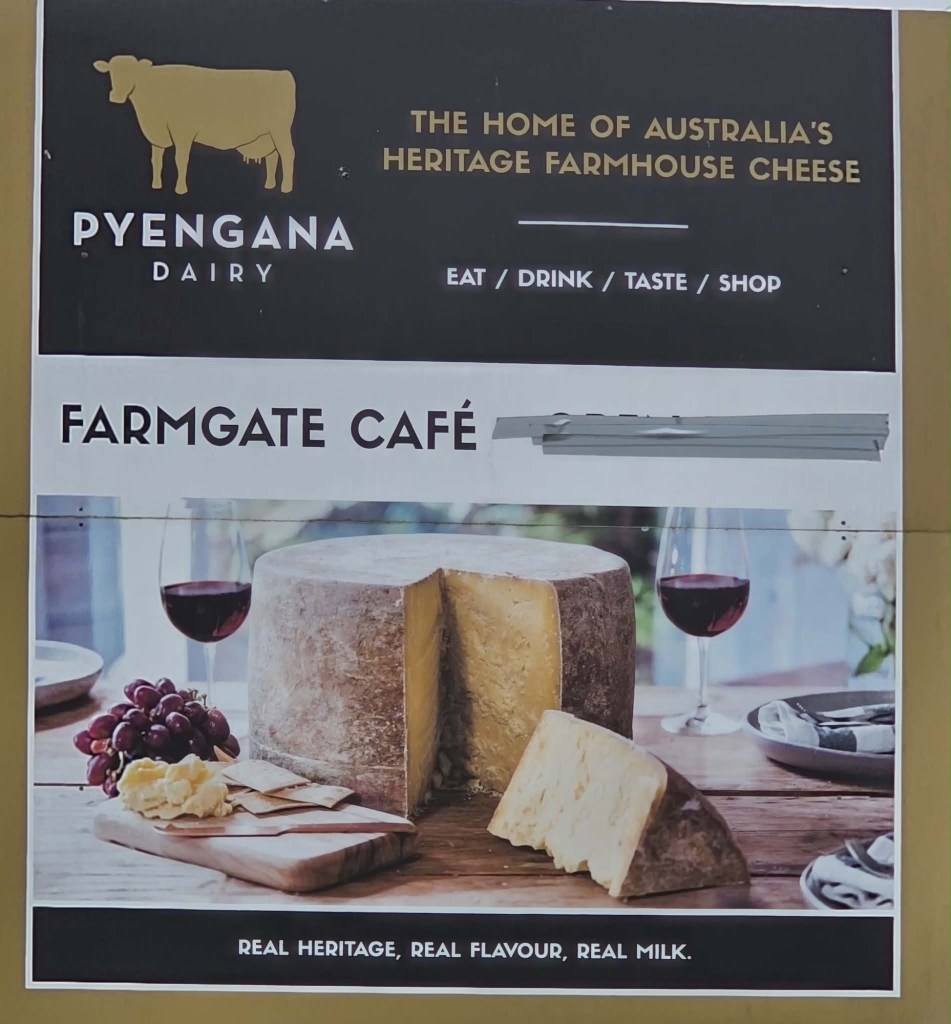
12. St Columba Falls, Purple Drop Bears & Hidden Halls Falls

St Columba Falls St Columba Falls were closed due to rockfall damage, but the universe compensated with a sighting of a Tasmanian drop bear.
Purple, no less.
Very rare.
Possibly cold.
Almost definitely plastic… but who’s checking?A local pointed us toward Halls Falls — a tricky walk down, but absolutely worth it. Water, light, and forest in perfect harmony.
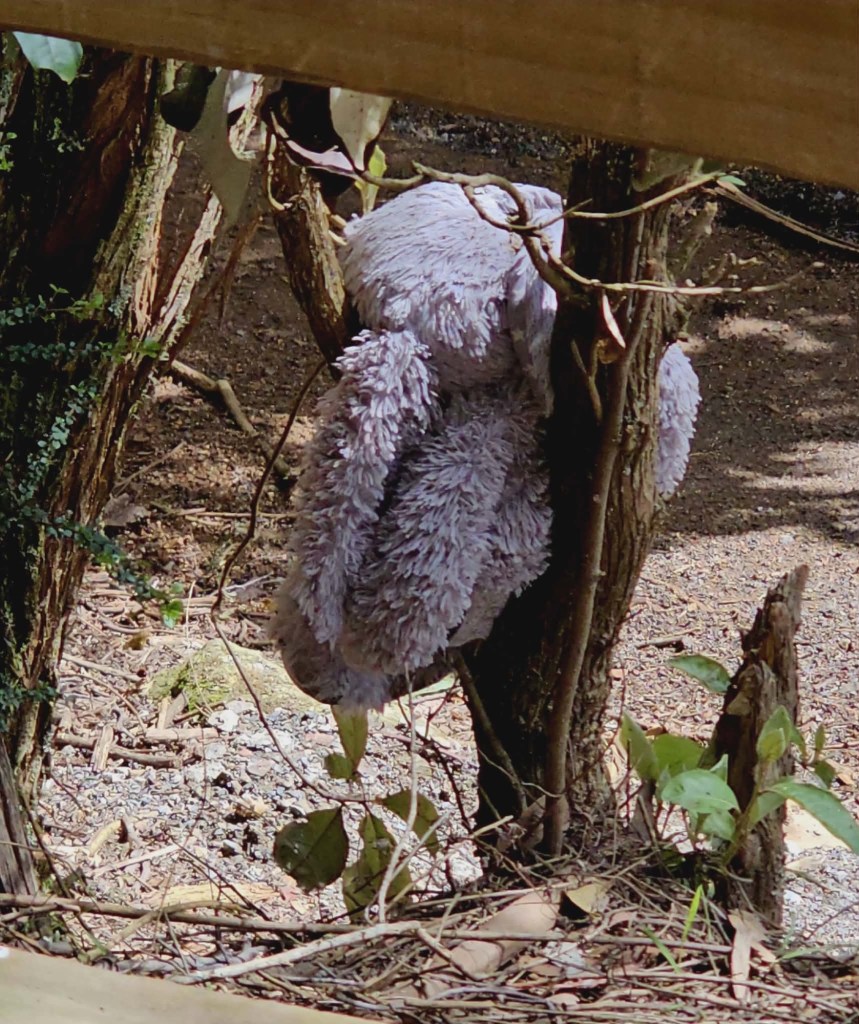
Tasmanian Drop Bear?? 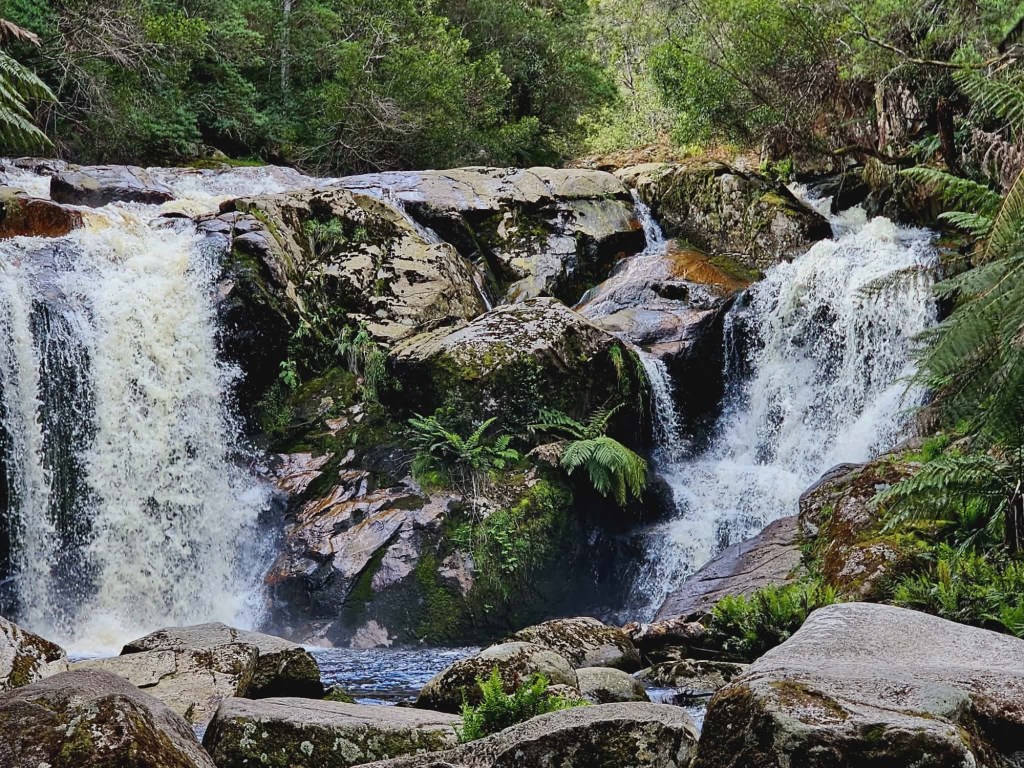
Halls Falls
13. Heading East — Where Week 2 Ends & Paradise Begins
We rolled toward St Helens to end the week, the first hints of the East Coast appearing like a promise.
The beaches deserved — and received — a blog post of their own.
But that’s for Week 3.
🌊 And That’s Week 2
Week 2 was a perfect balance of beauty, human stories, small wonders, and the kind of gentle wandering that fills the soul rather than the schedule.
Nature dazzled.
Communities inspired.
Roads meandered.
And Leslie and I continued doing what we do best: travelling slowly, laughing often, and noticing the details everyone else rushes past. -
WEEK 1 — Winds, Waterfalls & Wandering Wombats
Prologue — Getting to Tassie: Winds, Silo Art & Sheer Determination
Before Week 1 officially begins, I need to acknowledge the warm-up act: my epic 3,000-km solo drive from Queensland, zig-zagging through NSW in search of silo art like a woman on a mission. After one ocean crossing and a whole lot of caffeine, I finally arrived in Devonport on 5 October – just in time to be greeted by winds wild enough to blow the freckles off your face.
I retreated inland to New Norfolk, where Tasmania decided to continue its wind-based hazing ritual while I caught my breath. A few days of recovery, rest, and questioning my life choices later… it was time for the “real” trip to begin.
My beloved home on wheels, however, chose that exact moment to stage a dramatic breakdown. She’d carried me faithfully across three states and one sea, but apparently Tasmania was a bridge too far – so off to the mechanics she went.

When the wind wasn’t blowing me off my feet, the mountains were shrouded in clouds and cold rain. 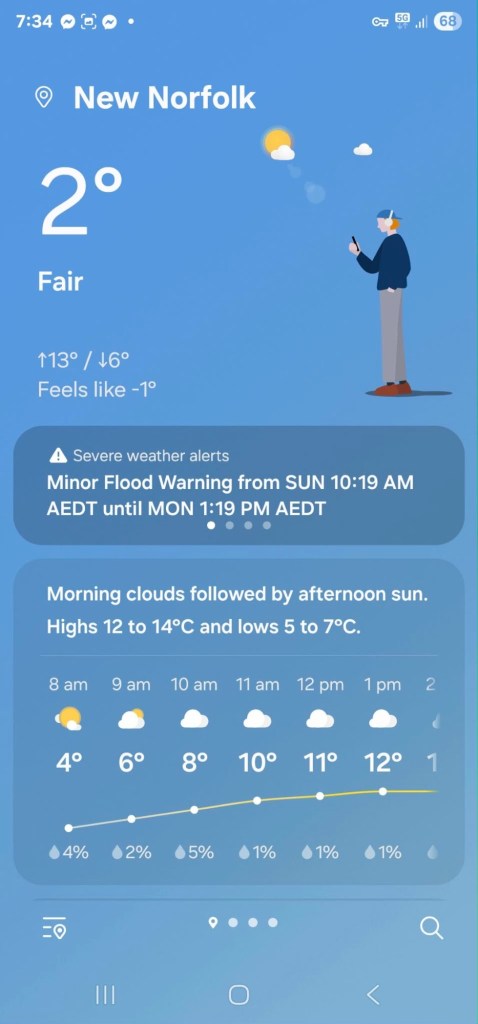
I arrived to several weeks of this. 
Beautiful but a tad cold for a Queenslander Day 1 — My Travel Buddy Arrives (right after – My Van Gives Up Immediately)
On 28 October, my Queensland travel buddy arrived to join the fun.
Cue: one hastily-hired smaller van. Not entirely off-grid, not entirely ideal, but entirely good enough to keep the adventure alive. And that’s all we needed.
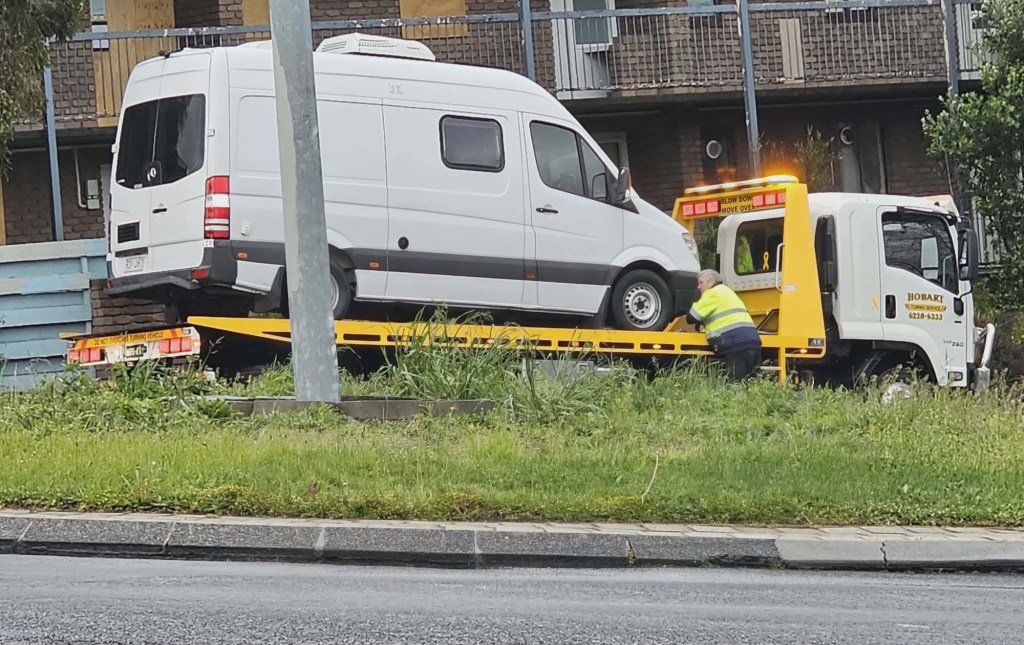
From this ….. 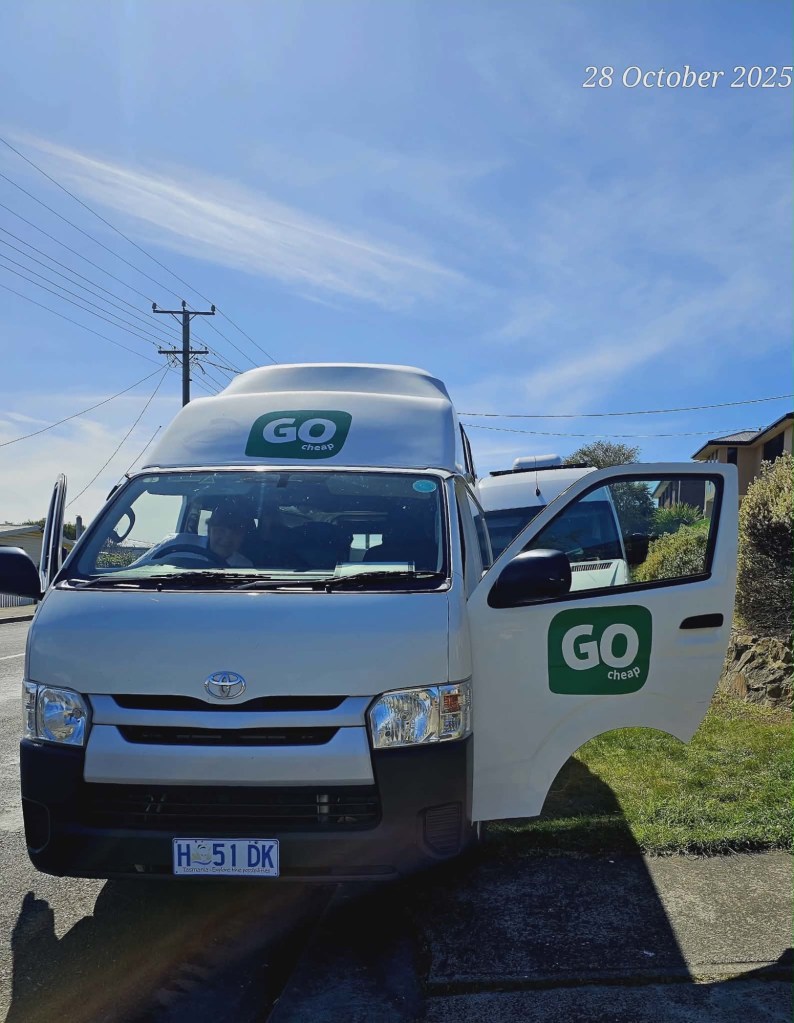
To this. Mount Field National Park — Glow Worms & Minus-One Madness
We aimed the temporary van westward and landed in Mount Field National Park, where we snagged a powered campsite for a very reasonable $20 for two adults. Bargain – until the temperature dropped to minus one overnight and we realised bargains do not come with central heating.
The highlight of the stay was a night walk to Russell Falls. There’s something magical, although slightly terrifying, about wandering through the forest after dark, guided only by torchlight and the soft shimmer of glow worms, like tiny celestial bodies strung through the undergrowth.
Morning came with frost on… well, everything. Our toes included.
A hasty trip back to New Norfolk was in order to pick up more warm bedding and the amazing Kick Ass camp heater I had left behind.
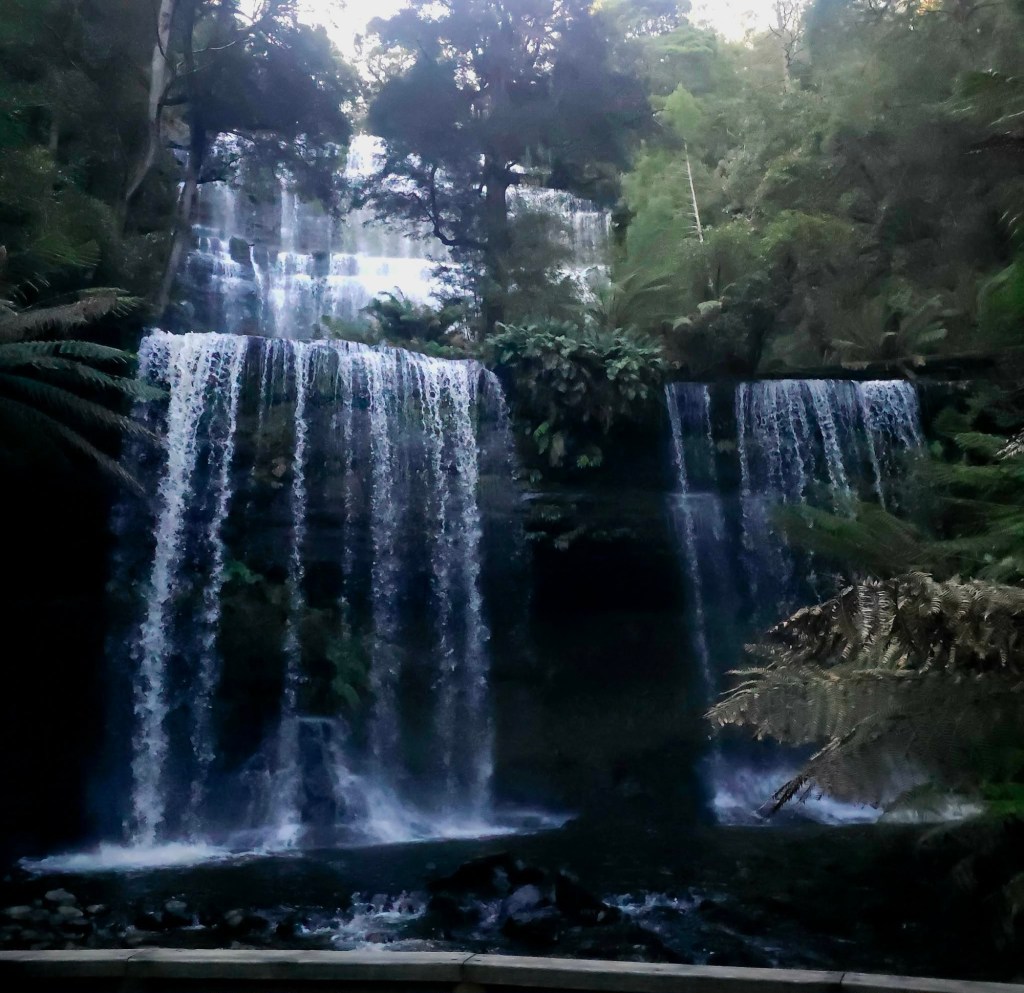
Russell Falls 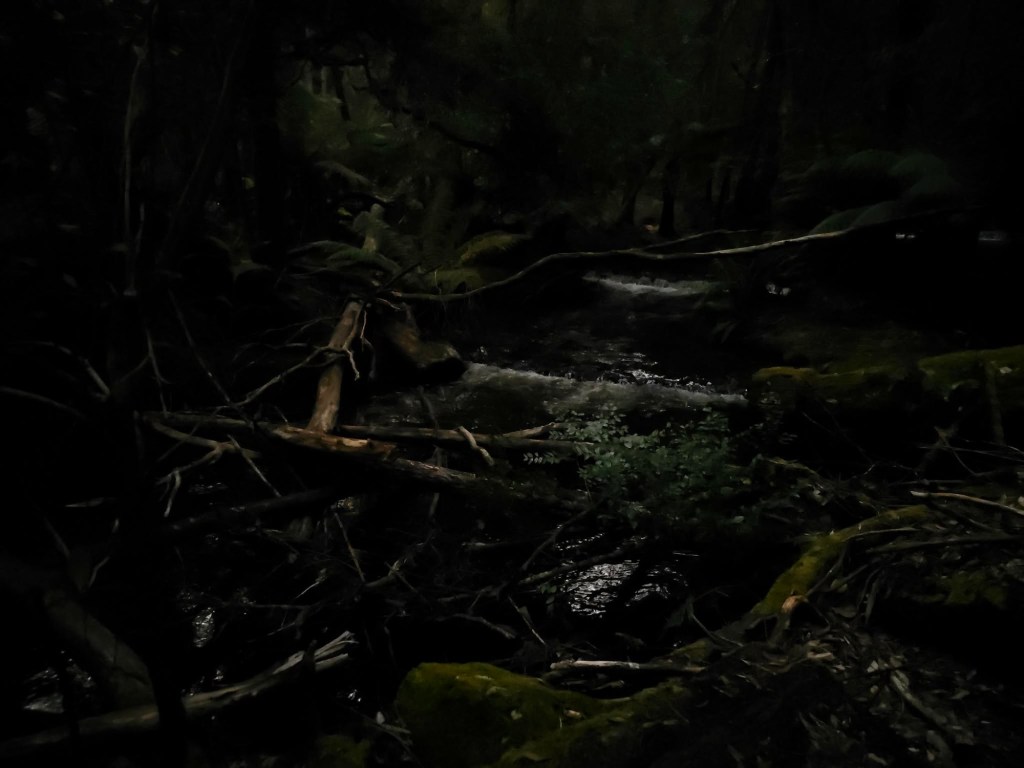
The forest at night, glow worm chasing. 
Daytime at Mount Field Maydena Meandering & Highlands Wandering
With numb fingers and warm spirits, we drove through Maydena, winding our way through forests and farmland that looked like scenes from a rustic postcard.
In the morning Ellendale Road took us to the Lwell Highway and past Lake Meadowbank, where the water was so still it felt like nature was trying to out-mirror itself.

Hydro Tasmania 
Lake Meadowbank Tarraleah Power & A Wall Worth Whispering About
The highlands introduced us to Tarraleah Power Station: a reminder that Tasmania doesn’t just do pretty scenery—it also does hydroelectric engineering with style. From there, we continued to Derwent Bridge to visit The Wall in the Wilderness, a jaw-dropping, hand-carved celebration of Tasmanian stories. No photos allowed inside, which is fair—some beauty belongs entirely to memory.

Power station pipe lines 
The Wall – a must visit. Lake St Clair — Mountains Wearing Snow Like Jewellery
We rolled into Lake St Clair next, where snow-capped peaks sparkled across the water like someone had sprinkled icing sugar over the mountains. Tasmania has a flair for drama, and we were absolutely here for it.
The Overland Track finishes at Lake St Claire and I was in awe, and just a tad jealous, of the hikers recovering from their adventures. Memories of crossing the Pyrenees during a blizzard in April this year flooded back and reminding me of why I won’t be undertaking the Overland Track. I will be content with looking on with envy and the utmost respect.
FUN FACT. Lake Dt Claire is the deepest freshwater lake in Australia, reaching a depth of over 215 metres. It was formed by glacial activity eons ago and is the headwaters of the Derwent River. Historically it was known by Aboriginal peoples as ‘Leeawuleena’ which means ‘Sleeping Water’.

End of the Overland Track 
Snow peaks in the distance 
Lake St Claire Lake Burbury — Misty Magic, Limited Amenities
Our final destination of the day was Lake Burbury. The scenery was beautiful, the sunset was gentle, the sunrise mist was ethereal, the silence was soothing…
The amenities? Let’s just say they were character building.Great toilets, no showers, and a vibe I’d rank as “Wouldn’t rush back, but glad I went once.” The misty morning made up for it, though—Tasmania never lets you stay unimpressed for long.
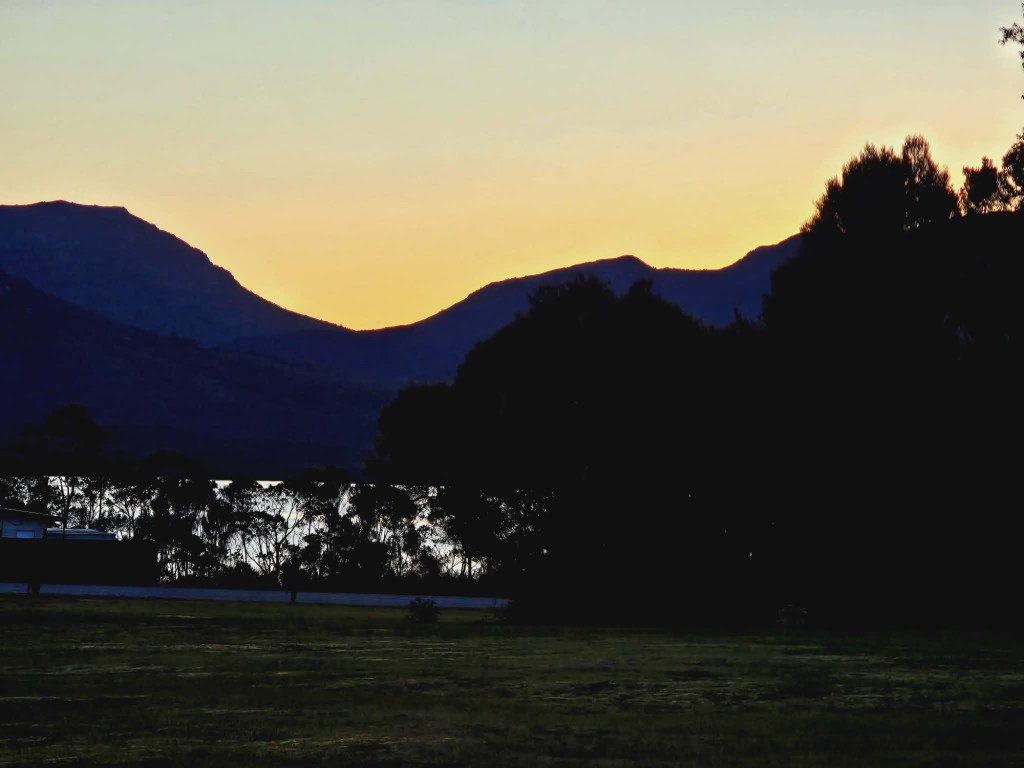
Gentle sunset Lake Burbury Queenstown — Halloween Brunch & Gritty Beauty
On 31 October, Queenstown greeted us with rugged hills, rich mining history, and the cheerful chaos of Queenies Crib Café. Their staff were dressed for Halloween and served brunch with flair – and possibly fake fangs.
We wandered through town admiring street art and learning about the town’s tough past. Queenstown feels like a place that has earned its character.
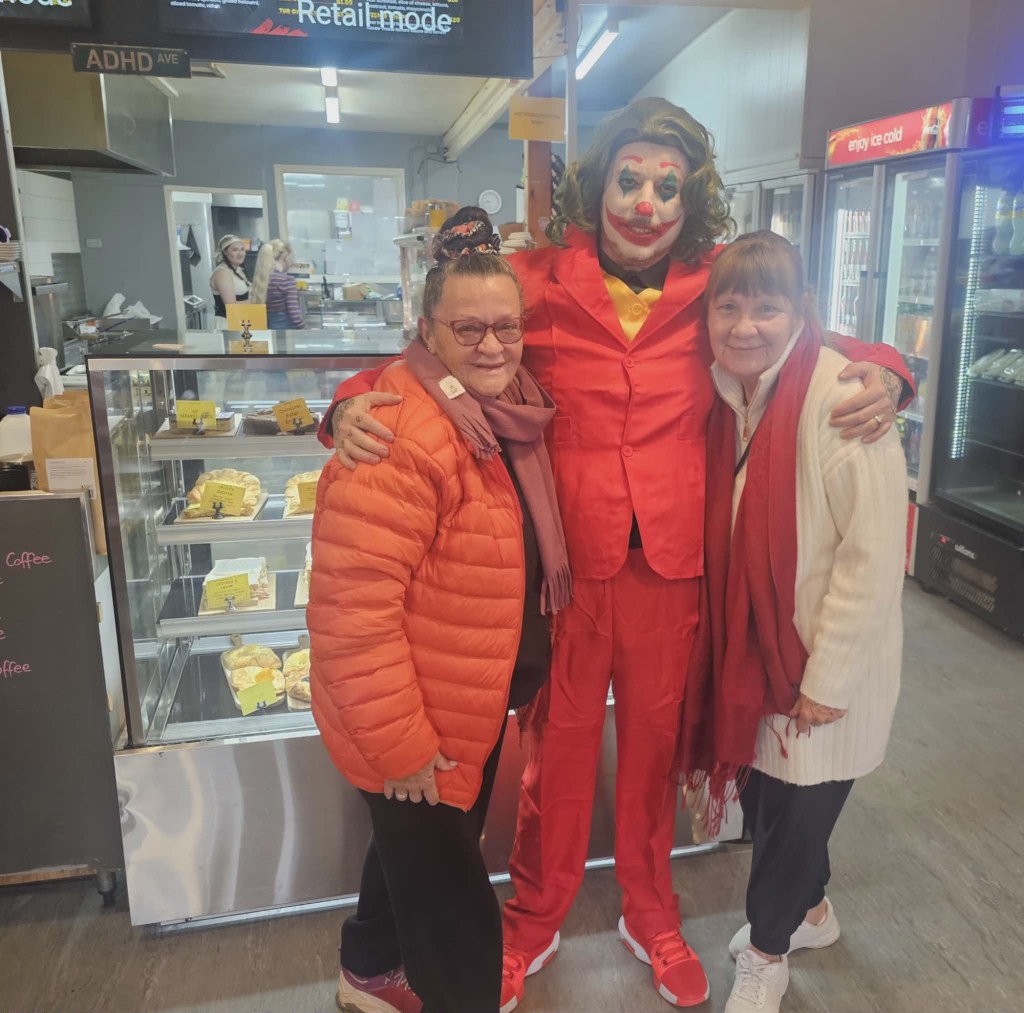
Ready for Halloween hijinks Zeehan’s Spray Tunnel — Google Maps Gets Creative
Our next challenge: reaching the Spray Tunnel outside Zeehan. Google Maps, in a comedic turn, kept insisting we turn right into dense bush. We persevered, laughed at our near-mythical navigation skills, and eventually found the narrow, winding track to the tunnel.
Inside we were rewarded with glow worms, soft mosses, ancient ferns, and relics of mining machinery long abandoned. Tasmania’s ability to make the wild look effortless never ceases to amaze.
As I looked around at the relics left behind I can’t help but reflect on how tough life was for the pioneers of this wilderness.
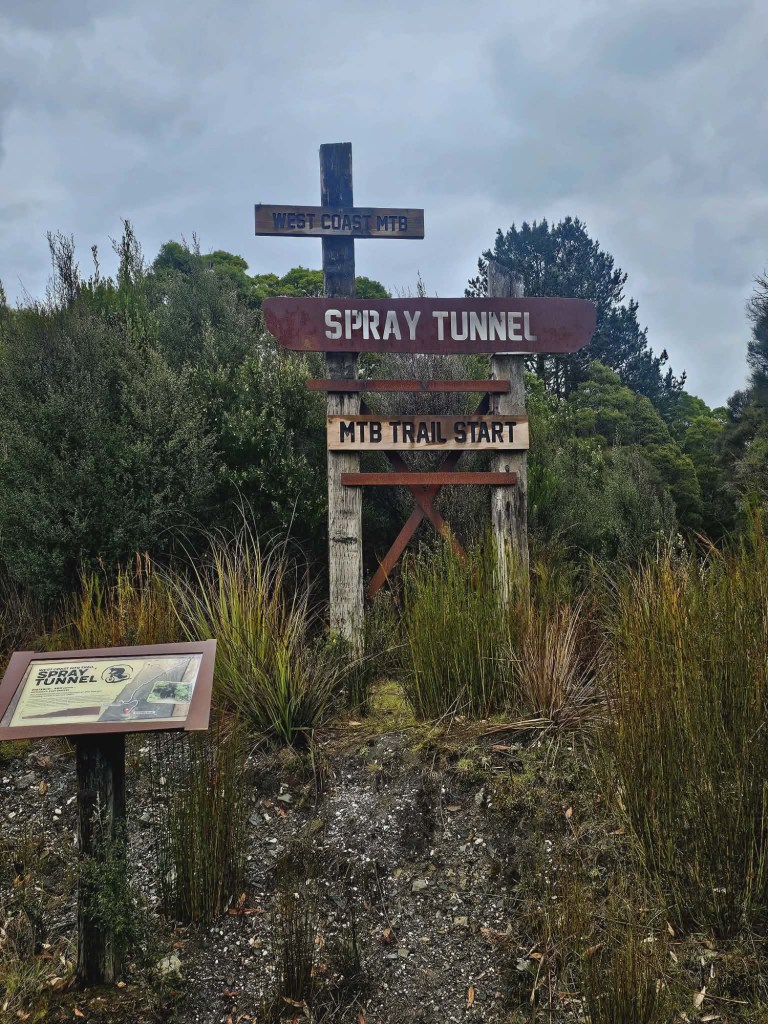
Spray Tunnell 

Misty tunnell 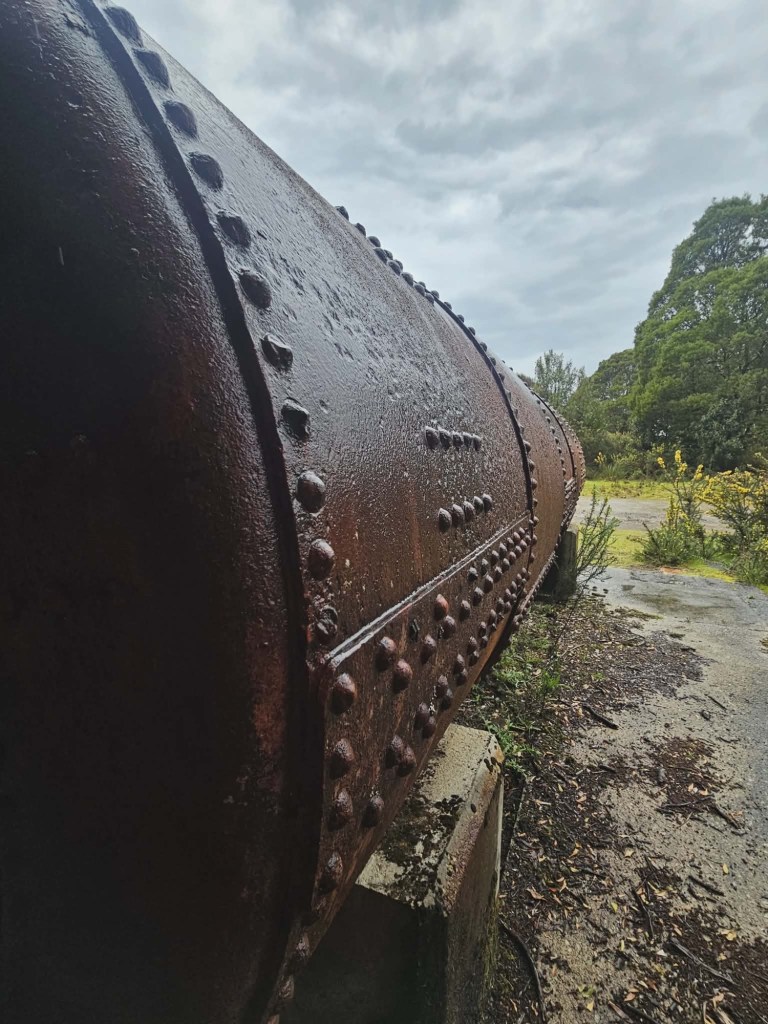
Relics of times past Platypus Café at Tullah — Platypuses Not Included
We stopped in Tullah for refreshments and hopeful platypus viewing. The café delivered good drinks, but the platypus?
Let’s just say the locals hold that information close to their chests.
We found the cafe but not the elusive platypuses Cradle Mountain — Mist, Magic & Wombats Living Their Best Lives
We settled into the Cradle Mountain Discovery Park for a couple of blissful nights. Heated bathrooms, heated camp kitchens—heated everything. After our frosty Mount Field experience, this felt like luxury camping at its finest.
A misty sunrise greeted us the next morning, setting the tone for a day filled with breathtaking beauty. At the Visitor Centre, we soaked up the human and ecological stories of the region before catching the shuttle to Dove Lake.
And oh—Dove Lake.
Brilliant blues, mirrored reflections, a sky that seemed freshly polished. The track provided endless panoramic moments, each one better than the last. The dramatic landscape has to be seen.On the way back, we hopped on and off the shuttle, walked part of the Overland Track – the section aptly named Wombat Poo, and watched wombats grazing like they owned the place. Which, to be fair, they do.

Misty morning Cradle Mountain 
Dove Lake Boat shed 
Dove Lake Reflections 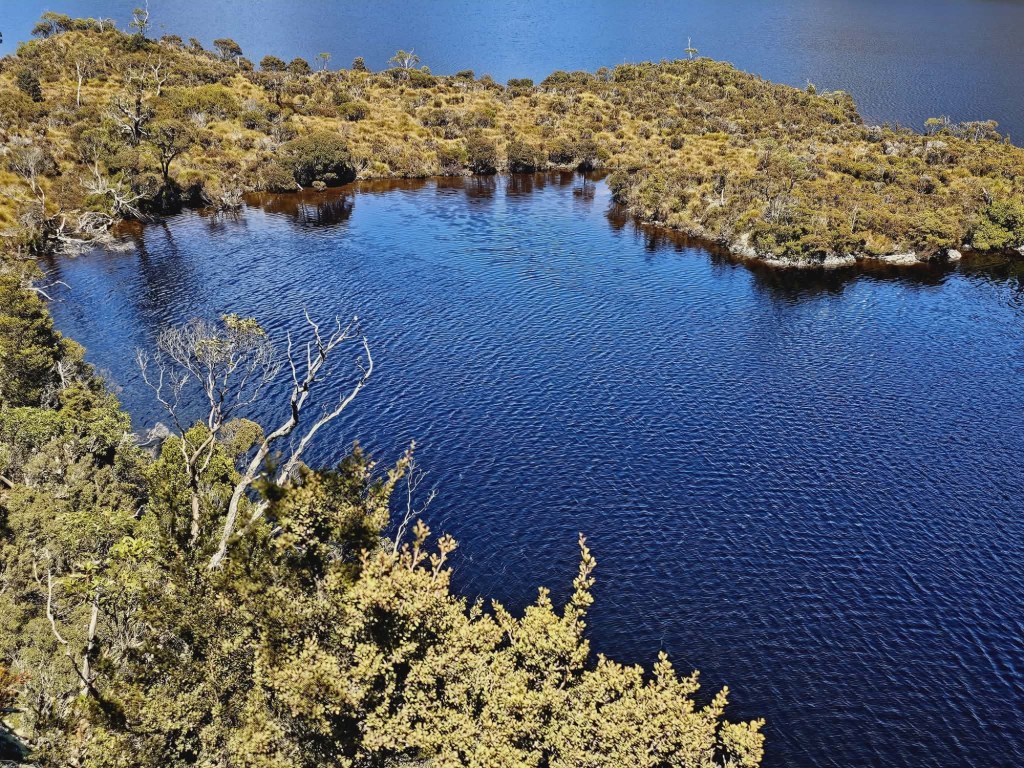
More of Dove Lake 
There’s no party here with the wombats 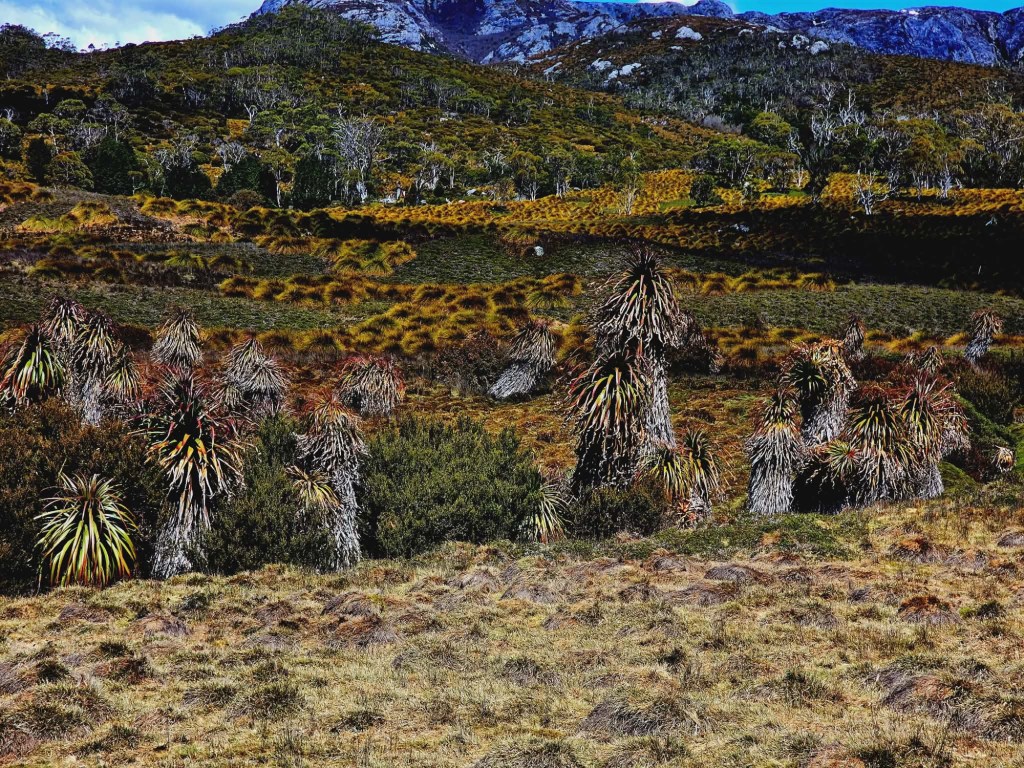
Dramatic landscape Cradle Mountain Stanley — Fish, Chips & A Nut That Said “Nope”
We pointed the van north toward Stanley, arriving just in time for some of the best fish and chips we’ve had—courtesy of the local supermarket, no less.
The Nut loomed above us, looking dramatic in the wind and rain. The chairlift was closed due to the weather, so we admired it from below and promised ourselves a sunnier visit another day.

The Nut looking uninviting between rain showers and wild winds 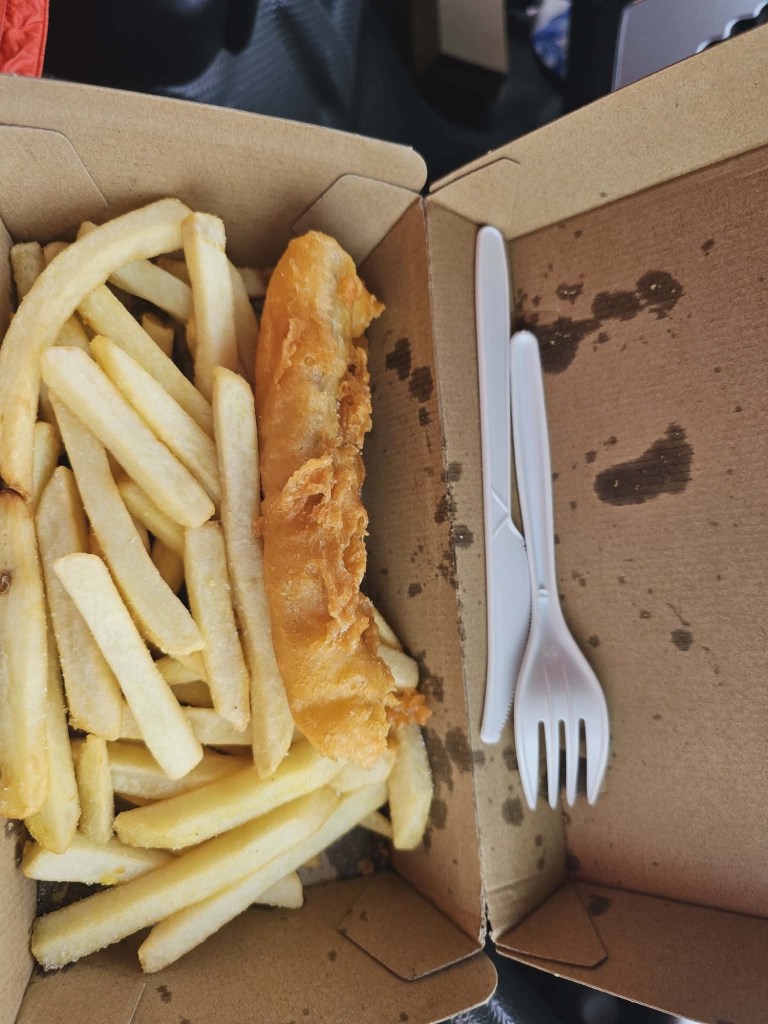
The best fish and chips Rocky Cape & the Case of the Missing Sisters Beach
I’d visited Sisters Beach over 15 years ago when it was a pristine, secluded gem. Roads change, coastlines shift, and alas… the beach I remembered seemed to have slipped into my past.
No matter—Rocky Cape National Park distracted us with its rugged coastline, fascinating rock formations, and a reminder that nature doesn’t need perfection to be beautiful.

The colours of Rocky Cape coastline. Penguin → Forth — Misty Mornings & Birds for Bedtime
We considered staying in Penguin to spot their famous fairy penguins, but the weather had other plans. So we continued to Forth and settled into a free riverside campground.
We expected a noisy night with the pub just across the river, but instead we were serenaded by birds perched overhead. Sometimes nature gives you exactly the soundtrack you didn’t know you needed.
Morning brought a thick, dreamy mist hovering over the water—one of those quiet moments that stays with you.
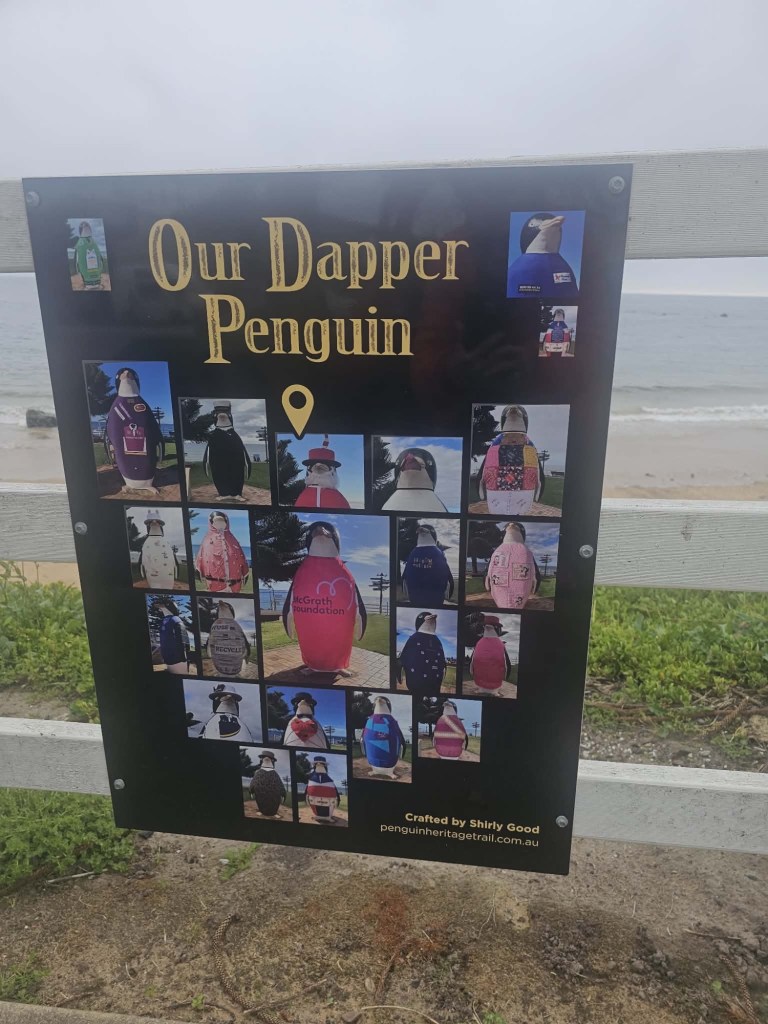
Penguin 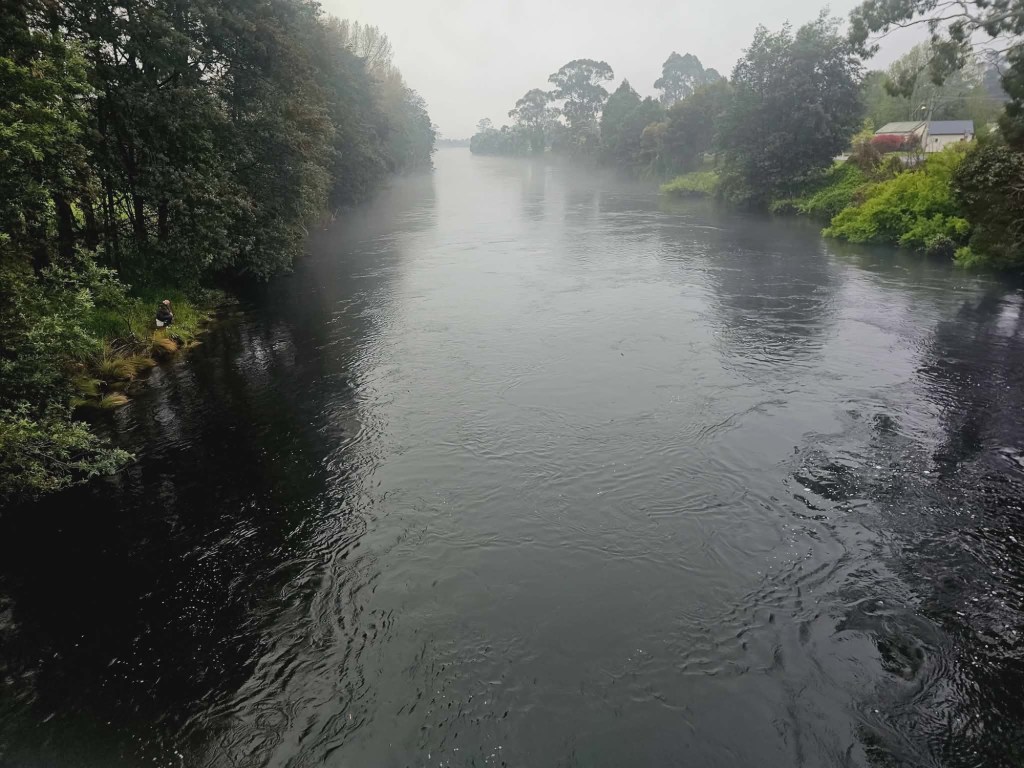
Misty morning on the river at Forth Sheffield’s Muralfest — Art Everywhere & an Alpaca Icon
We arrived in Sheffield with no idea the town was hosting its International Muralfest. Fate delivered a perfect surprise.
Twenty artists had submitted concepts; nine were chosen to paint full murals throughout the week. We spent hours wandering, watching artists at work, and admiring murals from years past.
And then we met Pedro the Poser—the local alpaca celebrity who genuinely loves posing for photos. Naturally, we obliged.
We posted cards at the iconic Post Office Tree (yes, a real tree, yes, still a functioning post box) and visited a local gallery showcasing extraordinary felt work and free-motion embroidery. Craft addicts, cover your eyes: it almost tempted me to try something new.
Almost.
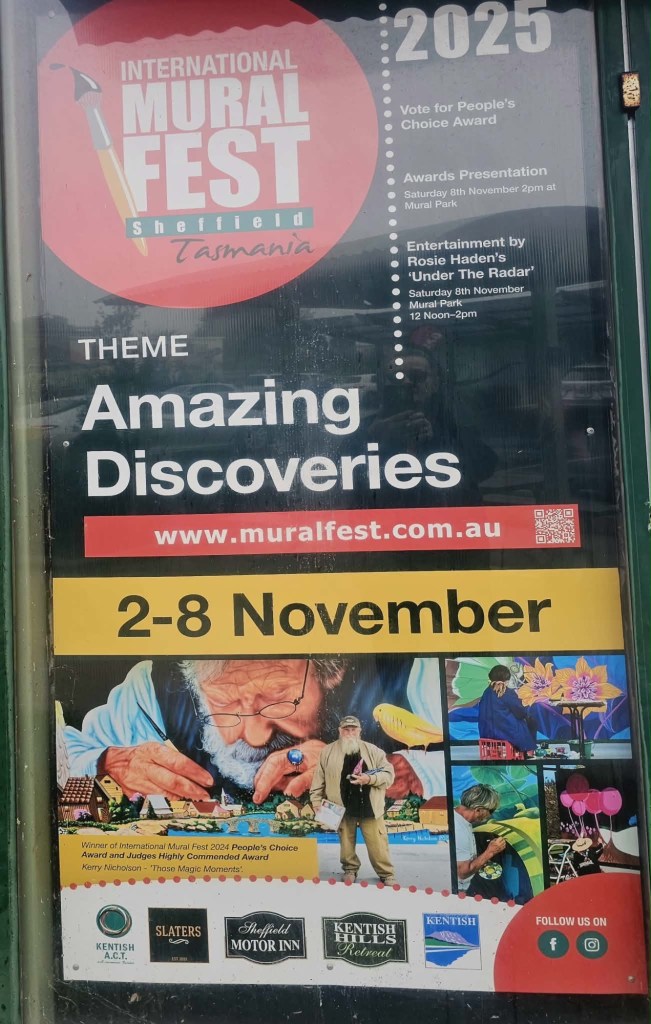
Luck was with us today 
Artists at work 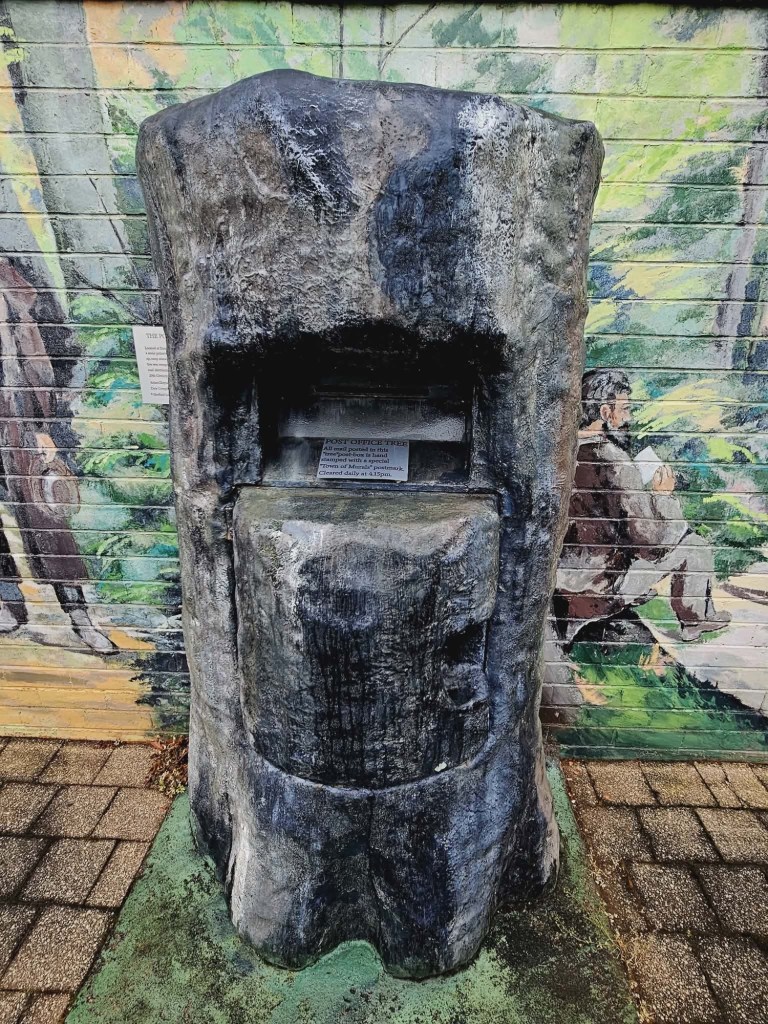
Post Office Tree operational postal box 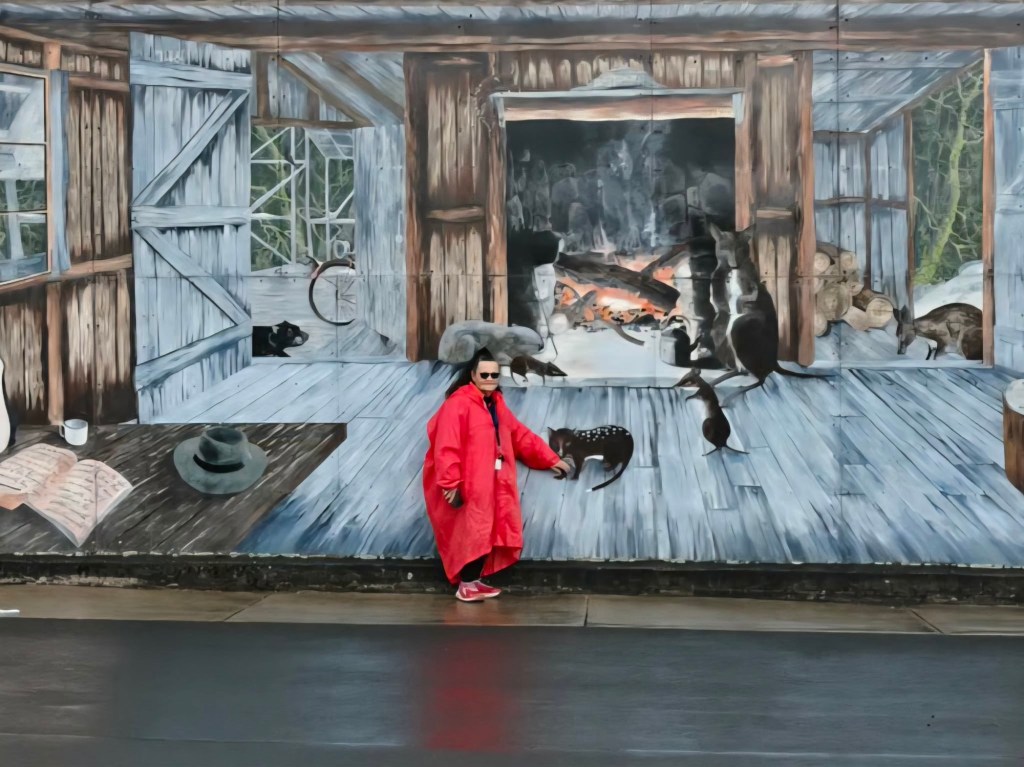
Murals of the past 
Me and Pedro the Poser 
Beautiful craft by very talented artists Mersey Bluff Lighthouse & A Sunset Worth Waiting For
We finished Week 1 with a visit to the Mersey Bluff Lighthouse, complete with seabirds swooping overhead and dramatic rock formations along the coast.
Then the weather turned again—mist rolling in, clouds thickening, rain threatening. It felt like the sunset was cancelled.
Our last night for the week was at Gowrie Park Wilderness Village. We were preparing for an early night when in the final moments, the clouds moved aside just enough to reveal a spectacular burst of colour across Mount Roland. Tasmania loves a good finale, and this one was worthy of applause.
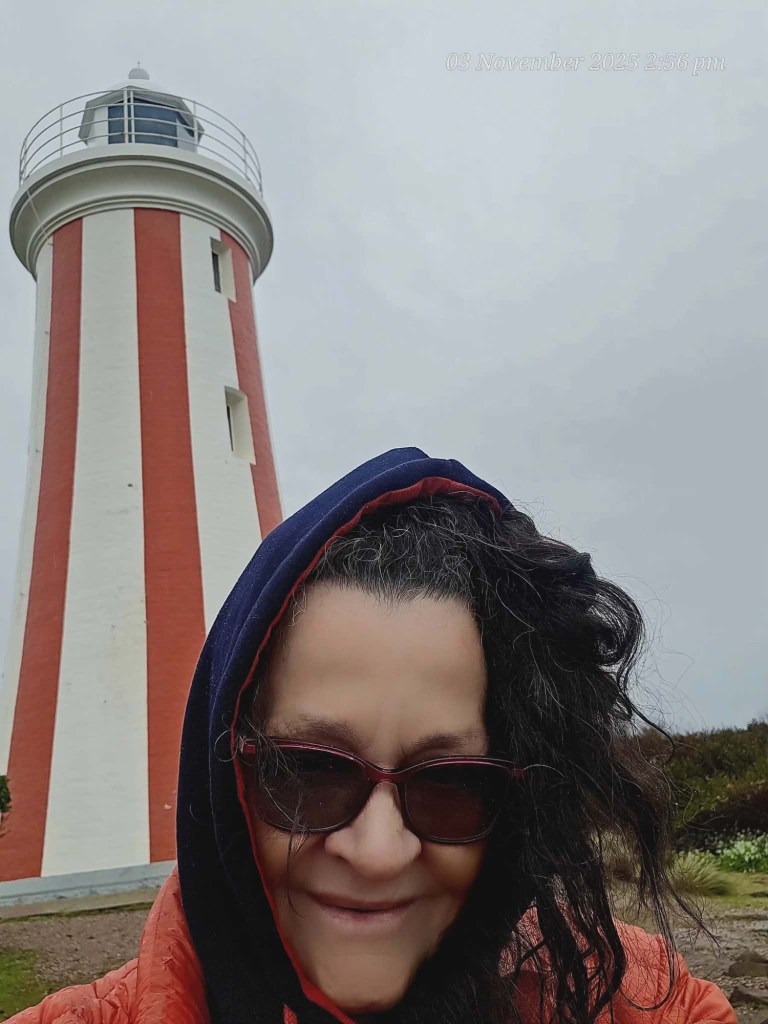
Mersey Bluff Lighthouse 
Mount Roland in the distance 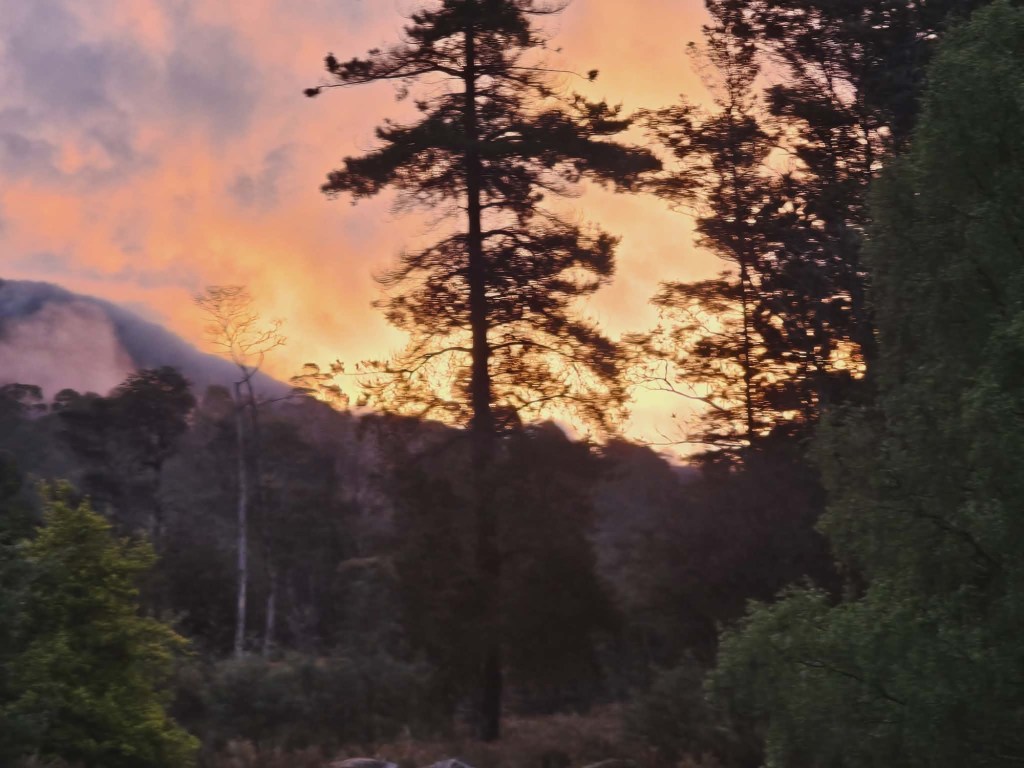
Sunset at Gowrie Park Wilderness Village 
Gowrie Park Wilderness Village. And That’s a Wrap for Week 1
One hire van, dozens of wild weather moments, glow worms, wombats, misty mornings, and more art than expected. If Week 1 is anything to go by, Tasmania has plenty more mischief and magic left for us in the next few weeks.
-
Our day starts with movements from Robs kitchen trailer. Kettle on and breakfast ready by 6am for the early risers. It is nice to have that first coffee before too many others are awake. Gradually, the camp-site comes alive, and before you know it, we are a big circle of chairs, Rob is taking bacon and egg orders and we are either reminiscing about yesterday or talking about what the day will bring. We are a group of 12 plus our guide, Rob, from Country Pub Tours. We have blended well together, and it feels like more than day 3, with lots of jokes and laughter and good-natured bantering.
After breakfast, my first task was to try and find tyres for the van. I managed to get one to replace the spare in Kingaroy, and Tyrepower agreed to fit me in. Unfortunately, they only had the one which will give me a spare but doesn’t help with my concerns about the remaining tyres that might also be at risk of a similar fate. I decided to rejoin the tour and try to get other tyres further on.
The group was at the Yarraman Heritage Centre. Rather than drive back there and rush through and/or have everyone waiting for me, I let Rob know I would wait at Nanango for them. I filled in time by visiting the local markets and the Ringsfield House Museum, then checking out some chainsaw art and street murals.
Ringsfield House began as a magnificent family home from 1908 until 1942, when the family aged and moved away. When the house was first built, it had open verandahs all around. The original owners would attend to their children using a secret passageway through the cupboard in the main bedroom, which led to the nursery.
From 1942 to 1970, it was used as a four-ward maternity hospital. Between 3,000 – 4,000 births were registered at Ringsfield House during that time. Hundreds of those people still live in the local area.
By 1973 the house was a Lifeline refuge for deserted wives and their children and continued in this capacity for a further 20 years, by which time it had become derelict and no longer suitable for use.
From 1992 to 1996, the then Nanango Shire Council restored Ringsfield House as a Museum and Historical Centre. From November 2017, Ringsfield House has operated as a museum, a cafe, a tourist destination, a restaurant, and an events venue. The centre is run by a team of volunteers.

Ringsfield House 
Local artist Karen – donated for auction to raise funds for breast cancer research. 
Nanango Street art. 

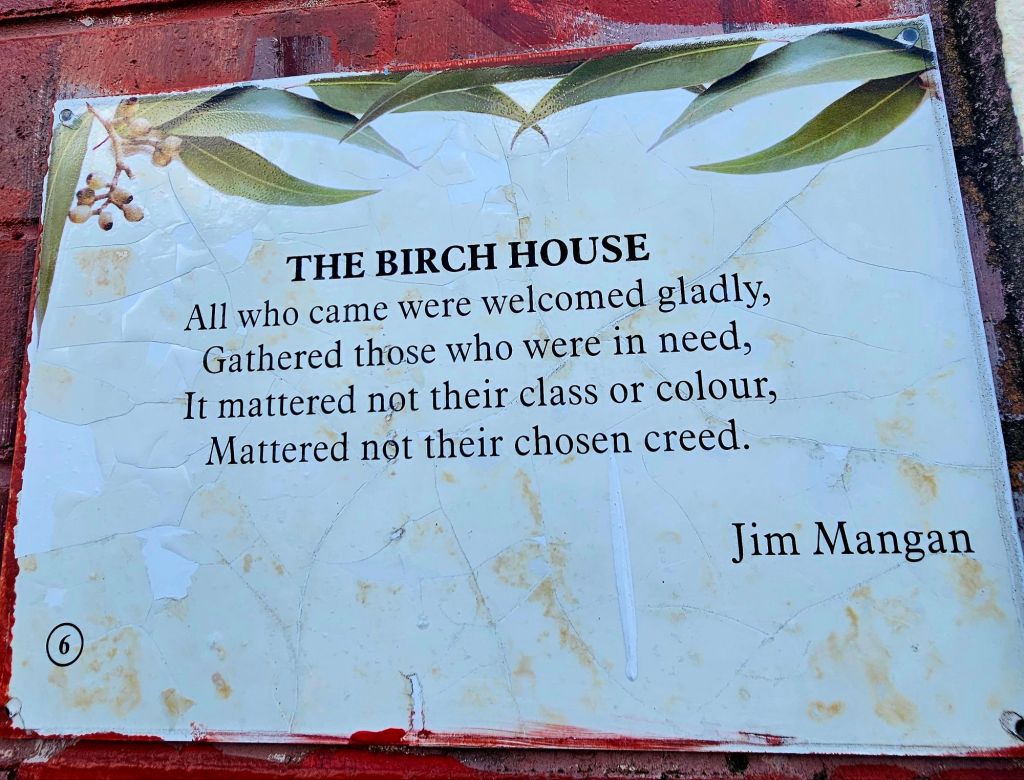

Chainsaw art. I met up with the rest of the crew for lunch before we headed to Kilkivan for the night at the RV rest stop.

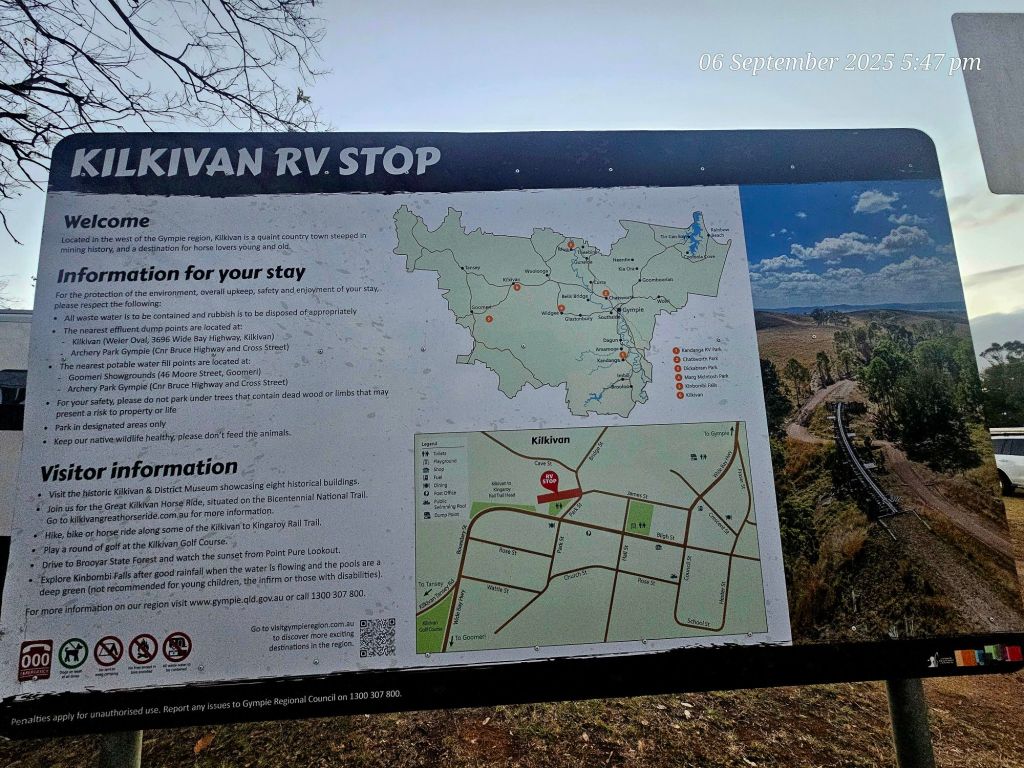
-
The morning started with the obligatory stop at the Esk bakery, where we sampled the local delicacies before heading off to Blackbutt.
After topping up with fuel at Toogoolawah, we visited the Exchange Hotel, which was first licensed in 1911. The hotel burnt down in 1926, and locals say that the licensee was so committed she continued to operate from under the burnt out iron roof until restoration was completed.
An interesting fact I discovered was that in the late 19th/early 20th centuries, many pub licenses were held by women. Apparently, running a hotel was seen as a domestic, family-oriented business requiring accommodation and meals, which aligned with women’s domestic roles and societal expectations at the time. Clearly before the feminist movement. 😊 Furthermore, the male-dominated, predominantly migrant populations of the colonies were seen to be more easily controlled by women publicans, who were expected to uphold standards of behaviour and manage the flow of alcohol.

Exchange Hotel public bar 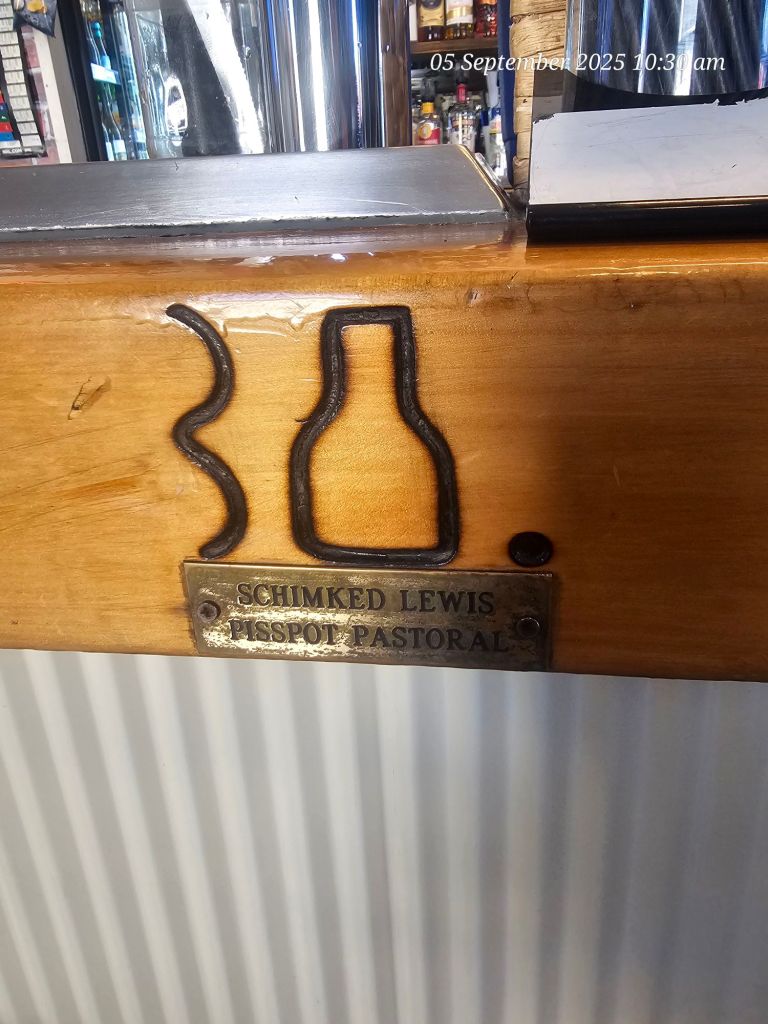
Local brands displayed around the bar 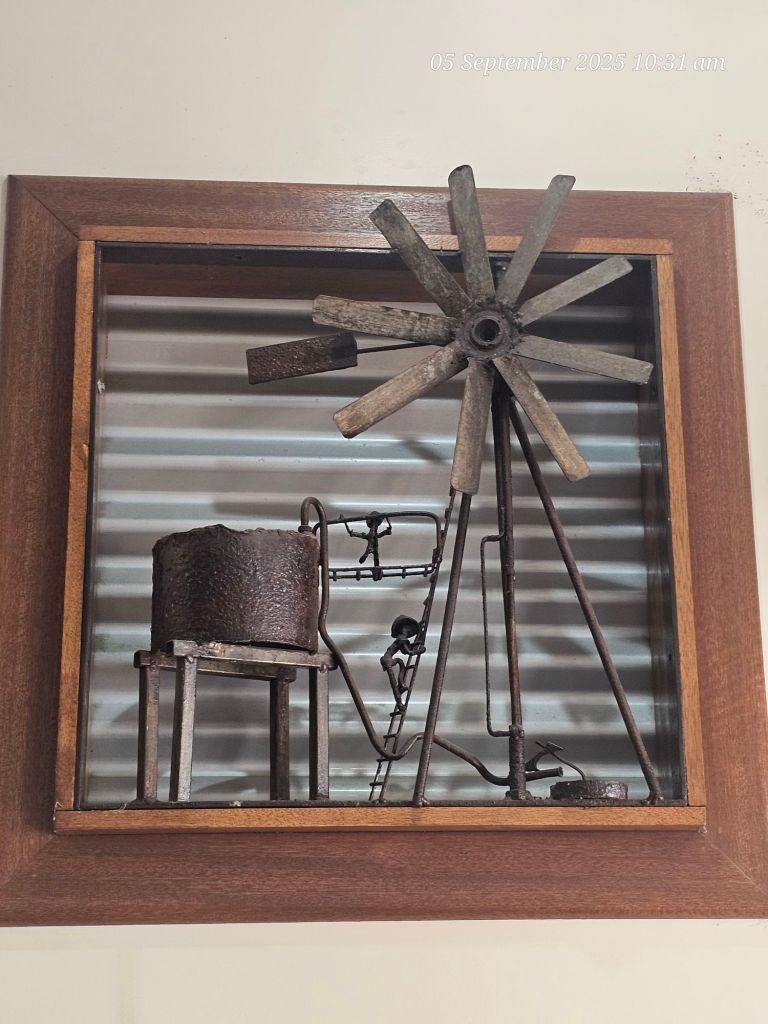

Exchange Hotel, Toogoolawah Leaving Toogoolawah, we travelled on to the Linville Hotel to hear about its interesting history and to partake in lunch.
Dating back to 1887, the hotel boasts a rich history. The region surrounding the hotel showcases the breathtaking beauty of Australian cattle country, teeming with remarkable birdlife, deer, the meandering Brisbane River, and the Rail Trail.
Just across the road from the hotel is the old disused railway station and museum, as well as a popular donation camping area equipped with public toilets. There are 2 powered spots, but you would need to be there early in the day to get one. When we pulled up for lunch, there were many travellers already parked up for the night.
The pub was originally located between Toogoolawah and Harlin and named the Moorabool Hotel. It was the first hotel in the Toogoolawah district. It was progressively moved by bullock teams as the rail line was constructed. It was bought to rest in its current location of Linville in 1911 when the railway line extended to there. It stayed in Linville as the range ahead was too steep for any further relocation.
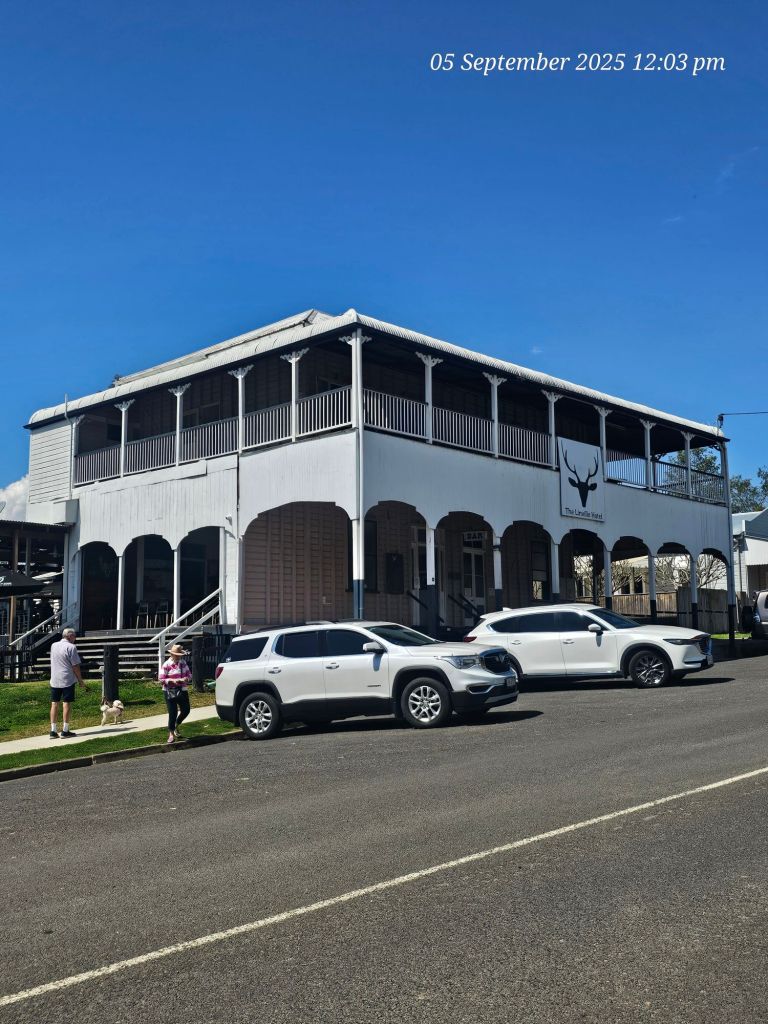
Linville Hotel 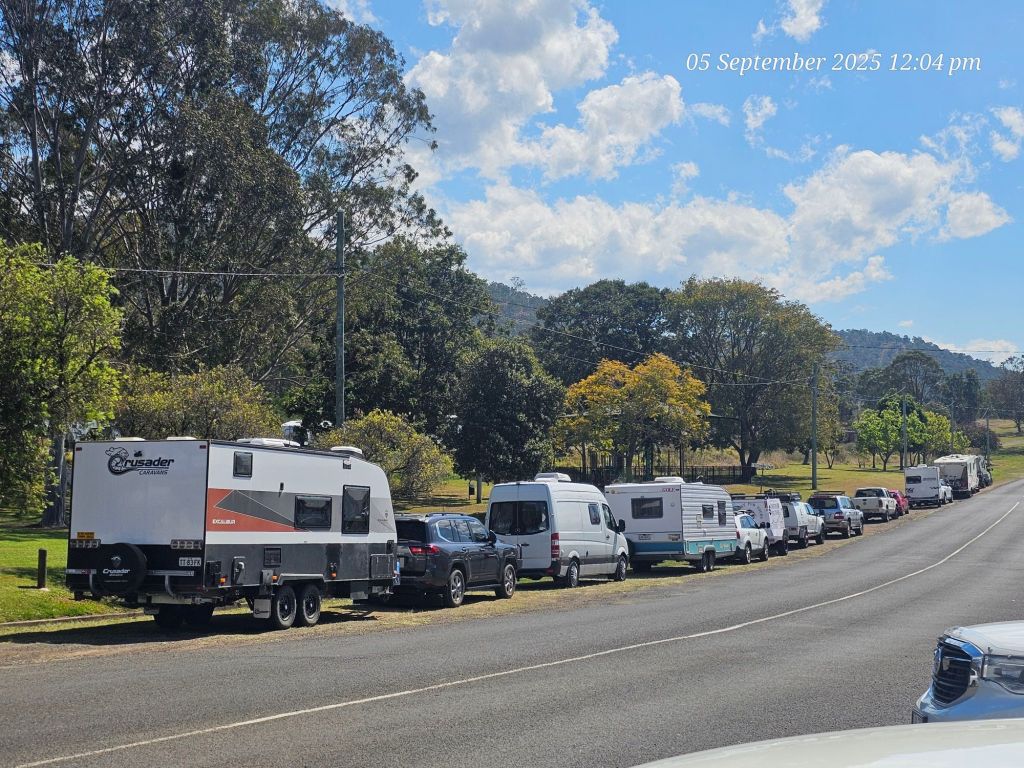
Country Pub Tours tag along group 

Beef and Guinness pie To add to the excitement of the day, my van had picked up a bit of a wobble and vibration. I thought it might have lost a wheel balance, so when we arrived at Blackbutt, our home for the night, I found a tyre shop. The tyre was suffering from ‘tyre separation’ possibly caused by age and not being driven for some time. Blackbutt Tyre and Fuel changed it over, and after checking the others, saw that they were all manufactured in 2019. Amongst all the other things I had done to prepare the van for travel, this was one thing I hadn’t checked. Rookie mistake. Unfortunately, they did not have a tyre to fit to replace the spare. That would be a job for the morning.
The Blackbutt showgrounds is a great place to stay. Clean amenities and well set out grounds within walking distance of the shops. Powered sites $ 25 per couple or $13 per single and $10 per single unpowered.
Our pub for the night was the Hotel Radnor, built in 1913 and originally called “The Grand.” In 1935, its owner renamed it after his dog, Radnor, following the dog’s death by being run over by a truck outside the front of the pub. The hotel has since been fully restored to its original appearance, retaining historic features like the original Blackbutt timber floors and walls, the hitching rings for horses and offering classic pub meals, accommodation, and a welcoming country hospitality experience. The pub is a favourite for cyclists using the Brisbane Valley Rail Trail.
After my Beef and Guiness pie for lunch, I settled for a bowl of ice cream for dinner.


Verandah of Hotel Radnor 

View for hotel verandah 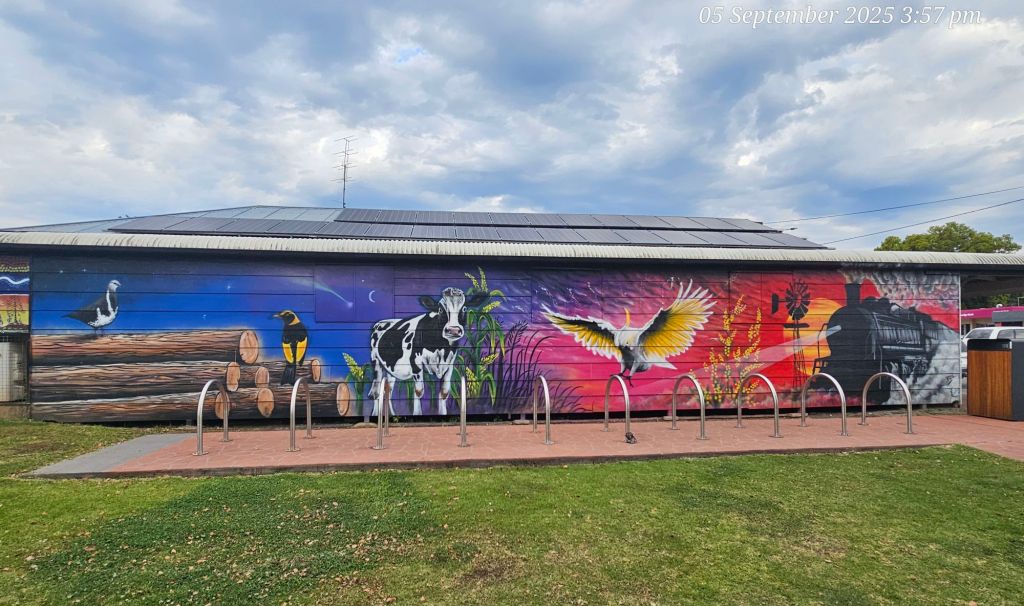
Street art Blackbutt -
After returning from my last Camino in May this year, I stayed close to home for my daughter’s wedding and to organise the never ending things that needed to be completed on my van in order to start my Australian adventures. I won’t bore you with the details of preparing the van because just thinking about it does my head in. Suffice to say it was more time-consuming and a little more costly than anticipated. Nevertheless, it is done (I think), and I am on the road appeasing my itchy feet once again.
3 days ago I joined Country Pub Tours on a 7 night Tag along tour, visiting historical country pubs, hearing their history, and enjoying scrumptious food and friendly company.
Day 1.
Our first meet-up was at the Esk Caravan Park, where we stayed the night. A good choice with great amenities. Dinner was at the Grand Hotel, where we heard the history of the pub, which has been serving the community since the early 20th century. Esk was settled in the 1840s with the copper mines bringing European families to the area. The Grand is noted for being family and community focused, with fundraising that supports not only the local Esk community groups and activities but also surrounding smaller communities. That aside, they also know how to welcome travellers. The atmosphere and the food were well worth the drive. For Brisbane or Gold Coast peeps, it would be worth a weekend break away.
We walked back to our vans under clear starlit skies, ready for a pleasant nights sleep.
The caravan park is set in a quiet side street with lots of options for accommodation, large grassed areas, and bordered on one side by a gentle flowing creek. Spotlessly clean amenities with steaming hot water, always a winner for me, a more than adequate camp kitchen with electric barbarcues and pizza ovens. There is also an adults only pool and a separate pool for kids.
I woke at 5.30 in the morning to the dawn chorus.
Rob, our tour guide, rounded us up for breakfast and to tell us what was in store for the coming days. More to come….
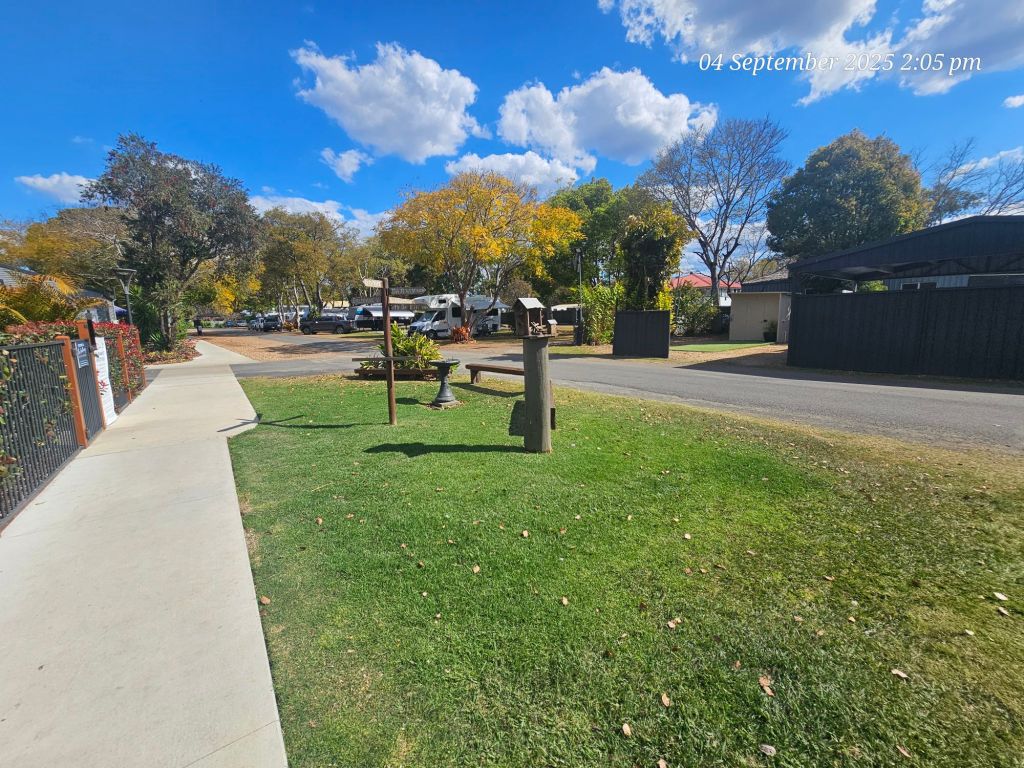


Esk Caravan Park Dawn chorus 


-
As I am about to journey off on another Camino, I thought it was timely to talk a little about the people who have inspired and encouraged me to get to this point.
While I was researching the Camino de Santiago in 2022 I stumbled across a woman, Carol Alexander-Price, who went on to become one of the most influential people in my journey into a life of retirement and travelling solo as a ‘woman of a certain age’. Carol is the founder of Camino Confidence, https://caminoconfidence.com/ a business created for women and with the aim of empowering women to walk the Camino de Santiago. Carol has walked a number of Caminos herself and wanted other women to have a similar experience. Aware that many forums dedicated to supporting people walking Caminos are not always encouraging of women and particularly ‘women of a certain age’, she started a Facebook group specifically designed to support women. It wasn’t long before she had women metaphorically ‘knocking at her door’, and I was one of them. With her encouragement I soon realised that I could do it too. I could step out of my door and head to Spain with nothing but my backpack and no words of Spanish no matter how hard I tried to learn. The Camino Confidence guided walks are perfect for women who might be unsure if they are ready for this adventure. Carol provides a boutique style service tailored to a woman’s individual needs and without the boutique price tag. The pre Camino zoom meetings, advice on what to pack, what not to pack, what to expect when I arrived and along the way and enough Spanish lessons to ask for a cafe con leche, and how not to ask the butcher for a clean penis, 🤣 I felt ready to conquer the world. I will be forever grateful to Carol for her wisdom and her humor. She has inspired me more than she knows. I look forward to walking with her again in the future.
Through another Camino forum I came across Colleen Sims. I quickly come to love her common sense writing style and found myself following along as she journeyed across the globe. Colleen writes a travel blog https://thenwewalked.com/ documenting the travels she and her husband do. If you are thinking about travels, even if not a Camino, have a look at Colleens page. She shares so much great information it is impossible not to be inspired. Her step by step daily guide to walking the Frances has been an integral part of my Camino planning this time around, and I am appreciative for the information she has shared.
Through my online engagement with both Carol and Colleen, I have connected with a number of other people who have inspired and encouraged me to continue challenging myself and to grab with both hands whatever adventures come my way. I want to acknowledge their insight, their wisdom, and their commitment to supporting women to get out there and have a go at life.
Susan Morris, I have followed along with you since I watched Camino Skies. Your tenacity and courage, your willingness to be vulnerable, and your raw honesty lit a spark in me that has not dimmed one bit. From you, I learnt I just needed to put one foot in front of the other, and I would get there and that it was okay to ask for help when I needed it.https://m.youtube.com/channel/UC37XdAoqs455gPpL5YcSy7g/videos
There are many other Aussies whose Camino travels I have followed and who have become part of my Camino community, because we all know that walking Camino’s becomes addictive. When we are not walking them, we are talking, reading or watching movies about walking them or sharing our memories of walking them with the world wide Camino community. If you know, you know. If not, then you are probably one of those poor humans that the Camino community bore the death with our stories. Bear with us, and one day, you too might become one of this community.
To my special group of Brisbane Camigas friends, you are all awesome. When Sharon Goulding put out the call looking to connect with other local women and we came together for that first lunch, Mary Atherden, Tracey Sheehan, Marie Griffin, Faith Valencia-Forrester and Naomi Behne, who knew how significant our catch-ups would become to me.
Robyn-Lee Nichols, I am sure we were meant to connect. Our worlds are so far apart, but our thoughts are so often in sync it is a tad scary. Thank you for your thoughtful insights.
A very special acknowledgment is for my family and friends who have supported and encouraged me, even when they are thinking ‘what the hell is she up to this time’ and are just too polite to say it aloud. Without your support, I might never have set foot on the path. You believed in me even when I didn’t especially my siblings and my children, and that is worth gold. Last but never the least, my beautiful granddaughters Nyesha and Chyla, who are trusting me with their lives as I take them well out of their comfort zones on an adventure they can not imagine and that I hope they will never forget. I can’t thank you enough for trusting me with this. 💕💕

Back to now, I am sitting up in bed at 2am in Barcelona, hoping that a few days here will help my body adjust to jet lag. I had a plan for how I was going to manage the long flights from home so that I would be asleep now but clearly that didn’t work so well 😳. Still, I have a few days here for the body clock to adjust before heading out on the trail starting in Saint Jean Pied de Port on 2 April. The younger generation are of course sleeping deeply, lucky them.
I write this to encourage women who are stepping out and having adventures to share their journeys as it might just be the thing that inspires someone else. It doesn’t need to be walking a Pilgrimage across parts of Europe, it can be anything you do that takes you out of the life you have created and lived in for most of your years, to having an extraordinary life.
If you have read to the end, thanks and get ready for the thousands of photos I might bombard my socials with and journey along with us as we venture out on the way.
-
Subscribe
Subscribed
Already have a WordPress.com account? Log in now.
 Trischs Travels